


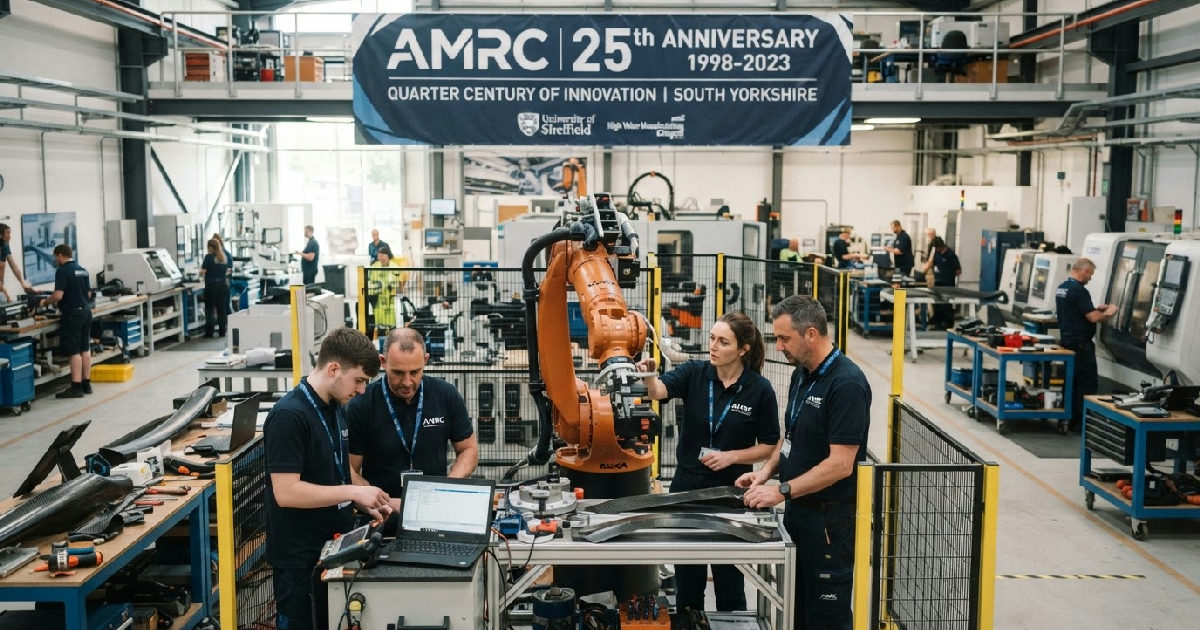
The University of Sheffield Advanced Manufacturing Research Centre (AMRC) marks its 25th anniversary this October 2026, commemorating a quarter-century of pioneering work that has reshaped South Yorkshire’s industrial landscape.
From its inception, the AMRC committed to bridging the gap between academic research and the practical demands of manufacturers. Its mission has always been to equip businesses with the advanced technologies needed to enhance industrial productivity. This sustained effort has transformed a site once emblematic of industrial decline into a vibrant hub of engineering excellence and job creation.
From Industrial Decline to Innovation Hub on the AMRC 25th Anniversary
The transformation of the former Orgreave Colliery site into the Advanced Manufacturing Park stands as a testament to the AMRC’s foundational vision.
This site, once scarred by the closure of its coal mine in 1981 and coke works in 1990, and the scene of the 1984-85 Miners’ Strike, now houses a concentration of major manufacturing businesses and research facilities. It is a powerful example of how strategic investment and collaborative research can drive regional economic renewal.
Professor Keith Ridgway, a co-founder of the AMRC, established the initiative alongside local businessman Adrian Allen, recognising the potential for machining research to generate wealth in a struggling industrial community. Professor Ridgway recalled, “We started with a team of eight people.
The aim was always to use the research in machining as a way of creating wealth in a depressed region.” This initial team has since expanded to more than 570 researchers and manufacturing specialists across South Yorkshire, Wales, and Lancashire.
Early foundations and visionary leadership
The AMRC’s origins were rooted in a clear need for practical, industry-focused research. The University of Sheffield, with its rich heritage in metallurgy and engineering, partnered with Boeing to create a unique environment where cutting-edge academic insights could directly serve industrial application. This partnership laid the groundwork for the future growth and influence of the centre.
Adrian Allen’s deep understanding of the aerospace industry, combined with Professor Ridgway’s academic prowess, proved instrumental in persuading key stakeholders of the project’s viability. Their collective efforts ensured that the AMRC was not just an academic exercise, but a tangible engine for economic development. The collaboration was designed to foster a radical research environment, attracting talent and investment to the region.
Regenerating a former colliery site
The choice of the Orgreave Colliery site for the AMRC was symbolic, directly addressing the legacy of de-industrialisation. In 1995, British Coal Opencast initiated restoration efforts to prepare the land, and by 2005, the last coal had been removed. Harworth Group has since invested over £200 million, turning the area into a significant innovation zone for advanced manufacturing.
This regeneration has attracted significant industrial players, including Boeing, Rolls-Royce, and McLaren, alongside numerous specialist suppliers. The Advanced Manufacturing Park now serves as the UK’s premier technology park, offering advanced solutions across aerospace, automotive, medical devices, and energy sectors. It underscores the potential for manufacturing industrial policies to drive regional economic growth.
Driving Economic Impact and Job Creation
The AMRC has demonstrably revitalised South Yorkshire, attracting substantial inward investment and creating thousands of jobs. Its work has directly contributed to £350 million in inward investment for the region, fostering the creation of more than 2,500 manufacturing jobs within the local cluster.
The centre’s commitment to skills development is also evident, having supported the recruitment of approximately 2,200 apprentices through partnerships with around 400 businesses.
These figures highlight the AMRC’s pivotal role in shaping a new industrial narrative for the area. The continuous pipeline of skilled labour and the sustained investment demonstrate a long-term commitment to enhancing the UK’s manufacturing capabilities. This approach ensures that local communities benefit directly from the research and development activities conducted at the centre.
Investment and employment figures
Specific examples of the AMRC’s influence include Boeing’s 2018 decision to invest £40 million in its first European factory in Sheffield. McLaren followed suit with a £50 million expansion of its composites technology centre. Rolls-Royce has also invested £19 million in an Advanced Blade Casting Facility in the vicinity, further solidifying the region’s reputation as a manufacturing powerhouse.
More than 1,000 businesses benefit annually from the AMRC’s collaborative innovation model, spanning areas like machining, automation, and digital manufacturing. These investments and collaborations not only create jobs but also build a robust ecosystem for future industrial growth. This collaborative model is a core reason for the sustained success seen over two and a half decades.
Regional productivity gains
Beyond direct investment and job creation, the AMRC has contributed to regional productivity. Its efforts, alongside the Advanced Manufacturing Park, have played significant roles in the area’s growth. The specific extent of this productivity increase and any direct attribution to particular analyses are not detailed in the provided research.
The sustained focus on advanced manufacturing technologies, from initial research to practical application on factory floors, has allowed businesses in the region to operate more efficiently and competitively. This tangible improvement in productivity ensures that South Yorkshire remains at the forefront of industrial innovation. Such developments are crucial for national economic health.
Pioneering Advanced Manufacturing Technologies
As a founding member of the High Value Manufacturing Catapult, the AMRC plays a crucial role in de-risking innovation for industry. It works to develop new manufacturing capabilities and accelerate the adoption of advanced technologies across various sectors. This involves extensive testing of technologies before their full-scale deployment, ensuring practical viability and efficiency.
Its work encompasses machining, automation, digital manufacturing, composites, and other advanced production processes. This breadth of expertise enables the AMRC to address complex industrial challenges, providing tailored solutions that enhance productivity and competitiveness for a wide range of companies. The centre acts as a vital bridge between theoretical research and real-world industrial impact.
Collaborative innovation ecosystem
The AMRC’s collaborative approach fosters an ecosystem where industry, academia, and government converge to drive progress.
Katherine Bennett CBE, Chief Executive of the High Value Manufacturing Catapult, highlighted this synergy: “Throughout my career in aerospace, I have seen first-hand the reputation the AMRC has built for turning world-class research into real-world impact through close collaboration between industry, academia and government, from South Yorkshire to the North West and Wales.”
This statement underscores the AMRC’s national reach and influence.
This ecosystem is a key enabler for advanced robotics and automation, allowing companies to experiment with new technologies in a supportive environment. The AMRC provides the infrastructure and expertise necessary for businesses to integrate advanced solutions without incurring prohibitive upfront risks. This model is critical for accelerating technological adoption in a competitive global market.
Key research initiatives
Among its latest major research initiatives is the £54 million Composites at Speed and Scale (COMPASS) facility. This facility is dedicated to advancing composite manufacturing capabilities, a critical area for sectors like aerospace and automotive. A Boeing representative described its opening as the latest chapter in the companies’ long-standing partnership, highlighting the importance of combining research, skills, and supply chains.
The AMRC is also supporting small modular reactor (SMR) development alongside Rolls-Royce SMR. This collaboration focuses on building the manufacturing expertise essential for emerging nuclear technologies, a sector poised for significant growth.
Alan Pardoe, Senior Manager for Manufacturing Capability Delivery at Rolls-Royce SMR, praised AMRC’s role, stating, “Through its unique and collaborative approach with British industry, it has helped turn ambition into reality – developing the skills, technologies and expertise required for long-term, sustainable success.”
A New Strategic Direction for UK Industry
As the AMRC embarks on its next chapter, it is strategically refocusing its research and technology capabilities on three priority areas: aerospace, defence, and nuclear and clean energy. This strategic pivot aligns directly with the UK’s broader industrial strategy, addressing the imperative to strengthen domestic supply chains and boost manufacturing capacity in these critical sectors.
This targeted approach ensures that the AMRC’s extensive resources and expertise are concentrated where they can deliver the greatest national impact. The emphasis on these sectors reflects their significance not only for economic growth but also for national security and energy independence. This move is a clear signal of the centre’s commitment to the UK’s long-term industrial resilience.
Focus on critical sectors
In aerospace, the COMPASS facility directly supports the development and scaling of composite manufacturing technologies. For nuclear, its collaboration with Rolls-Royce SMR focuses on refining factory-based production techniques for power stations. In defence, the AMRC applies its automation and advanced engineering knowledge to help manufacturers increase production rates and enhance supply chain resilience, supporting supply chain security within manufacturing.
Ben Morgan, CEO of the AMRC, articulated the centre’s mission: “For 25 years, our mission has been to take high-risk R&D off industry’s shoulders so manufacturers can start, scale, and stay in the UK. Our goal for the next decade is to quadruple our historical impact.
We aren’t just doing research – we are driving up shop-floor production rates, shortening technology adoption cycles and ensuring critical supply chains remain firmly anchored in the UK.” This statement underscores a clear, quantifiable ambition for the future.
Future ambitions and UK industrial strategy
The AMRC’s ambition to quadruple its impact over the coming decade hinges on its ability to help manufacturers adopt new technologies at scale. This strategy is vital for bolstering the UK’s capabilities in these strategically important sectors. The centre envisions itself as a catalyst for a more productive, resilient, and technologically advanced manufacturing base.
Sir Jeremy Quin, President of Boeing UK and Ireland, affirmed AMRC’s foundational role, stating, “The AMRC, in which Boeing is proud to have played a key role, provided a catalyst to help produce a cluster of world-class manufacturing and research facilities in South Yorkshire.”
This ongoing partnership model is crucial for delivering the future goals, ensuring that the UK maintains its competitive edge in global manufacturing.
Lessons for Industrial Development
The AMRC’s quarter-century journey offers insights into successful industrial development. Its model of transforming a site of former industrial decline into a high-tech manufacturing hub, driven by collaboration between academia and industry, provides a framework for others. This approach consistently focuses on practical research and direct economic impact.
This success highlights the importance of strategic, targeted investments in engineering research and development. Establishing similar centres, tailored to local industrial needs and leveraging regional academic strengths, can accelerate manufacturing capabilities. It demonstrates how a sustained commitment to innovation can regenerate communities and create sustainable employment.
The emphasis on skills development and apprenticeship programmes at AMRC also offers a vital lesson. Building a skilled workforce is paramount for any industrial growth strategy. Integrating hands-on training with cutting-edge research ensures that the benefits of technological advancement are widely distributed, fostering a resilient and adaptable manufacturing sector for the future. The AMRC has consistently showcased this throughout its history.
