


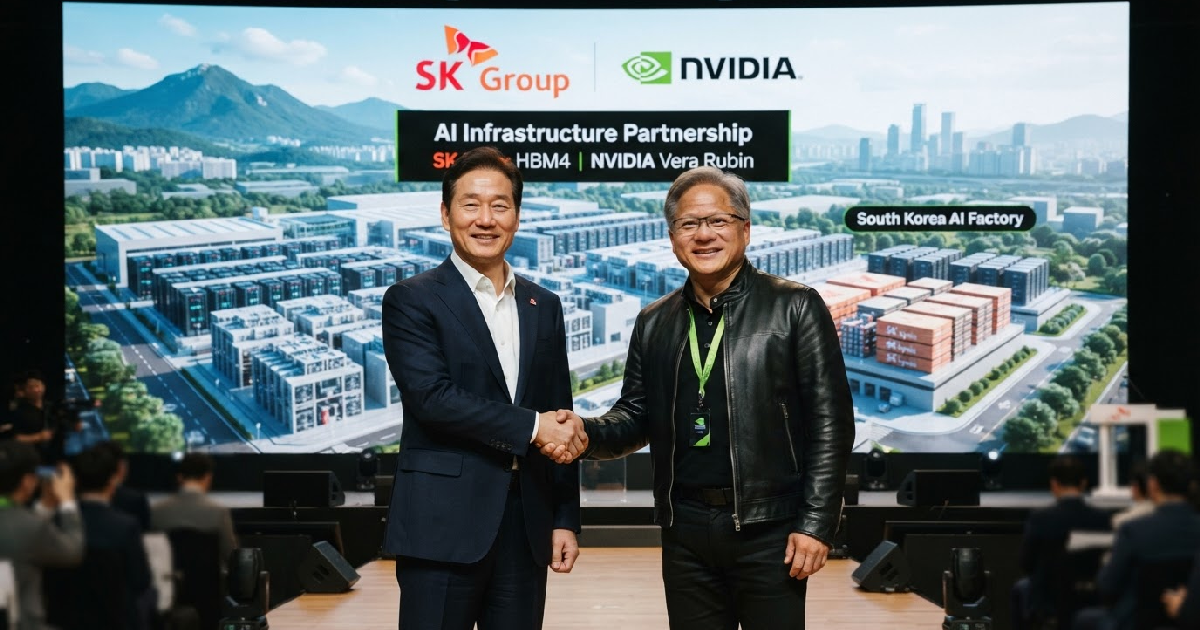
SK Group and NVIDIA have announced a comprehensive AI infrastructure partnership valued at more than $500 billion. This significant collaboration, formalised through letters of intent, aims to meet the escalating global demand for compute power for artificial intelligence.
The announcement came on July 24, 2026, during the AI Summit in San Francisco, California. Its core components include the construction of a 2-gigawatt (GW) AI factory in South Korea and a long-term agreement for the supply and co-development of next-generation AI memory.
Building Korea’s AI factory with NVIDIA Vera Rubin
Central to this partnership is the establishment of a large-scale AI factory in South Korea by SK Telecom, an affiliate of SK Group. This facility will be a 2-gigawatt NVIDIA Vera Rubin DSX AI Factory, designed to provide advanced computing capabilities.
The factory will deploy NVIDIA Vera Rubin accelerated computing systems, powered by the NVIDIA DSX platform. Crucially, these systems will integrate SK hynix HBM4 memory, with the first AI factory expected to commence operations in 2027.
NVIDIA’s DSX full-stack AI factory architecture underpins this development. It combines NVIDIA accelerated computing, systems, software, and partner technologies, engineered to deliver the lowest token cost while maximising energy efficiency.
This infrastructure will serve a range of AI services, including sovereign, physical, agentic, and enterprise AI. The collaboration aims to accelerate large-scale AI infrastructure development across the Asia-Pacific region, with a particular focus on South Korea.
Advancing next-generation AI memory with SK hynix
Beyond the AI factory, the agreement solidifies a long-term AI memory partnership between NVIDIA and SK hynix. This collaboration builds on their existing technical relationship, ensuring a stable supply of next-generation AI memory for NVIDIA.
For SK hynix, the partnership provides a significant opportunity to expand its foundation for growth in a rapidly evolving market. Both companies will codevelop and optimise AI memory solutions, including High Bandwidth Memory (HBM).
This co-development effort is critical for meeting the diverse and demanding infrastructure requirements of modern AI. These include applications ranging from large language model (LLM) training to agentic AI and physical AI, pushing the boundaries of what AI systems can achieve.
South Korea’s strategic push for AI leadership
This partnership fits neatly into South Korea’s broader national strategy to become a global AI powerhouse. President Lee Jae Myung was present at the Korea AI summit where the deal was announced, underscoring its national importance.
The country has already committed substantial resources, with approximately $950 billion in AI-related investments involving domestic and U.S. technology firms. This figure highlights the ambition to not just adopt AI, but to actively drive its innovation and implementation globally.
SK Group Chairman Chey Tae-won emphasised this point, stating that competitiveness in the AI era depends on intelligence production. He believes leveraging SK hynix’s memory and SK Telecom’s infrastructure will help Korea transcend its role as an adopter, becoming a hub for AI innovation.
Jensen Huang, NVIDIA’s Founder and CEO, echoed this sentiment. He noted South Korea possesses the essential elements—world-class networks, data centres, and semiconductors—to become a leading AI nation.
The role of the Vera Rubin platform in future AI
The NVIDIA Vera Rubin AI computing platform stands as a cornerstone of this new infrastructure. It represents a significant leap in AI hardware design, integrating 32 Vera central processing units (CPUs) and 72 Rubin graphics processing units (GPUs).
This powerful combination is unified through NVLink 6 architecture. Such an integrated design is vital for handling the immense computational loads required for complex AI tasks, making it a critical component for the new AI factory.
Broader AI infrastructure investments
The $500 billion-plus partnership with NVIDIA forms part of an even larger picture for SK Group. The conglomerate is pursuing business partnerships worth a combined $250 billion with other global technology companies.
This brings SK Group’s total planned global AI infrastructure agreements to an impressive $750 billion. Such extensive investment signals a profound commitment to establishing a dominant position in the global AI landscape.
NVIDIA is also making other significant investments in the region. They’re putting $1 billion into South Korean internet company Naver, for instance, to help finance an AI data centre expansion from 55 megawatts to 200 megawatts.
A US private equity firm, Brookfield, has also agreed to a nonbinding term sheet to fund up to $9 billion for the Naver project. These related investments underscore the deep financial and strategic commitments being made to AI infrastructure in South Korea.
The strategic implications of large-scale AI factories
The construction of a 2-gigawatt AI factory in South Korea carries considerable strategic weight. It’s not just about raw computing power; it’s about establishing a physical foundation for the future of artificial intelligence.
These facilities, often termed “AI factories,” are designed for the continuous, large-scale production of AI models and services. They represent a fundamental shift in how AI is developed and deployed, moving from experimental phases to industrial-scale operations.
The sheer energy requirements, exemplified by the 2 GW capacity, highlight the energy-intensive nature of advanced AI compute. This necessitates robust power infrastructure upgrades and efficient cooling solutions.
It also underscores the increasing capital expenditure required to stay competitive in the AI race. Companies and nations that can mobilise such resources are positioning themselves at the forefront of this technological transformation.
Potential impact on African industrial development
While this AI infrastructure partnership is geographically centred in South Korea, its implications resonate globally, including for African industrial development. The establishment of large-scale AI compute capabilities sets a benchmark for what’s possible in AI infrastructure investment.
African nations are increasingly looking to harness AI for economic growth, particularly in sectors like manufacturing, energy, and logistics. However, access to the sophisticated computing resources required for advanced AI training and deployment remains a significant challenge.
The SK Group-NVIDIA model demonstrates the necessity of massive, integrated investments in hardware, software, and memory. For African industries, this highlights the critical need to develop foundational digital payment infrastructure and advanced computing centres.
It also means fostering partnerships that can bring both capital and technological expertise to the continent. This sort of strategic investment could unlock Africa’s industrial potential by providing the computational backbone for localised AI solutions, custom-built for the continent’s unique challenges and opportunities.
