


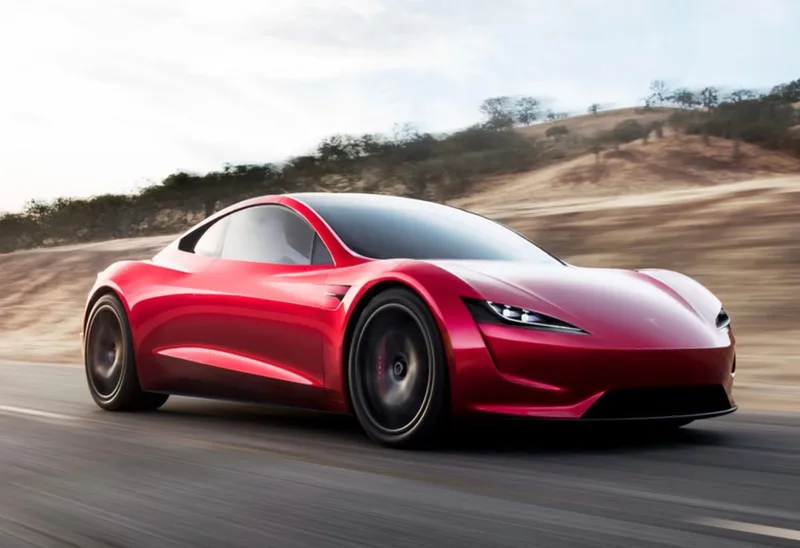
The second-generation Tesla Roadster will be officially unveiled on October 1, 2026. The unveiling is expected to attract attention from electric vehicle enthusiasts and the wider automotive industry.
The reveal, scheduled for 7:30 pm, marks an important milestone for Tesla. It signals Tesla’s continued focus on electric vehicle performance and design, integrating advanced technologies from its sister company, SpaceX.
The long wait for the Tesla Roadster unveiling
The second-generation Tesla Roadster was first unveiled as a concept in November 2017, with initial deliveries originally targeted for 2020. However, the project subsequently faced repeated delays, with its anticipated arrival repeatedly pushed back over nearly a decade.
Tesla CEO Elon Musk has attributed the delays to several factors, including supply chain disruptions and the prioritisation of other critical models like the Cybertruck and the Semi. The Roadster’s launch target has shifted at least eight times since its original announcement, contributing to frustration among prospective owners.
Evolution of a hypercar design
Early reports suggested that Tesla had abandoned an approach based on existing Model S Plaid components for the new Roadster. Instead, the company reportedly opted to develop a new carbon-fibre hypercar, indicating a substantial redesign aimed at meeting its performance goals.
This approach represents a substantial departure from the earlier design. Such an extensive re-engineering effort may have contributed to the prolonged development cycle, aiming for a truly distinct vehicle in the high-performance electric segment.
SpaceX collaboration and propulsion technology
Central to the mystique about the new Roadster is its potential integration of SpaceX technology. The teaser image for the Tesla Roadster unveiling depicts what Tesla described as “rocket-launch lighting” and “four thruster plumes firing”, suggesting a connection with SpaceX technology.
Reports indicate that a limited-edition model will feature cold-gas thrusters developed by SpaceX, codenamed A71. This system would occupy the rear seating area and reportedly use approximately ten thrusters and a high-pressure air tank to enable unprecedented manoeuvres.
Performance claims and track demonstration
Reports suggest that the optional thrusters could allow the Roadster to perform additional manoeuvres, potentially allowing the vehicle to lift off the ground. The planned demonstration at SpaceX’s McGregor engine test site in Waco, Texas, will reportedly involve remote operation, with spectators reportedly kept several hundred yards away because of the noise and force involved.
Performance figures presented when the prototype was revealed in 2017 included a 0 to 60 mph acceleration in 1.9 seconds, a top speed exceeding 250 mph, and a 620-mile range from a 200 kWh battery pack. Musk has since proposed an acceleration target of under one second, although achieving this in a production vehicle would represent a significant technical challenge.
The event in Waco, Texas
The choice of Waco, Texas, for the official Roadster unveiling is strategically significant. Waco is approximately 1.5 hours north of Tesla’s headquarters in Austin and is a short drive from SpaceX’s McGregor engine test site.
This proximity could facilitate a demonstration of the thruster technology. The venue offers the necessary space and infrastructure to showcase the vehicle’s more unconventional capabilities, highlighting the potential connection between Tesla and SpaceX’s technology.
Logistics for reservation holders
Invitations have already gone out to Roadster reservation holders, who must RSVP by midnight on September 16, 2026. Access to the event is limited to guests aged 21 and older, and all invitations are non-transferable, indicating an exclusive gathering.
The restrictions limit attendance to invited reservation holders and their guests. It also limits access to the vehicle’s unveiling.
Long wait for reservation holders
The prolonged development has extended the wait for early reservation holders, some of whom paid substantial deposits. Standard car reservations required $50,000, while the Founders Series demanded $250,000, tying up considerable capital for years.
Some prominent reservation holders, including OpenAI CEO Sam Altman, have reportedly cancelled their orders due to the extended wait. The cancellations illustrate the uncertainty associated with long development cycles for new vehicle programmes.
Musk’s vision versus reality
The delays have prompted public discussion, including a social media exchange between Elon Musk and Sam Altman last year regarding refunds and the timeline. Musk has said that the extended development period was necessary to achieve the vehicle’s revised performance and design targets.
The extended development timeline reflects the challenges involved in bringing the vehicle to production. Musk has indicated that production will begin 12 to 18 months after the unveiling, pushing initial deliveries to 2027 or 2028.
Broader EV market context
The Roadster’s unveiling comes as the electric vehicle market undergoes significant changes. Tesla’s U.S. EV market share stood at 52% in the first eight months of 2026, an increase from 43% in the same period of 2025.
This growth occurred despite a 16% year-over-year decline in Tesla’s U.S. sales, against a backdrop where overall U.S. EV sales fell approximately 30%. Traditional automakers such as Ford, General Motors, and Honda have scaled back or cancelled some EV plans amid changing market conditions.
Tesla’s production track record
Tesla has previously announced products that subsequently experienced production delays. The Cybertruck, unveiled in November 2019, only began customer deliveries in November 2023.
Similarly, the Semi truck, after a protracted development, only began volume production in April 2026. The Roadster has also experienced a prolonged development timeline, illustrating some of the challenges associated with bringing new automotive technologies into production.
Legacy of the first Roadster
The original Tesla Roadster, produced between 2008 and 2012, was an early milestone in Tesla’s development of electric vehicles. Based on a Lotus Elise chassis, it was the first highway-legal, series-production electric car to use lithium-ion battery cells.
With a range exceeding 200 miles per charge, it helped establish Tesla’s early position in the electric vehicle market. Approximately 2,450 units were sold across more than 30 countries and contributed to Tesla’s early reputation for electric performance.
Outlook for high-performance EVs
The second-generation Roadster represents a new high-performance model for Tesla and is intended to demonstrate the capabilities of electric propulsion. Its design and proposed thruster technology could expand the range of performance features offered in high-performance electric vehicles.
The unveiling will provide further details about Tesla’s approach to high-performance electric vehicle design and propulsion. The event will provide an opportunity to assess Tesla’s latest approach to high-performance electric vehicle development.
