


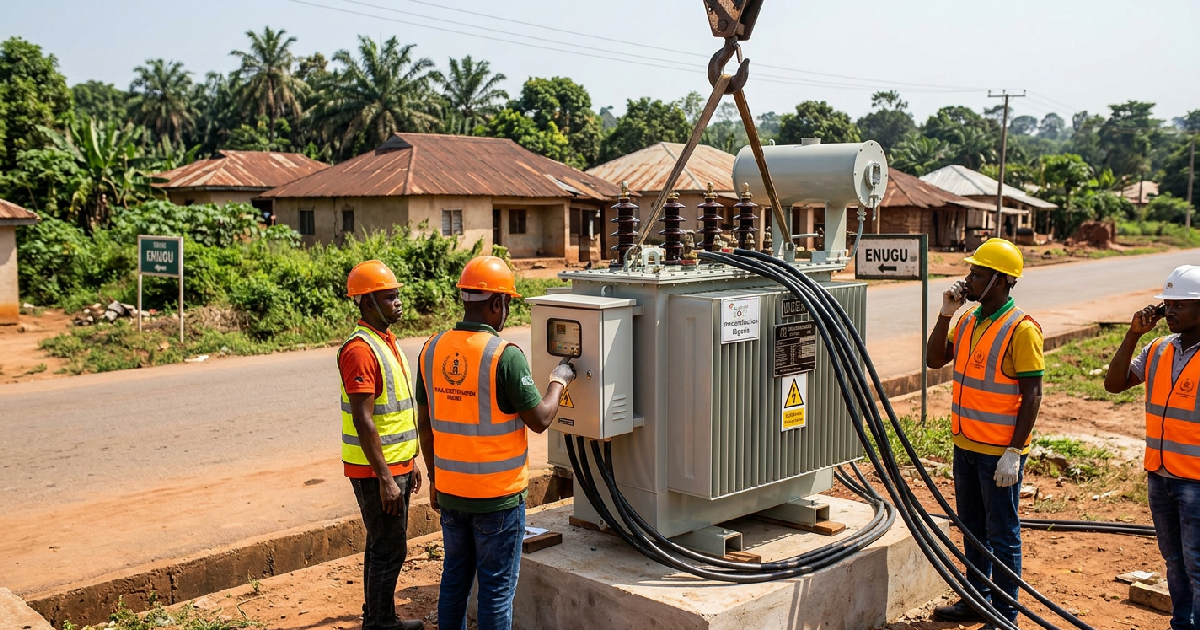
Nigeria’s federal government has initiated a fresh wave of upgrades to the electricity distribution network across Ebonyi and Enugu, marking a tactical shift toward rural and semi-urban energy security. The move aims to address long-standing bottlenecks in the southeastern grid, where aging transformers and overloaded transmission lines have frequently stifled local industrial growth and domestic supply.
This localized push focuses on the installation of injection substations and the replacement of derelict distribution assets. For residents and business owners in these states, the intervention isn’t just about keeping the lights on; it’s about stabilizing a voltage profile that has been notoriously unreliable for years. By targeting these specific geographic hubs, the government is attempting to bridge the gap between national generation capacity and the end-user’s wall socket.
Strengthening the Southeast Power Grid
The technical scope of the project involves a mixture of hardware replacement and grid optimization. In Ebonyi, the focus has landed heavily on expanding the reach of the distribution network to academic and industrial clusters. Engineering teams are reportedly prioritizing the synchronization of new transformers with existing feeder lines to ensure that increased load capacity doesn’t result in system trips.
In Enugu, the strategy is slightly different, leaning toward the rehabilitation of urban infrastructure that has struggled under the weight of a growing population. These upgrades are essential because, while Nigeria has seen marginal gains in total power generation, the “last mile” of delivery—the wires and poles that connect to homes—remains a critical point of failure. Without these specific interventions, the added megawatts at the national level rarely reach the consumer in a stable form. This focus on the “last mile” mirrors broader efforts across the country, where Tinubu committed to stable electricity for Nigerians through the Rural Electrification Agency and other federal bodies.
Engineering and Logistics Challenges
Deploying heavy electrical infrastructure in the Southeast presents unique engineering hurdles. The terrain in parts of Ebonyi requires specialized foundation work for substation mounting, particularly in areas prone to seasonal soil shifts. Furthermore, engineers have to work around the existing “legacy” network, which often features mismatched components from different eras of power development.
The integration process involves circuit-breaker installations designed to isolate faults. This ensures that a single downed tree or a blown fuse in one neighborhood doesn’t necessarily plunge an entire local government area into darkness. It’s a granular approach to grid resilience that emphasizes durability over temporary fixes. And while the physical installation is complex, the goal remains a more predictable flow of electricity for the region’s expanding residential zones.
Economic Ripple Effects of Stable Voltage
Reliable power is the primary catalyst for the burgeoning small-scale manufacturing sectors in Enugu and Ebonyi. From rice milling clusters in Abakaliki to the tech hubs emerging in Enugu city, the cost of diesel remains a huge overhead for businesses. Reducing the reliance on “self-generation” through generators could pivot these local economies toward more sustainable expansion.
Infrastructure isn’t just about steel and copper; it is the foundation for digital and educational advancement. For instance, as Enugu State builds smart schools to modernize its curriculum, the underlying necessity for a stable power grid becomes even more critical. A smart school without a reliable feed from the national grid faces significant operational hurdles. The federal government’s current infrastructure boost acts as a prerequisite for these state-level digital ambitions and educational reforms.
Mitigating Energy Poverty
Modernizing the grid also serves a social function. By improving the reliability of the supply, authorities are looking to increase bill collection efficiency. When power is consistent, consumers are more likely to accept the transition to prepaid metering systems, which in turn provides the liquidity needed for the DisCos (Distribution Companies) to maintain the equipment. It is a cycle that the federal government is eager to kickstart in the Southeast to ensure the system remains self-sustaining.
Long-Term Reliability and Maintenance Outlook
The success of this infrastructure boost depends heavily on a shift in maintenance culture. Historically, the Nigerian power sector has struggled with equipment longevity, where substations have been known to fall into disrepair prematurely due to a lack of routine servicing. Technical reports suggest that this current phase includes a mandate for local technical teams to undergo updated training on the new hardware being installed to prevent such early decay.
Another layer of the strategy involves securing the assets themselves. Vandalism remains a persistent threat to electrical engineering projects. The new installations are reportedly incorporating sensor-based monitoring to alert central hubs of tampering or sudden drops in pressure in oil-cooled transformers. This move toward a more “aware” grid aligns with the general trend where Africa digital payments must shift focus to infrastructure reliability and similar sectors are discovering that uptime is the only metric that truly matters.
While these upgrades in Ebonyi and Enugu represent a step forward, they are part of a much larger, multi-year effort. The transition from a fragile national grid to a resilient network is ongoing, and for the residents of these two states, the coming months will be a test of whether these engineering interventions can translate into a more stable reality.
