


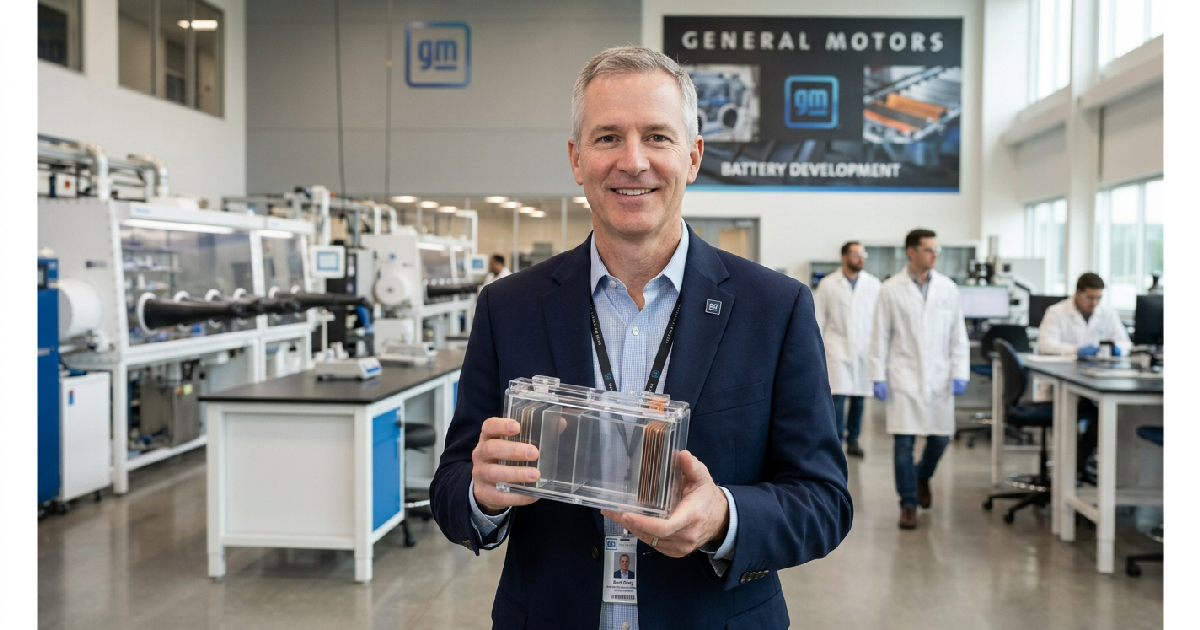
General Motors is investing $900 million into a battery development programme designed to accelerate the commercialisation of Lithium-Manganese-Rich (LMR) chemistry. Kurt Kelty, GM’s Vice President of battery and sustainability, confirmed the initiative aims to bridge the gap between initial research and full-scale production. The core of this investment involves a new 500,000-square-foot Battery Cell Development Centre at the Warren Technical Center outside Detroit.
The transition to LMR chemistry is expected to preserve a truck’s 400-plus mile range while slashing production costs. If successful, this specific chemistry could cut electric vehicle battery costs by at least $6,000 per vehicle. For the Chevrolet Silverado EV, this reduction would represent a significant shift in affordability for the consumer market.
GM aims to bring these cheaper batteries to market a year earlier than originally planned, targeting deliveries for models scheduled for 2027.
This strategic move also involves expanding the wider manufacturing footprint in Michigan. A new battery module assembly plant in the state is expected to create over 2,500 jobs. By 2028, GM anticipates it can lower its average battery costs by 15% through these domestic production efficiencies. These advancements in com/ngx-market-capitalization-increase-industrial-engineering-rally/”>industrial and engineering stocks reflect a broader push toward scaling domestic supply chains and reducing reliance on China for minerals like cobalt and lithium.
LMR chemistry serves as the main product line for heavy-duty trucks
The LMR cells being developed are composed of approximately 35% nickel and 65% manganese, requiring almost no cobalt. This ratio allows the cells to be 33% more energy-dense than Lithium-Iron-Phosphate (LFP) at a comparable cost. Kurt Kelty described LMR as the company’s “bread and butter” solution for the future, as it matches the energy density of the high-end Nickel-Manganese-Cobalt (NMC) cells used in current models.
To support this rollout, GM is diversifying its manufacturing facilities across the United States. Later in 2025, the Spring Hill, Tennessee plant operated by Ultium Cells will begin converting lines to produce LFP cells. Commercial production of those lower-cost cells is expected by late 2027. This flexibility in production mirrored the regional shifts seen where the FG upgrades power infrastructure to meet specific industrial demands.
The automaker also maintains a joint venture with Samsung SDI in New Carlisle, Indiana, which is scheduled to open in 2026 with a capacity exceeding 30 gigawatt hours per year. By utilizing different chemistries across various plants, GM can segment its fleet according to performance and price.
Smaller vehicles may utilize the LFP cells from Tennessee, while heavy-duty trucks will adopt the LMR cells developed in Michigan.
Artificial intelligence and virtual testing speed up development cycles
Supporting the physical manufacturing investment is a new focus on software-led engineering. Sterling Anderson, GM’s Chief Product Officer, and Jason Fischer, Executive Director of virtual integration engineering, are employing AI to streamline the design process. The company uses both third-party and in-house AI models to run simulations across the business, specifically to speed up the vehicle development cycle.
This virtual integration allows engineers to test how new LMR battery configurations perform without waiting for months of physical prototypes. Using these models, GM can predict battery degradation and performance under various conditions long before a cell hits the assembly line. This approach ensures that technical hurdles are addressed early, keeping the 2027 model delivery timelines on track.
The $900 million gamble is part of a larger multi-billion dollar effort to secure U.S. battery independence. This follows a $2.5 billion loan from the Department of Energy to Ultium Cells for plants in Michigan, Tennessee, and Ohio. This investment in industrial connectivity and local production helps insulate the company from global commodity price swings and geopolitical disruptions in the supply of critical materials.
Targeting commercial production for the 2028 truck market
Commercial production of LMR batteries is officially targeted for trucks by 2028. This timeframe is critical for GM as it seeks to align its manufacturing costs with those of traditional internal combustion vehicles. By reaching cost parity, the automaker hopes to encourage larger fleet adoptions by logistics and construction firms that require the high energy density LMR provides.
While the focus remains on the North American market, the global implications for industrial energy are clear. As manufacturers standardise these low-cost chemistries, the barrier to entry for heavy-duty electric transport will lower globally. For engineers and logistics managers in Africa, the availability of high-density battery modules at a $6,000 lower cost per vehicle could eventually reshape heavy-duty transport and industrial storage options.
GM’s goal remains to provide a mix of range, performance, and affordability. The shift toward LMR represents move away from expensive, cobalt-heavy designs toward a manganese-rich future. If the 2028 production goals are met, the Warren facility will have successfully served as the bridge from the lab to the road, establishing a new baseline for the next generation of industrial electric mobility.
