


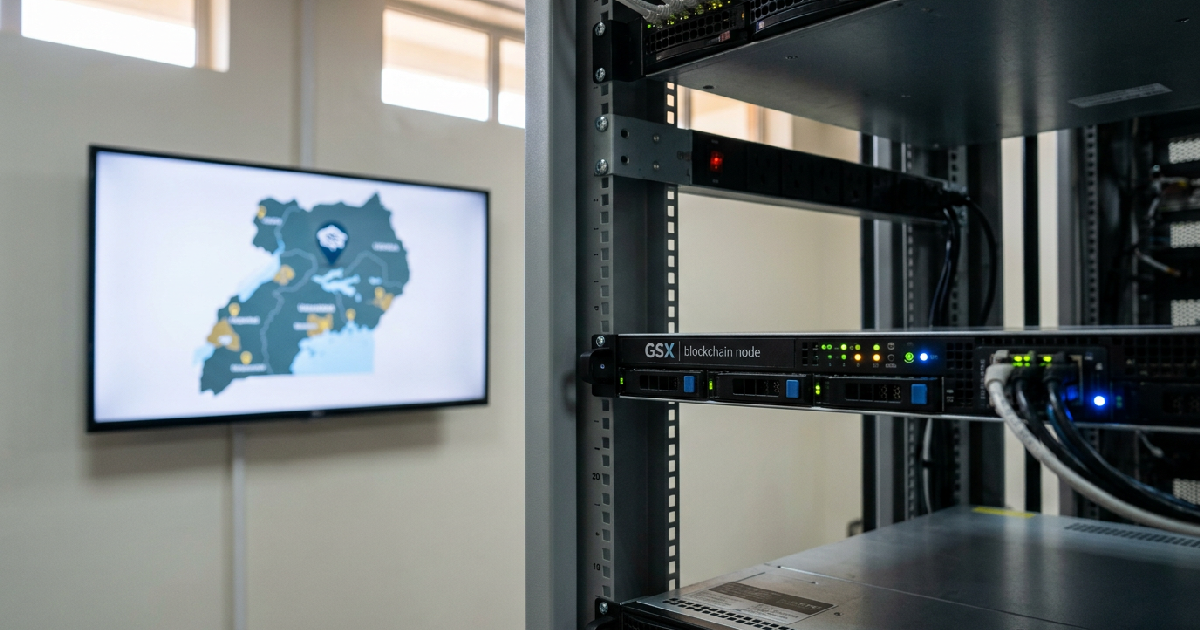
Uganda is serving as the primary testbed for a new sovereign financial architecture as Global Settlement Network (GSX) deploys blockchain-based settlement rails to link the country’s industrial value chains.
The Miami-based infrastructure firm, led by CEO Ryan Kirkley, is shifting the focus from consumer-facing fintech toward the underlying settlement layers that central banks and governments use to control liquidity. The project aims to modernize payment systems that currently rely on expensive correspondent banking networks, which often subject African remittances to double-digit fees.
Global Settlement Network targets sovereign financial rails in Uganda
In October 2025, Global Settlement Network (GSX) partnered with Diacente Group, a developer of green industrial zones, on a $5.5 billion project to build digital infrastructure for Uganda’s farms, mines, and power projects.
This initiative includes a pilot for a digital shilling and seeks to improve transparency for large-scale operations, such as a $2 billion solar project. By providing immutable digital rails, the partnership allows stakeholders to monitor budgets and execution in real-time, helping to mitigate corruption risks that often deter capital in underdeveloped regions like Karamoja.
CEO Ryan Kirkley is positioning Global Settlement Network (GSX) at the base of the financial stack, focusing on issuance and transfer infrastructure rather than retail apps. This strategy treats financial settlement as a critical utility, much like the physical gas pipelines that power industrial hubs.
Key details
By building these sovereign rails, GSX aims to give African nations greater control over their economic futures, reducing reliance on foreign settlement systems like SWIFT or European correspondent banks.
The technical architecture of GSX emphasizes interoperability between fragmented ecosystems. While many early blockchain proponents predicted a single dominant network, Kirkley anticipates that each institution and government will eventually operate its own blockchain infrastructure. To support this, GSX has built compliance frameworks encompassing identity verification, sanctions screening, and anti-money laundering controls.
These tools are designed to integrate with existing systems, allowing for a phased transition toward industrial connectivity and digital currencies.
Tokenisation of real-world assets to unlock industrial liquidity
For the engineering and mining sectors, the implementation of Real-World Asset (RWA) tokenisation addresses the chronic illiquidity of African capital markets. Currently, many investors find their capital locked indefinitely due to shallow secondary trading options. GSX uses blockchain to fractionalise these assets, creating digital units that can be traded more easily.
This mechanism is intended to build a more mature financial ecosystem where secondary market opportunities encourage greater inflows of investment into infrastructure.
Uganda’s mining sector provides a concrete example of this need. While the country possesses several artisanal gold mines, it lacks domestic refining capacity, meaning significant value is exported before processing. Digital infrastructure can provide the transparent financial foundation needed to attract investment for local refineries.
The goal is to domesticate more of the value chain, ensuring that raw materials are refined within Uganda before they reach global markets, provided the necessary infrastructure development follows.
Key details
The impact of digitized financial rails extends to the broader population. GSX estimates that its infrastructure could eventually help bring formal financial access to approximately 8.7 million Ugandans, representing 19% of the country’s unbanked population.
By lowering the cost of mobile money transfers and remittances, the system provides a more stable store of value for citizens. Kirkley notes that while the average person may not care about the underlying blockchain, the outcome—cheaper and faster transfers—is what defines success.
This focus on measurable outcomes mirrors previous successful tokenisation pilots. In 2022, Mercy Corps Ventures launched a product in Cameroon that allowed 11,000 low-income users to save in government bonds via digital units. GSX is now scaling this concept to support sovereign financial infrastructure.
In Uganda, the company measures success through investment volume and the physical development of infrastructure, aiming to show that transparent digital rails can attract the capital necessary for large-scale national projects.
Overcoming fragmentation across regional African markets
Industrial growth across Africa is often hamstrung by fragmentation between 54 different regulatory and financial systems. CEO Ryan Kirkley argues that stronger cooperation through the African Union (AU) is vital to creating regional connectivity.
Just as physical freight corridors are needed to link landlocked mines to distal ports, digital corridors are required to facilitate direct trade between African currencies without routing through the US dollar or European intermediaries.
To support this expansion, GSX closed an $11 million pre-seed funding round in May 2026. The firm has also taken strategic steps to secure local expertise, such as its April 2026 acquisition of a majority stake in the capital markets firm AKIBA International.
These moves provide the regulatory licensing and market presence required to implement Manufacturing Execution Systems and settlement rails that can survive shifts in the global regulatory environment.
Key details
The revenue model for Global Settlement Network (GSX) varies by the maturity of the market. In developed systems, the firm acts primarily as a software provider. In emerging economies with higher inflation or restricted budgets, GSX adopts more flexible models, including fractional fees on payments or small ownership stakes in the projects they enable.
This flexibility allows the venture-backed firm to absorb some of the upfront infrastructure costs that might otherwise prevent governments from modernizing their systems.
Ultimately, the objective is to enable African economies to settle transactions directly with one another. By creating direct trading pairs and local digital currency systems, countries can reduce the foreign exchange risks that currently inflate the cost of industrial machinery and energy imports.
As the Ugandan pilot in the Karamoja region matures, it will provide a case study for how digital finance can be integrated into large-scale industrial processing and agricultural development projects across the continent.
