


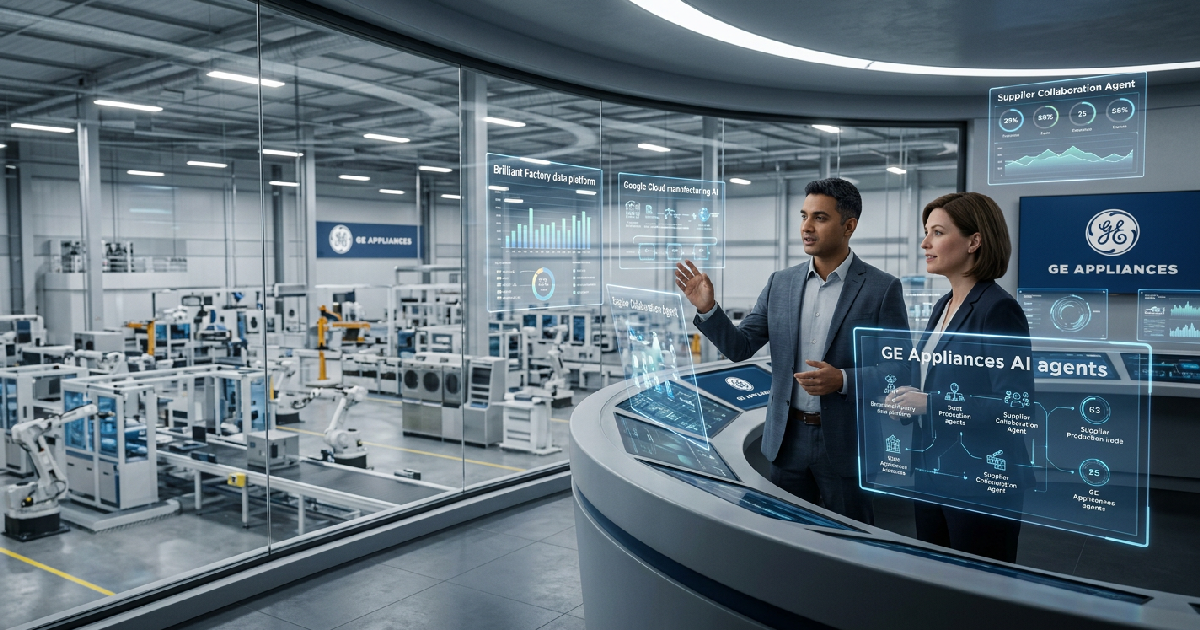
GE Appliances has deployed more than 800 AI agents across its manufacturing, logistics, and supply chain operations to accelerate decision-making and improve product quality. The large-scale rollout, officially announced on 22 April 2026, at Cloud Next ’26 in Las Vegas, signals a shift in how the appliance giant, a Haier company, handles the persistent variability of modern global markets.
Mandar Deo, Vice President of Digital Technology & Chief Digital Officer at GE Appliances, and Marcia Brey, Vice President of Logistics, are steering the integration. Working with Google Cloud, the company is embedding Gemini Enterprise tools directly into daily workflows. This allows frontline staff to act on real-time data rather than spending the first half of a shift manually gathering information. These tools are being used right where the work happens, rather than being restricted to a centralized data lab.
The initiative moves beyond standard digital assistants. While assistants help individuals think faster, these agents perform specific pieces of work within defined workflows. They process information and produce outputs that allow teams to diagnose issues before they cause significant disruptions. This transition is essential for an organisation that ships approximately 27 million service parts and accessories annually.
Integrating AI agents into the Brilliant Factory platform
GE Appliances is embedding Gemini Enterprise into its “Brilliant Factory” manufacturing data platform. This system already tracks production performance, part genealogy, and workforce activity across various shifts and plants. By layering AI agents over this existing data, the company can now surface anomalies in real time.
A specific Gemini-powered tool provides real-time summaries of production shifts. By analysing equipment performance and pinpointing root causes of delays, the tool has reduced shift review times from up to an hour down to just a few minutes. This allows engineers and supervisors to focus on immediate problem-solving during shift huddles.
Praveen Rao, the global head of manufacturing at Google Cloud, noted that while everyone in a manufacturing company shares the same data source, they require different insights. A shop floor operator might focus on machine health under their purview, while a CFO might use the same data to compare the efficiency of a factory in Kentucky against one in another region. com/african-iot-sector-growth-industrial-impact/”>African IoT sector expands through industrial connectivity in a similar fashion, proving that specific, actionable data is more valuable than raw volume.
Managing logistics through autonomous supplier collaboration
The scope of the rollout extends deep into the supply chain to manage a network of over 700 service parts suppliers. In 2025, GE Appliances introduced a Supplier Collaboration Agent to automate communication and tracking within this complex network. This is a critical function for a company that must maintain parts availability for at least seven years after a product’s production ends.
The Supplier Collaboration Agent has already delivered a 25% reduction in backorders. By handling routine correspondence and identifying inventory gaps, the agent frees procurement teams to tackle high-level strategic challenges. This focus on operational consistency mirrors efforts in other emerging markets, where Africa digital payments must shift focus to infrastructure reliability to support growing industrial activity.
Marcia Brey described these AI tools as an “operational toolset” rather than a “magic bean.” She highlighted that the goal is to be flexible and nimble in an environment where inputs and supplier timings are constantly shifting. The system allows the company to look at all logistical options simultaneously, which is impossible with manual planning.
Extending Gemini Enterprise to consumer products
Beyond the factory floor, the technology is also reaching consumer homes through the SmartHQ™ app. Shawn Stover, Executive Director of SmartHome and Energy Solutions, has overseen the introduction of AI-powered features like Flavorly™ AI, a laundry assistant, and a coffee assistant. These tools utilize Google Cloud’s Vertex AI to help users reduce food waste and manage daily chores more efficiently.
GE Appliances has also automated parts of its customer service. Working with implementation partner Neuraflash, the company deployed an autonomous service agent on Salesforce’s Agentforce platform. This agent was implemented in just seven weeks. It draws data from Oracle systems via MuleSoft to resolve customer inquiries without requiring human intervention.
This broad adoption did not start as a top-down mandate. Instead, it grew from internal curiosity, with employees testing and finding practical uses for AI tools. These experiments have eventually uncovered improvement opportunities valued at millions of dollars. As the company continues to embed these agents, the focus remains on reducing the time between a data signal and a corrective action.
