


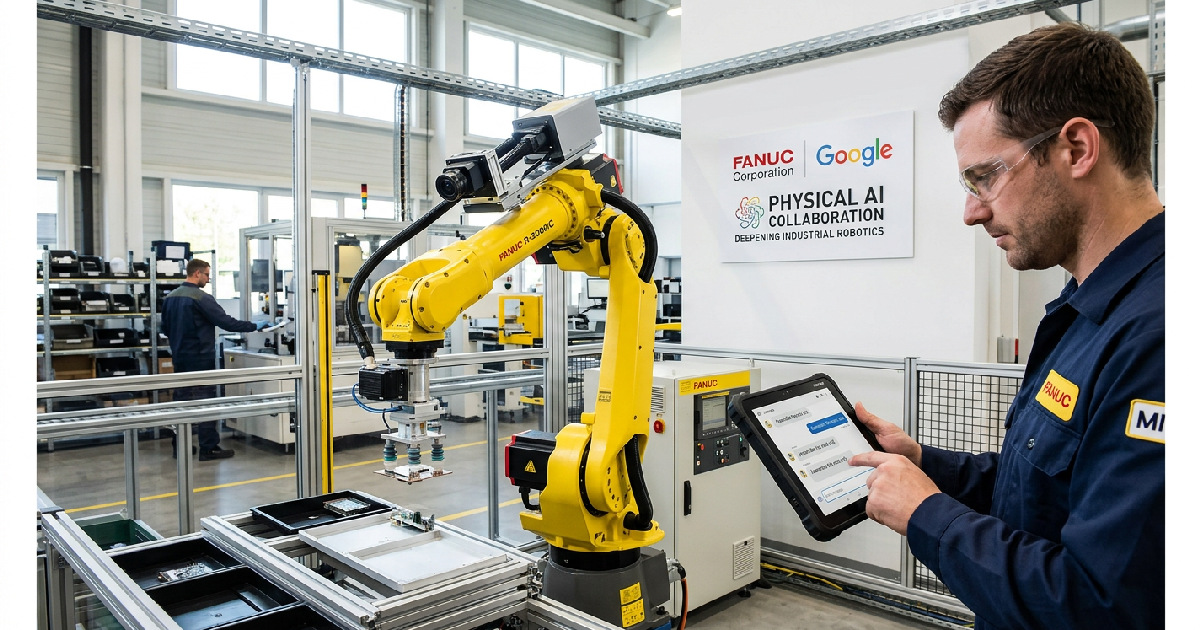
FANUC Corporation and Google have entered a strategic collaboration to integrate “Physical AI” into industrial robotics, a move that will allow factory machines to perceive environments and execute complex tasks through natural language instructions. The partnership, announced between 13 May and 20 May 2026, involves FANUC Corporation, Google Cloud, and Google DeepMind, with a specific focus on leveraging the Gemini Enterprise generative AI platform and Intrinsic’s Flowstate development environment.
This deal aims to transition industrial robots from rigid, pre-programmed machines into adaptive systems capable of autonomous decision-making on the factory floor.
The collaboration comes as FANUC America Corporation, headquartered in Rochester Hills, Michigan, prepares to scale its regional footprint significantly. By integrating Google’s AI models, FANUC aims to solve a long-standing hurdle in manufacturing: the high cost and technical expertise required to program robots for varied tasks. Under the new agreement, FANUC robots will receive full support on the Intrinsic software platform.
This allows collaborative robots and traditional industrial units to operate together within a single cell, directed by simple verbal or text commands rather than thousands of lines of manual code.
Industry leaders view this as a primary shift toward Physical AI—a term describing the fusion of cognitive intelligence with physical movement. Google DeepMind is facilitating this via the Gemini Robotics Trusted Tester Program, where FANUC is testing foundational robotics models that can generalise across different industrial applications. This advancement is particularly relevant as the African IoT sector expands through industrial connectivity, suggesting a growing global appetite for machines that can talk to one another and their human operators without proprietary software barriers.
Fanuc leverages Google Gemini to simplify factory floor automation
At the heart of the deal is the integration of the Gemini Enterprise generative AI platform into FANUC’s Physical AI Robot System. This system was first released at the International Robot Exhibition in Tokyo in December 2025 and more recently demonstrated at FANUC’s 34th New Products Open House Show in Japan this May. During the demonstration, engineers showed how Gemini could interpret high-level goals and translate them into precise mechanical movements, effectively removing the need for specialized programming for every new part change.
The application of generative AI goes beyond simple task execution. By using Google’s platform, these robots can perceive environments through sensors and make autonomous decisions. This level of intelligence is critical for manufacturers dealing with high-mix production where retooling a line traditionally takes significant time.
Now, software updates and AI training can handle those transitions more efficiently. com/ijeoma-eti-ai-infrastructure-trust-security-compliance/”>Ijeoma Eti address AI infrastructure faults by focusing on the underlying security and trust of these autonomous systems.
Intrinsic Flowstate and the role of Google DeepMind
Intrinsic, the robotics AI arm of Google, plays a pivotal role by providing the Flowstate development environment. Flowstate acts as a bridge, allowing developers to simulate and deploy AI-driven robotic workflows across diverse hardware. By ensuring FANUC—the world’s leading supplier of factory automation—is fully supported on Flowstate, Google is effectively setting a new industry standard for how robotic software is developed and deployed at scale.
The participation of FANUC in the Gemini Robotics Trusted Tester Program indicates that the collaboration is not merely about using existing AI, but building new, robotics-specific models. These foundational models are central to Physical AI, which aims to deliver smarter, more adaptive robots for manufacturers. This reduces the time spent on manual calibration and allows for more complex operations, such as handling collaborative and non-collaborative robots as a single cell, which was previously difficult to automate.
Expanding the physical AI footprint in Michigan and California
The timing of the Google deal aligns with FANUC’s massive infrastructure expansion in the United States. The company is currently building an 840,000-square-foot robot manufacturing facility in Pontiac, Michigan. Additionally, FANUC America is developing what will be the largest robotics and automation skills development centre in the country in Auburn Hills, Michigan. These facilities will serve as the primary testing grounds for the Physical AI systems developed alongside Google’s technical teams.
While FANUC and Google have dominated recent headlines, they are not alone in this race. On 21 May 2026, Kawasaki Heavy Industries opened its own Physical AI centre in San Jose, California, signalling a broader industry trend toward Silicon Valley-driven industrial software. The concentration of these developments in North American hubs highlights a strategic move to bring AI expertise closer to the mechanical engineering powerhouses of the Midwest and Japan.
Global implications for industrial productivity and scaling
For operations managers and engineers, this collaboration represents a move toward more integrated intelligence. When a FANUC robot can be controlled via an enterprise platform like Google Cloud, the barrier to entry for diverse manufacturing environments drops. It simplifies the process of managing a fleet of robots using natural language. This scalability is a vital component of modern industrial strategy, much like how industrial and engineering stocks rally when companies demonstrate clear paths to increased efficiency and lower operational costs.
Looking ahead, the industry will gather at McCormick Place in Chicago for the Automate 2026 conference from 22–26 June. This event is expected to feature the first large-scale public demonstrations of these AI-integrated systems on American soil. As these Physical AI systems move from tester programs into active factory environments, the focus will shift from simple automation to how quickly robots can adapt to new tasks. The success of this partnership will likely determine the pace at which generative AI becomes a standard tool in the global manufacturing toolkit.
