


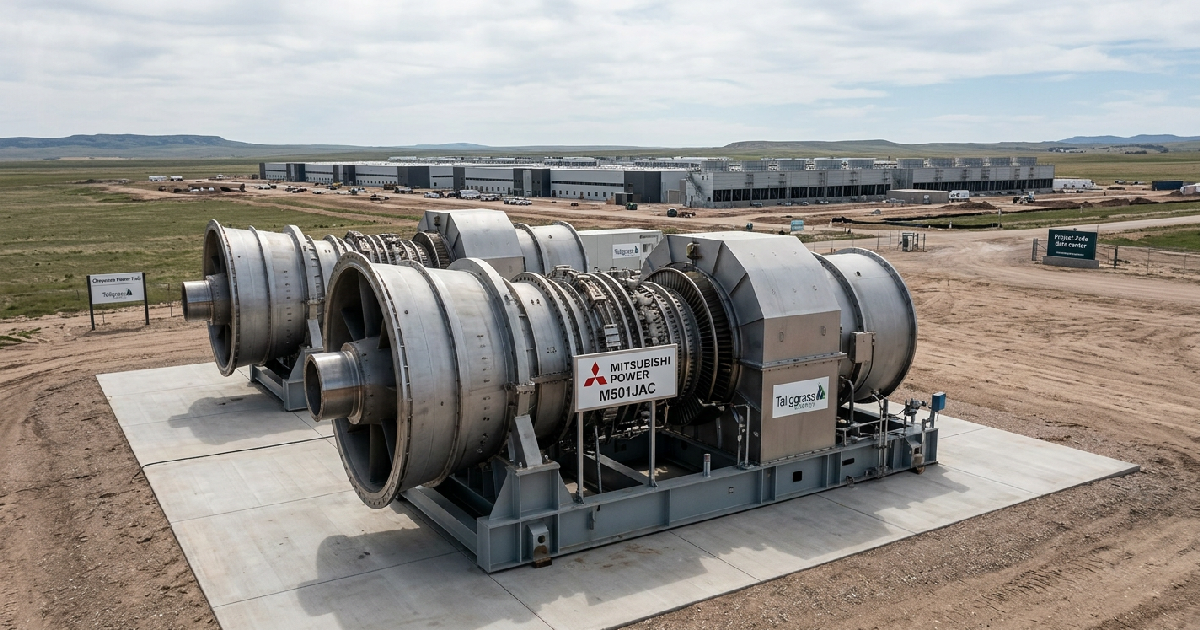
8 GW capacity that could scale to 10 GW. The delivery of two M501JAC gas turbines earlier this month marks a significant milestone for “Project Jade,” a site situated in the Switchgrass Industrial Park in Laramie County. Developed in partnership with Crusoe, a vertically integrated AI infrastructure provider, the project highlights how midstream companies are entering the power generation market to meet accelerating electricity demand.
The Cheyenne Power Hub will leverage Tallgrass Energy’s existing Rockies Express Pipeline to fuel two combined cycle power plants. By utilizing “behind-the-meter” generation, the project avoids adding immediate strain to the regional transmission system, though the design includes a grid interconnection to facilitate future renewable energy integration. County commissioners approved the site plan in January, setting the stage for a massive industrial build-out.
S. to compete in the global AI race.
This strategic move by a midstream firm reflects a broader shift where pipeline operators become utility-scale power producers. Much like the industrial connectivity expansion observed in other emerging markets, these projects demonstrate the importance of local infrastructure in supporting high-density workloads.
Engineering specifics of the Cheyenne Power Hub
The hub’s first phase features two large-frame M501JAC turbines expected to provide approximately 1,150 MW of capacity. According to planning documents, the generation component—formally designated as the BFC Power and Cheyenne Power Hub Project—will also include a fuel cell yard and a fleet of temporary and permanent aeroderivative turbines. These units will provide critical startup, backup, and base load supplemental generation to ensure the 24/7 reliability required by the adjacent 600-acre data center campus.
Engineers have integrated various layers of redundancy into the site. Beyond the gas-fired plants, the project is located near Tallgrass’s Trailblazer carbon capture and sequestration hub, offering a long-term pathway for decarbonization through CO2 storage. This is particularly relevant as hyperscale operators face increasing pressure to maintain infrastructure reliability while meeting net-zero commitments. Installation of the first turbine is scheduled to begin as early as July 2026.
Market dynamics and gas turbine procurement challenges
Tallgrass Energy’s ability to secure equipment comes amid a tightening global supply chain for heavy-duty power equipment. Mitsubishi Heavy Industries reported booking orders for 35 large-frame gas turbines in the fiscal year ending March 31, 2026, with 19 of those orders coming from the Americas. This surge has driven the company’s backlog to roughly $34 billion (five trillion yen), as developers compete for manufacturing slots.
The competition is equally fierce for GE Vernova, which signed 21 GW of new gas turbine agreements in the first quarter of 2026 alone. Chief Executive Scott Strazik noted that 2029 manufacturing slots are filling rapidly, forcing customers to accelerate procurement. While demand is high, pricing is also on the rise. According to consulting firm Wood Mackenzie, gas turbine prices are projected to reach $600 per kilowatt by the end of 2027—a figure nearly triple 2019 levels.
For many developers, the turbines are no longer the primary bottleneck. Strazik noted that lead times of approximately three years are often eclipsed by the time required for permitting, fuel availability, and EPC buildout. This has led to an industrial and engineering rally as firms capable of managing complex, integrated energy projects gain market favor.
Wyoming’s emergence as a regional power destination
Southeast Wyoming has become a focal point for massive energy investments due to several converging factors. Electricity demand across the Western grid is expected to grow by over 20 percent this decade, with data centers alone accounting for an estimated 90 GW of that demand. Wyoming Governor Mark Gordon has indicated that these projects are not only vital for technology infrastructure but also beneficial for the state’s natural gas producers.
Major tech players are already active in the region:
- Meta is partnering with Enbridge on the “Cowboy Project,” a $1.2 billion investment featuring 365 MW of solar and a 1,600 MWh Tesla battery energy storage system (BESS).
- Microsoft recently acquired 3,200 acres in Cheyenne for data center expansions, utilizing a “Large Power Contract Service” tariff that requires the company to pay directly for infrastructure upgrades.
- Tallgrass and Crusoe’s Project Jade represents one of the largest single-site infrastructure investments in the state’s history.
As these AI factories scale, the intersection of gas-fired stability and carbon-capture technology will likely define the next decade of industrial engineering. While the immediate focus remains on securing power capacity, the long-term viability of these hubs will depend on their ability to integrate into a cleaner, dual-fuel grid environment.
