


Japanese robotics software company Mujin, Inc. has secured US$251.5 million in Series D financing, with SK Square participating in the round. The investment reflects growing interest in software that enables industrial robots to operate with greater autonomy.
SK Square’s participation may support its wider interest in AI and semiconductor-related technologies. However, the investment alone does not establish that Mujin’s software will be deployed across SK Group’s semiconductor operations. Mujin’s software could support more coordinated automation across factories and warehouses, although the extent of any future deployment within SK Group remains unclear.
How MujinOS coordinates industrial robots
Mujin’s core product is MujinOS, a general-purpose control platform designed to coordinate industrial automation equipment. Factories and warehouses often use equipment from multiple manufacturers, with different control systems and software interfaces. Integrating a robotic arm with an automated guided vehicle (AGV) from another manufacturer can require additional interfaces and system integration.
MujinOS is designed to simplify the integration and control of industrial automation equipment. Mujin describes its platform as providing ‘real perception, autonomous motion planning, and dynamic orchestration.’ The platform is designed to coordinate equipment such as robotic arms, conveyors, and mobile robots through a shared control system.
This type of unified control is part of the broader move towards software-driven industrial automation.
Instead of requiring task-specific programming for every operation, MujinOS is designed to allow robots to perceive their environment and adjust their movements in real time.
Mujin’s approach is intended to allow robots to identify previously unseen objects, plan movements, and respond to changes in their environment with limited human intervention.
This approach differs from conventional automation systems that rely more heavily on predefined instructions and may require reprogramming when operating conditions change.
SK Square’s semiconductor and AI investment strategy
SK Square participated through its overseas investment company, TGC Square, as part of its investment strategy across the AI and semiconductor value chain. SK Square has said it is focusing its investment activities on the AI and semiconductor value chain.
An SK Square official said, ‘We plan to continue identifying new investment opportunities across the AI and semiconductor value chain,’ adding that the company will ‘pursue new investments according to a strategy of selection and focus.’
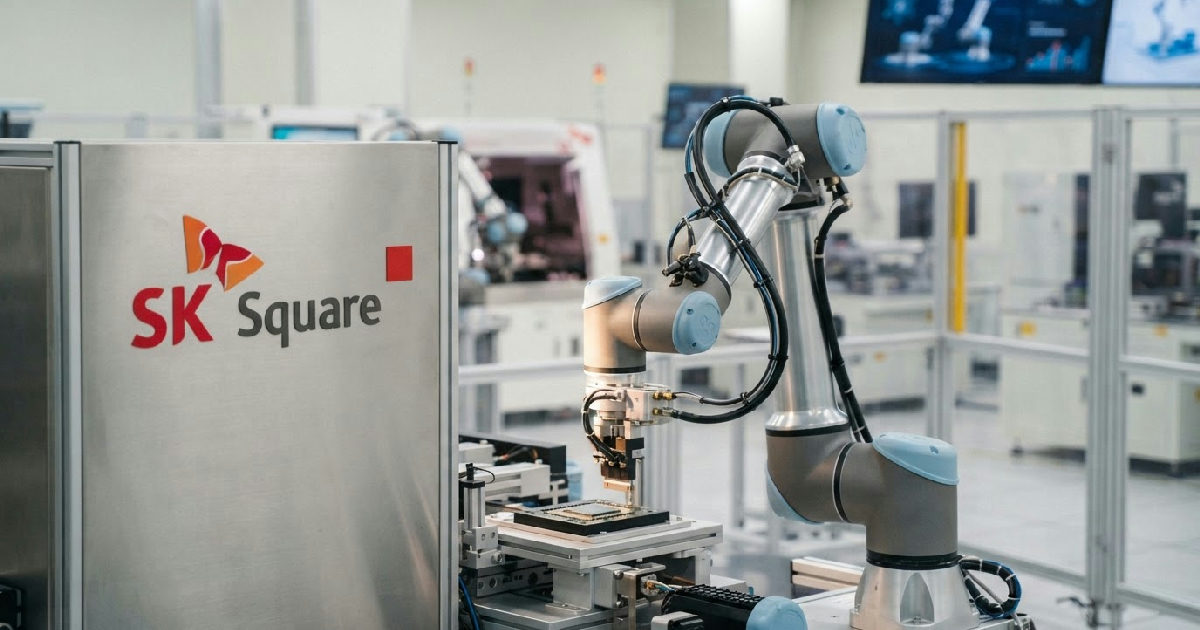
Potential applications within the SK Group include semiconductor manufacturing and logistics. Semiconductor packaging involves the precise handling of components and could provide an application for Mujin’s automation technology. Automation could also be applied to material handling and logistics within semiconductor fabrication plants.
Such facilities use sensors and automated equipment to monitor and move materials, while MujinOS is designed to coordinate equipment based on available data.
SK Square’s broader interest is in applying AI and automation across industrial operations. SK Square’s investment gives it exposure to Mujin’s approach to coordinating robots and other automated equipment across industrial workflows. This follows SK Square’s previous investments in AI-related technologies.
SK Square also invested in US AI chip company d-Matrix in 2023. The company has since reported a valuation of more than $2 billion
Deconstructing the $251.5 million funding round
SK Square participated in Mujin’s Series D financing, which totals US$251.5 million. The amount SK Square invested was not disclosed. This follows an initial US$233 million close announced in December 2025, comprising US$133 million in equity and US$100 million in debt financing.
The earlier financing valued Mujin at more than US$1 billion, according to the company/investor announcement.
The financing included investors from Japan, Qatar and the United States. The initial equity financing was led by NTT Group and co-led by the Qatar Investment Authority (QIA).
Other investors included Mitsubishi HC Capital Realty Co., Ltd. and Salesforce Ventures, while the debt financing came from a consortium of Japanese financial institutions.
The company said the latest financing brings its total capital raised to more than US$503 million since its 2011 founding. This substantial war chest provides the company, which employed 345 people as of March 2026, with the resources needed to scale its operations globally and deepen its technological lead in the industrial robotics software market. Mujin said the funding will support further expansion and development of MujinOS.
A wider industry shift to physical AI
Mujin’s funding round reflects growing investor interest in physical AI and industrial robotics.
While recent AI investment has focused heavily on large language models and supporting computing infrastructure, investors are also backing companies developing AI systems for physical environments. Physical AI generally refers to AI systems that perceive and act in physical environments, including through robots and autonomous machines.
The growing interest reflects expectations that AI can generate value beyond digital services by supporting physical operations in sectors such as manufacturing, logistics and transportation. Physical AI could change how goods are manufactured, stored and transported.
Investment in other forms of physical automation, including autonomous vehicles and automated fulfilment systems, is also growing.
For industrial operators and supply-chain professionals, companies such as Mujin illustrate the growing role of software in coordinating industrial automation.
The longer-term potential is for software to make automated production systems easier to reconfigure, while robots handle some repetitive or physically demanding tasks alongside human workers.
As robotics systems become more software-driven, the control and orchestration layer could become an increasingly important part of their value.
