


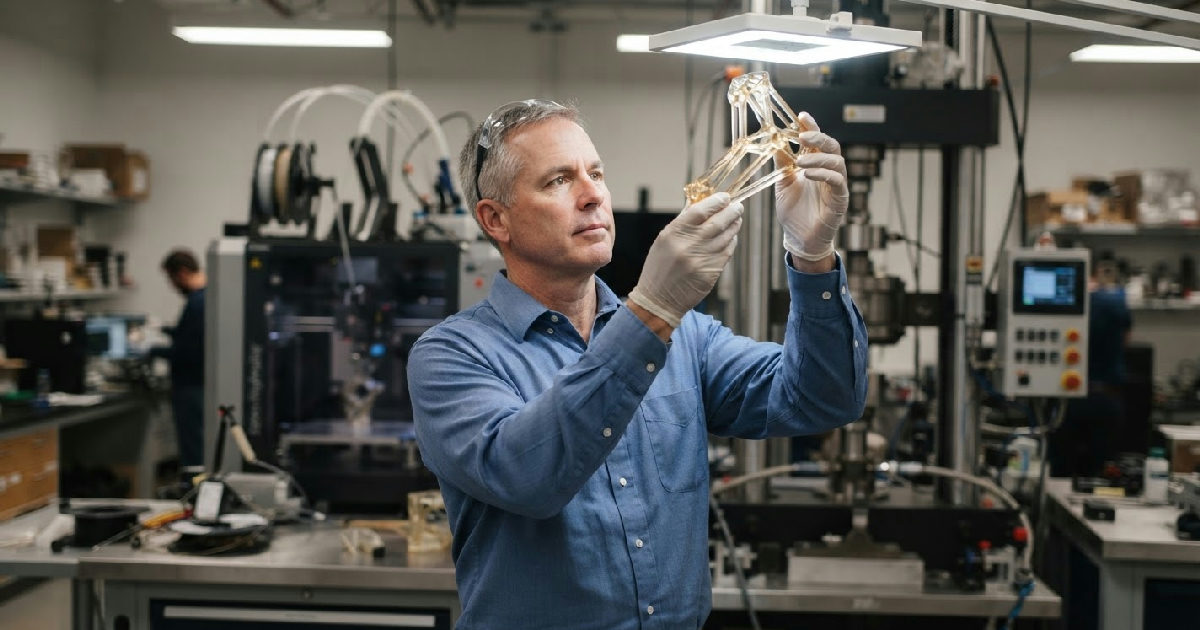
Manufacturers have wrung incredible gains from new processes and equipment for decades, but Z-Polymers’ Tullomer aims to unlock the next wave of industrial efficiency by targeting material limitations.
Z-Polymers was built to tackle that problem head-on. Z-Polymers, founded in 2021, has developed Tullomer, a ‘super-polymer’ that is several times stronger than steel by weight and boasts extreme thermal and chemical resistance. It represents a new class of liquid crystal polymers (LCPs) designed to solve intractable problems in aerospace, energy, and transportation.
How Z-Polymers’ Tullomer aims to redefine materials science
According to Zimmerman, a former Tufts University professor with experience at Bell Labs, genuine product breakthroughs are almost always driven by materials science. He notes that many high-performance polymers used in additive manufacturing today, such as nylon, are based on chemistry that is 20 or 30 years old. This creates a ceiling on performance.
“Manufacturing can’t advance using just old materials. We’ve got to develop better materials that can help spur new manufacturing processes,” Zimmerman said in a recent interview with Manufacturing Dive. “The next step comes when entirely new materials enable capabilities that today’s materials simply can’t.”
This belief is what spurred the creation of Z-Polymers and its flagship product. The company, incubated at the UMass Lowell Innovation Hub, is commercialising a material that pushes performance boundaries far beyond incumbent polymers like PEEK and Ultem. With the right partnerships, Tullomer could unlock new designs and applications previously considered impossible.
What makes Tullomer different?
Tullomer is not an incremental improvement. It is a new molecular architecture, resulting in a PFAS-free liquid crystal super-polymer with a unique combination of properties. By weight, its fibres are several times stronger than steel, and its mechanical strength is reported to be more than four times that of PEEK, a leading high-performance thermoplastic.
The material’s thermal performance is equally impressive, with the ability to carry loads at temperatures of up to 400°C. This opens up applications in high-temperature environments where other polymers would fail. Unlike carbon fibre composites, which are stiff and strong but reflect radar, Tullomer offers comparable strength while being radar-transparent, a critical feature for aerospace and defence applications such as drones and radomes.
“With drones, for example, people use a lot of carbon fiber to make parts very stiff and strong,” Zimmerman explained. “Our material can be very stiff and strong as well, but it’s also radar transparent.” The material is also highly fire-resistant, making it attractive to customers like NASA and producers of specialist sports equipment.
From lab bench to factory floor
One of the biggest hurdles for any new material is the journey from a successful lab sample to a commercially viable, scalable product. This “valley of death” is where many promising inventions falter. Zimmerman points to high development costs, difficult processing, and a lack of pilot facilities as major barriers.
VVenture capital investors have also been hesitant. “There also hasn’t been a lot of venture funding because materials can take a longer time to develop than software and hardware,” he notes. “Many investors actually expect software timelines from materials companies, which isn’t necessarily realistic.”
Z-Polymers is tackling this challenge by integrating production realities from day one. Instead of using lab-scale prototype equipment, the company develops its materials on the same end-manufacturing equipment that customers will use. This strategy eliminates a difficult and often unpredictable transition step, ensuring that the properties achieved during development are repeatable at production scale.
Building a commercial ecosystem
A novel material is only useful if it can be accessed and adopted by industry. Z-Polymers has made significant strides in building this commercial pathway since its founding. In March 2026, the company announced a strategic investment and joint development agreement with Kureha Corporation, a major Japanese specialty chemicals and plastics manufacturer.
The investment from Tokyo-based Kureha, which formed part of Z-Polymers’ Series Seed financing, serves as a powerful market validation. “We believe Z-Polymers’ technology platform represents an exciting advancement in high-performance polymer materials,” said Naomitsu Nishihata, senior vice president of Kureha Corporation, at the time of the announcement. This partnership aims to expand advanced material solutions for global markets.
The material is already in the hands of users. The first Tullomer additive manufacturing filament was commercially introduced in 2024 and is now available in North America through resellers Dynamism and MatterHackers. Dynamism lists a 1 kg spool of the filament for $500, positioning it as a premium option for demanding applications.
The company has also partnered with Advanced Functional Fabrics of America, Inc. (AFFOA) to accelerate prototyping, particularly for textile applications where Tullomer’s strength and cut resistance are highly valued.
Confronting the skills gap and the role of AI
The development of advanced materials like Tullomer in the United States runs counter to a decades-long trend of offshoring. Zimmerman points to the hollowing out of America’s domestic materials expertise as a significant challenge. When manufacturing moves offshore, he argues, the entire ecosystem of innovation, from R&D to process engineering, often goes with it.
The use of real-time AI temperature-offset is one way modern manufacturing is trying to reclaim a technical edge.
“DuPont invented Kevlar, but now most of that product is made overseas, and most of the innovations around it are there, too,” Zimmerman says. He saw a similar pattern with semiconductor packaging during his time at Bell Labs. In response, all four companies he has founded have focused on keeping innovation, materials development, and manufacturing within the U.S.
Looking ahead, artificial intelligence could help accelerate the discovery process. Zimmerman believes AI will become a powerful tool for designing new molecules and optimising polymer formulations by learning from vast material databases. While he says the technology is “not fully there yet,” he has started using AI in his own work.
This mirrors a broader trend in which even large firms are investing in new domestic production sites, such as when Siemens’ addition of two US manufacturing facilities for data centres that power AI development.
What this means for manufacturing
The story of Z-Polymers is a showcase for a broader truth: the physical world is still bound by the limits of its constituent materials. While automation, software, and new processes can optimise production, they can only work with the materials available. Creating entirely new classes of polymers, as Z-Polymers has done with Tullomer, opens a new frontier for product engineers.
The ability to 3D print parts that are not only lighter and stronger than metal but also possess unique properties like radar transparency and extreme heat resistance can fundamentally change design approaches.
It allows engineers to move beyond simply replacing a metal part with a plastic one and instead design components that were never possible before. This is particularly true as AI-driven hiring fraud makes securing top engineering talent even more complex.
For Z-Polymers, the next challenge is focus. The properties of Tullomer are so diverse that it has potential applications across numerous high-value industries. “The nature of our material is that we formulated it to have better mechanical properties than PEEK while offering equivalent or better properties in other areas,” Zimmerman stated.
The biggest task now, he says, is “trying to focus on the best application for it.” How the market adopts this new capability will be a story to watch.
