


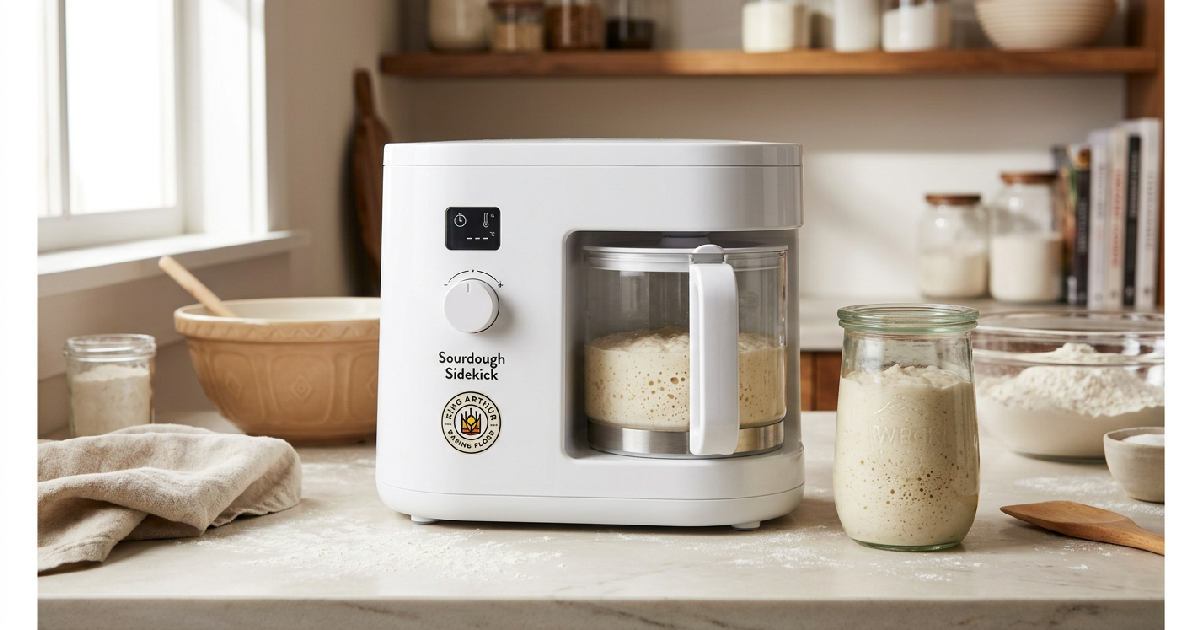
The Sourdough Sidekick, a novel automated appliance from King Arthur Baking Company and FirstBuild, is now simplifying the often-demanding process of maintaining a healthy sourdough starter. Launched commercially on 1 May 2026, this device specifically targets the time-consuming chore of feeding and mixing starter cultures. Its introduction marks a notable application of technology to a traditionally analogue craft.
The appliance, priced at $179.99 USD, emerged from a crowdfunding campaign on Indiegogo in March 2025, where it met its funding goal in just 12 minutes. Now widely available, it promises to make sourdough baking more accessible by handling the core maintenance, delivering a peak-activity starter precisely when a baker is ready.
King Arthur Baking: Precision Automation for Sourdough Starters
This integration of automation aims to remove a significant barrier for many home bakers, reflecting a broader trend of technological solutions enhancing traditional practices.
At its heart, the Sourdough Sidekick automation system uses a sophisticated mechanism involving a flour hopper and a removable water tank. These components dispense precise amounts of ingredients into a dedicated starter crock, ensuring the correct ratios of flour and water are always maintained. This level of precise measurement eliminates much of the guesswork inherent in manual sourdough maintenance.
Once dispensed, the system automatically stirs the mixture. This continuous agitation ensures consistent feeding and optimal hydration for the culture, critical for developing a robust and active starter. Such controlled mixing, executed on a dynamic schedule, is paramount to fostering the wild yeast and bacteria responsible for sourdough’s unique characteristics.
Crucially, the appliance intelligently adapts to its environment by taking ambient temperature into account. It dynamically adjusts its feeding schedule as needed, optimising starter activity regardless of kitchen conditions.
Key details
Users initiate the process with a small quantity, just 15 grams, of existing starter, which the Sidekick can then cultivate to a maximum of 525 grams, ensuring enough active starter is ready for typical baking recipes.
This automated process can significantly reduce the daily commitment typically required for traditional starter care, promising no discard for up to a week in its Auto mode.
Working with a simple white bread flour, The Verge review noted that the Sidekick produced an exceptionally active starter, sometimes leading to overproofed bread. This suggests the automated process can cultivate a more potent culture than manual feeding.
Such consistent and powerful leavening could significantly improve bake quality for home users, demonstrating the direct impact of precise process control on output. Monica Petrucci, for instance, reviewed the device for Forbes, contributing to its early market assessment.
Navigating User Modes and Practicalities
The Sidekick offers various operational modes, each designed to cater to different baking needs and levels of user control. Its primary “Auto” mode is built for convenience, requiring users only to input their desired bake day, time, and target starter weight. This mode handles the complex feeding schedule and temperature adjustments, aiming for a truly “set it and forget it” experience for regular bakers.
However, the Auto mode operates within specific parameters that may not suit every baker’s routine. It mandates a 15-gram starter input for initiation and can enforce a minimum production of 400 grams for bakes scheduled four days or more in advance.
This can lead to greater discard than a baker might produce manually, a common point of frustration for those aiming for minimal waste. Furthermore, the Auto mode requires a specific bake day within a one-week timeframe, lacking an indefinite maintenance setting for periods when baking frequency is uncertain.
For greater flexibility, the device offers “Ratio” and “Custom” modes. Ratio mode allows selection from a few preset ingredient proportions and adjustable feeding frequencies, offering some customisation.
Yet, it does not permit unequal amounts of flour and water, which can be a limitation when working with flours of varying densities, such as the coarse rye flour from British miller Landrace, as highlighted in The Verge’s review.
For such specific requirements, a starter often needs a looser or thicker consistency, which Ratio mode cannot achieve.
Key details
The “Custom” mode delivers the most granular control, allowing users to precisely set the seed amount, feeding frequency, and exact quantities of flour and water for each feed.
This flexibility enables bakers to create specific starter consistencies, necessary for challenging flours, and even to establish customised micro-feeding schedules for long-term maintenance or to rehabilitate a struggling starter. This mode even facilitates making a starter from scratch within four days.
Unlike Auto mode, neither Ratio nor Custom modes factor in ambient temperature, placing the onus on the user to monitor starter activity manually.
Beyond its core function, the Sidekick’s practical design includes a few notable considerations for daily use. While the water tank and flour hopper are designed for convenience and are dishwasher-safe, the glass crock, lid, and paddle require handwashing after each feeding cycle to prevent unwelcome buildup.
This design choice implies a trade-off between material selection and ease of cleaning. Furthermore, the unit generates a distinct, loud whirring sound for approximately 30 seconds every two hours during its stirring cycles.
While perhaps acceptable in a spacious kitchen, this noise could be a significant factor in smaller living environments, underscoring the importance of acoustic design in kitchen appliance development.
A Collaborative Approach to Appliance Innovation
The Sourdough Sidekick is a product of a focused collaboration between King Arthur Baking Company, a venerable flour producer with roots dating back to 1790, and FirstBuild. FirstBuild, based in Louisville, Kentucky, serves as GE Appliances’ global co-creation community and a physical microfactory. This partnership effectively combined King Arthur’s extensive baking expertise and established brand with FirstBuild’s agile product development capabilities.
André Zdanow, President of FirstBuild, clearly articulated the importance of involving end-users in the product development lifecycle. “At FirstBuild, we’ve always believed that the best products come from building alongside the people who will actually use them, and the Sourdough Sidekick is proof of that,” Zdanow stated.
He added, “Our baking community helped shape this from the ground up, and partnering with King Arthur Baking Company gave us the confidence to get every detail right. We couldn’t be more excited to see Sourdough Sidekick in kitchens across the country.”
This philosophy underpins FirstBuild’s model, launched in 2014, which aims to accelerate product innovation by bridging online co-creation with rapid prototyping and micro-manufacturing, often bringing products from concept to market or crowdfunding in an average of six months.
This model has demonstrated its effectiveness repeatedly. Over its first decade, FirstBuild has developed more than 100 products and features, with 37 of these successfully graduating to GE Appliances’ house of brands. The initiative has cultivated a community of over 245,000 co-creators and raised over $5.2 million through crowdfunding.
Key details
A notable precedent is the Opal nugget ice maker, also developed by FirstBuild, which launched via Indiegogo in 2015 and quickly surpassed its initial funding goal of $150,000, ultimately raising over $1.25 million within days.
The Sourdough Sidekick’s own crowdfunding campaign mirrored this success, achieving its Indiegogo funding goal within just 12 minutes of its launch in March 2025, with an initial pledge price starting at $129. Shipping to Indiegogo backers began in January 2026, leading to nationwide availability by May 2026.
From an industrial standpoint, the Sidekick’s manufacturing is confirmed to be in China, as per King Arthur Baking Company’s product information, while its design originates from the United States. This globalised production strategy, characteristic of modern appliance manufacturing, allows for cost-effective scaling and access to specialised supply chains.
The collaboration itself underscores a broader trend in manufacturing: leveraging diverse expertise, fostering open innovation, and integrating direct community feedback to create highly targeted and market-responsive products.
This approach, leveraging agile manufacturing and direct user engagement, is becoming increasingly relevant across various industrial sectors, particularly as the cobot market continues its growth, pointing to a future of collaborative automation.
Driving Growth in the Home Baking Market
The introduction of the Sourdough Sidekick arrives amidst a sustained and significant surge in home baking, particularly for sourdough products. King Arthur Baking Company, a major influencer and supplier in this sector, has reported a substantial 40% year-over-year increase in sales of its Fresh Sourdough Starter.
Further testament to this booming interest, their “Sourdough for Beginners” class stands as their best-selling on-demand offering, clearly signalling a robust demand for education and simplification in the craft.
Recent data from King Arthur’s 2024 Bread Baking Survey provides a comprehensive picture of this market, indicating that 60% of bread bakers now actively maintain a sourdough starter. The company’s digital content related to sourdough has accumulated an impressive 18.4 million views over the past year.
Crucially, their sourdough starter recipe alone garnered 1.3 million views, solidifying its position as their most popular recipe of the year. These figures collectively highlight a robust, expanding, and highly engaged market for sourdough-related products and technological solutions.
The Sidekick directly addresses a critical and long-standing pain point for this growing community: the considerable daily commitment required to keep a starter alive, healthy, and ready for baking.
Key details
By automating this laborious and often intimidating step, it aims to reduce the common problem of discard and significantly lower the barrier to entry for more casual bakers.
This makes the craft considerably more approachable, allowing more individuals to partake in artisan bread making without the historical time commitment, thus preserving the artisanal quality that attracts many to sourdough in the first place.
This is a key lesson for the broader industrial sector, where manufacturers pivot to Manufacturing Execution Systems to boost plant agility. Such systems exemplify how technology can streamline complex processes, much like the Sidekick.
This focus on simplifying complex manual processes holds significant implications beyond the realm of home baking. Industries ranging from chemical processing and biotechnology to precision agriculture frequently grapple with the precise maintenance of biological cultures or critical environmental parameters.
Technologies that can automate these intricate elements, while preserving core functionality and allowing for customisation, offer substantial productivity gains and broaden access to traditionally skilled processes.
The Sidekick serves as a compelling example of how targeted automation can enhance skilled human work, rather than simply replacing it, by taking over the most repetitive or challenging aspects.
Design and Connectivity Specifications
The Sourdough Sidekick is thoughtfully engineered for seamless integration into modern kitchens, both aesthetically and functionally. Its physical dimensions are listed at 8.72” D x 5.65” W x 13.25” H, though King Arthur Baking Company also provides an alternative measurement of 17 ½″ L x 8″ W x 12″ H.
Weighing 6 lbs, the appliance is designed to be manageable yet stable on a countertop. It operates on a low-voltage 12-volt system with a wattage of 36 watts, indicating energy efficiency for a continuous-operation device. The inclusion of a generous 70.9-inch power cord offers flexibility in placement.
Beyond its core mechanical functions, the appliance incorporates contemporary smart features. It offers compatibility with the GE SmartHQ app, enabling wireless connectivity for crucial functions such as software updates, status tracking, and the delivery of timely notifications. This connectivity keeps users informed about their starter’s readiness and any impending maintenance needs, without requiring constant physical checks.
Key details
While the app provides convenience for monitoring, its control functionality is noted to be limited, with many settings still requiring direct interaction with the device’s physical buttons and dial. This design choice highlights a pragmatic balance between digital oversight and tactile user experience in specialised kitchen technology.
As The Verge review pointed out, the Wi-Fi option and app, though present, are “easy to ignore” for many users, as the built-in screen capably provides much of the same essential information. This raises pertinent questions about the optimal degree of “smart” integration for single-purpose appliances and where the most value lies for the end-user.
The development journey of such niche appliances, from concept to mass production in China, often involves advanced manufacturing techniques. For instance, new approaches in additive manufacturing, such as the Peopoly Giga 800 pellet 3D printer, are also reshaping how products are made, focusing on efficiency and material cost reduction.
