


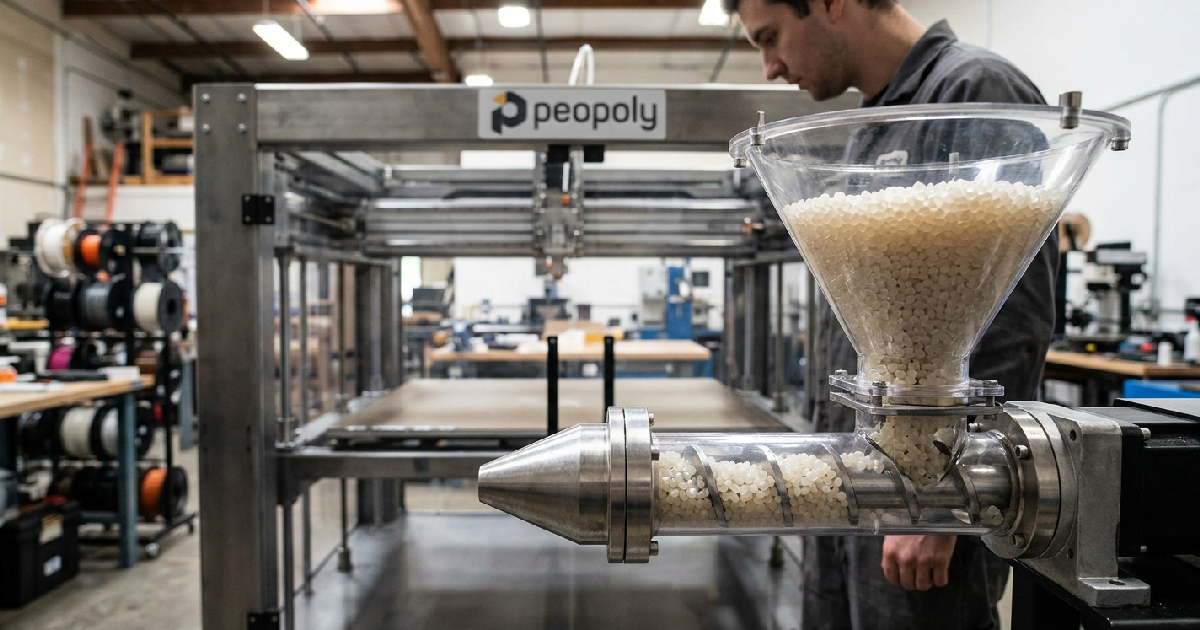
Peopoly has launched the Giga 800, a large-format 3D printer that uses raw polymer pellets instead of traditional spooled filament to reduce material costs by up to 90%. The Hong Kong-based manufacturer designed the system to bridge the gap between accessible desktop units and the six-figure industrial machines typically required for Fused Granular Fabrication (FGF). The system features an expansive 800 x 800 x 800 mm build volume and is currently available through an early adopter program for commercial partners and print farms at a starting price of $15,000 USD (EXW).
The move represents a tactical shift for Peopoly into the industrial space where operating costs dictate the feasibility of large-scale engineering projects. By switching to pellets, the Giga 800 allows users to source raw plastic granules—the same feedstocks used in traditional injection moulding—eliminating the price markup associated with filament extrusion. This development provides a tool for engineers across global tech sectors to build structural components without the overhead of specialized proprietary materials.
Industry practitioners recognise that large-format printing often faces hurdles in reliability. Peopoly addresses this through a CoreXY motion system powered by closed-loop servo motors, which actively monitor position to prevent skipped steps or layer shifts during long production cycles. This level of precision is becoming a prerequisite as industrial and engineering sectors rally around more efficient manufacturing processes that prize uptime and repeatable results.
Industrial pellet extrusion and thermal management
At the heart of the Giga 800 is a custom-engineered, dual-zone heating screw extruder capable of processing up to 3 kg of polymer per hour. The system supports a wide range of nozzle sizes, from 0.4 mm for finer detail up to 3.0 mm for rapid bulk printing. To manage the inherent “oozing” associated with pellet extruders, the machine employs an active mechanical retraction system combined with Klipper Pressure Advance, ensuring cleaner transitions on large structural parts.
The thermal capabilities are tailored for engineering-grade materials. The nozzle reaches temperatures up to 400°C, while the heated bed supports up to 120°C. While the chamber is not actively heated, Peopoly insulated the enclosure to passively retain heat from the bed and nozzle, reaching internal temperatures of approximately 60°C. This environment helps stabilise common industrial materials and reduces warp in large prints.
The system is compatible with a diverse material library, including:
- Standard Polymers: PLA, PETG, and PCTG for architectural models and outdoor art.
- Structural Composites: ABS-CF, ABS-GF, and ASA-GF for tooling and composite moulds.
- High-Temperature Plastics: PPA-CF, PA-CF, and PET-GF for rigid, heat-resistant industrial components.
Security and software for sensitive engineering environments
Peopoly opted for an open-source approach to the software stack, utilising Klipper firmware and Orca Slicer. This allows engineering teams to fine-tune motion parameters and material flow without being locked into a proprietary ecosystem. Furthermore, the Giga 800 is designed for “air-gap” operation. This means it can function entirely without an internet connection, a critical requirement for defense, aerospace, and advanced R&D facilities where data security remains a priority.
Material handling has been simplified to allow for easier integration into busy shop floors. Unlike many FGF systems that require external pneumatic feeding lines, the Giga 800 features a self-contained, moisture-sealed metal hopper integrated directly into the machine. This design minimises the footprint of the unit, which measures 1200 x 1140 x 1560 mm, making it easier to deploy in facilities with limited space.
Commercial availability and industrial outlook
The Giga 800 weighs 320 kg and requires a 5000W 220V power supply to maintain its high flow rates and thermal zones. Its arrival provides a middle ground for manufacturers who need the scale of FGF but cannot justify the high capital expenditure of traditional large-scale robotic 3D printing arms. Peopoly’s partnership with material specialist Siraya Tech also means the machine ships with pre-configured material profiles, reducing the calibration time usually associated with switching feedstocks.
For the broader manufacturing landscape, the Giga 800 lowers the barrier to entry for producing structural tooling, jigs, and fixtures on-site. As companies look to de-risk their supply chains, the ability to print moulds or replacement parts for larger machines using the same pellets used in production lines becomes a strategic advantage. Peopoly’s early adopter program is now open, with the first units expected to enter service with print farms and commercial partners in the coming weeks.
