


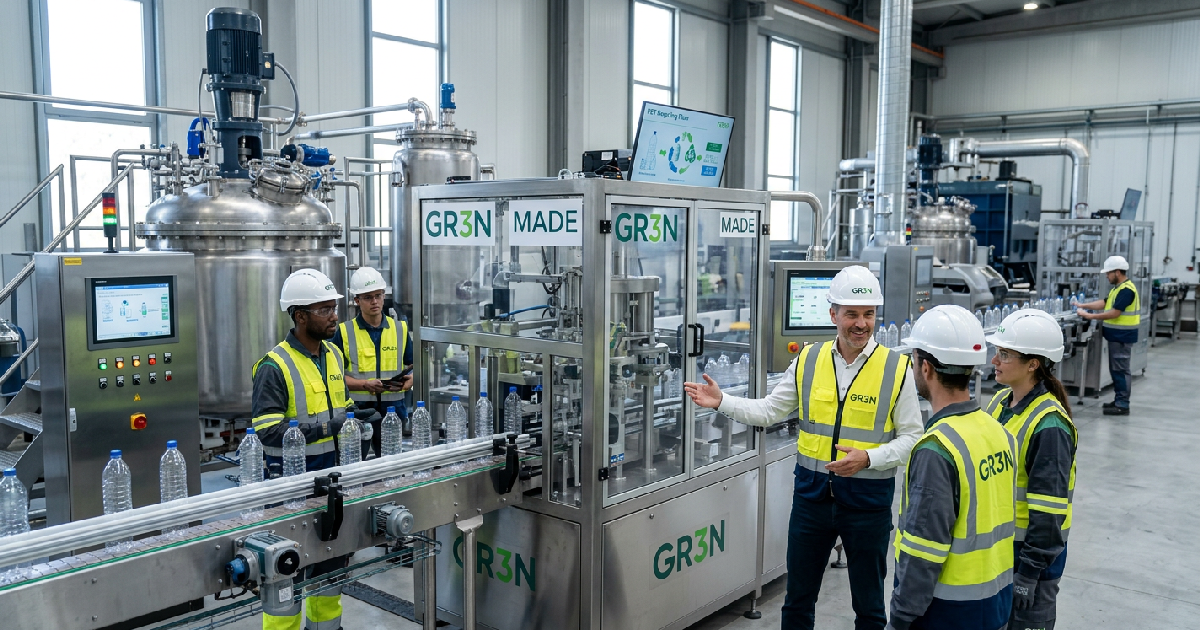
Swiss cleantech innovator GR3N has secured €15.5 million in Series B financing to scale its Microwave-Assisted Depolymerisation (MADE) technology, a system designed to recycle 100% of PET and polyester waste.
The funding round, led by Franco-Italian venture capital firm 360 Capital and Dutch workwear specialist VP Textile, officially positions the Lugano-based company to break ground on its first commercial-scale plant, MODUS, in Spain.
In conjunction with the capital raise, the company appointed Martin Stephan as Chief Executive Officer to lead the transition from pilot operations to industrial production.
The PET market currently processes approximately 100 million tonnes of material annually, yet global recycling rates remain hampered by the limitations of mechanical systems. Standard mechanical recycling is restricted largely to clear or light blue bottles, which represent only about 15% of the total PET feed stream.
The remaining 85%—comprised of dark resins, food trays, multilayer films, and synthetic textiles—is typically diverted to landfills or incinerators because it cannot be processed without significant loss in material quality.
GR3N’s MADE system addresses this engineering bottleneck by using microwave energy to trigger a chemical reaction that breaks the polymer down into its core monomers, terephthalic acid (TPA) and monoethylene glycol (MEG).
Unlike traditional mechanical methods, this process is indifferent to feedstock contamination or colour, allowing for the infinite recycling of blended fabrics and dirty packaging. This shift toward chemical recycling is essential as industrial and engineering stocks rally around sustainable infrastructure projects that can meet looming regulatory deadlines.
Engineering the MODUS commercial production facility
The primary objective for the newly raised €15.5 million is the development of the MODUS production plant in Spain. Spanish engineering firm Intecsa Industrial, a subsidiary of the Cobra IS group, has signed an EPC contract to execute the facility’s construction.
Once operational, the plant is designed to process between 40,000 and 50,000 tonnes of PET and textile waste each year, producing virgin-quality monomers that meet food-grade safety standards.
The project has already secured a €35 million grant from the European Union Innovation Fund, highlighting the strategic importance of at-scale chemical depolymerisation for the continent’s circular economy. GR3N expects to reach a formal financial close for the construction phase by the fourth quarter of 2027.
If the current timeline holds, commercial operations will begin by the second quarter of 2030, providing a significant boost to Europe’s chemical processing capacity.
By producing monomers that are chemically identical to those derived from crude oil, the MADE process eliminates the performance trade-offs usually associated with recycled plastics. Early validation data indicates that this method can reduce CO₂ emissions by as much as 80% compared to virgin PET production.
This environmental footprint makes the technology a central pillar for manufacturers facing stricter carbon reporting requirements and material circularity mandates.
Adapting to global regulatory shifts in packaging
The drive to commercialise MADE technology coincides with the European Union’s Packaging and Packaging Waste Regulation (PPWR), which sets mandatory recycled content targets for plastic packaging. Under these rules, producers must achieve 20-30% recycled PET integration by 2030, a figure that jumps to 65% by 2040.
Meeting these targets is impossible through mechanical recycling alone, creating an immediate demand for the high-purity outputs generated by chemical depolymerisation.
For industrial operators, the focus is increasingly on industrial connectivity and technology that can integrate these new materials into existing supply chains. GR3N’s output can be fed directly into existing repolymerisation lines without modifying current machinery, easing the transition for packaging fabricators and textile mills.
This compatibility is a key reason for the strategic investment from VP Textile, whose interest lies in closing the loop for polyester-heavy workwear.
Future outlook for chemical recycling infrastructure
The appointment of Martin Stephan as CEO marks a strategic shift for GR3N as it moves away from its origins as a research-heavy innovator toward being an industrial operator.
“With this round, and the support of our financial and industrial partners, we accelerate the construction of the first-of-a-kind plant operating our technology,” Martin Stephan stated following the announcement. His leadership will be critical as the firm manages the complex EPC phase with Intecsa Industrial.
Textile waste remains a particularly difficult hurdle for the sustainability transition, as less than 1% of clothing is currently recycled back into new garments. The ability of the MADE system to handle synthetic blended textiles means the fashion industry finally has a technical pathway to manage its 90 million tonnes of annual waste.
As the Spanish facility moves toward financial close, the engineering community will be watching to see if microwave depolymerisation can truly serve as the blueprint for global plastic recovery.
While the focus is currently European, the implications for emerging markets are significant. Countries with large textile manufacturing sectors could adopt similar microwave-assisted chemical recycling to mitigate the environmental impact of industrial waste. As technical plans for infrastructure continue to evolve globally, the integration of chemical recycling plants near major manufacturing hubs will likely become a standard feature of 21st-century industrial zones.
