


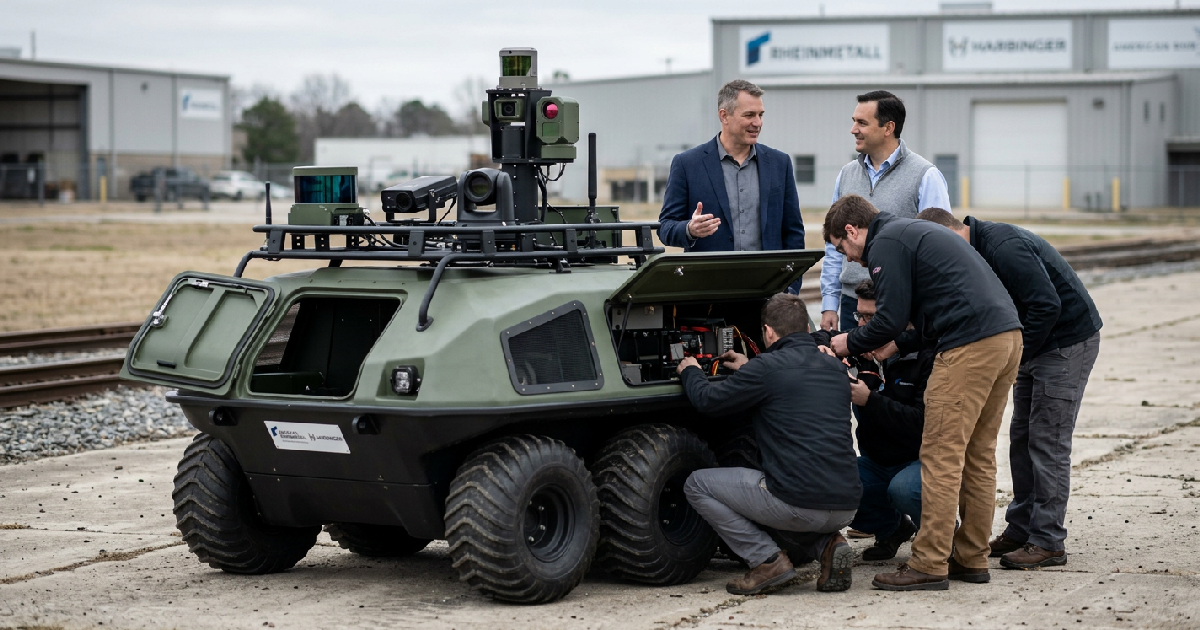
American Rheinmetall and electric vehicle startup Harbinger announced a strategic partnership on May 27, 2026, to design and manufacture a new generation of hybrid-electric uncrewed ground vehicles (UGVs) for the U.S. Department of Defense.
Leading the collaboration are American Rheinmetall CEO Matthew Warnick and Harbinger CEO John Harris, who intend to combine heavy combat vehicle integration with commercial EV technology to produce “attritable” robotic platforms. The joint venture targets immediate Department of War programs, with technical demonstrations scheduled to begin as early as the summer of 2026.
The deal represents a significant shift in defense procurement, moving away from bespoke, artisanally crafted military hardware toward high-volume commercial manufacturing. By utilising Harbinger’s medium-duty EV chassis, known for its drive-by-wire capabilities and scalable battery architecture, the partners aim to lower the cost barrier for robotic fleets.
This approach allows the military to field uncrewed systems in large numbers—mass that is considered “attritable,” meaning the loss of a single unit in combat is financially and operationally sustainable.
American Rheinmetall is backing this domestic production push with a $41 million investment across six of its U.S. manufacturing facilities to fortify its supply chain and expand capacity. This industrial scaling follows a trend of industrial and engineering stocks rally as companies pivot toward automated and uncrewed technologies.
Of the total investment, $3 million is earmarked for immediate implementation during the latter half of 2026 at sites across Michigan, Ohio, and Maine.
American Rheinmetall combines combat expertise with Harbinger EV tech
The technical core of the partnership merges American Rheinmetall’s mature modular architectures with Harbinger’s commercially derived powertrain. Harbinger, based in Garden Grove, California, assembles its battery systems and chassis in-house, offering a platform that is natively “autonomy-ready.” This means the hardware is designed from the outset to receive digital commands without the mechanical linkages found in traditional internal combustion engines.
The hybrid-electric design provides a specific tactical advantage: silent watch and reduced thermal signatures. Because these uncrewed ground vehicles can operate on battery power while stationary or moving at low speeds, they are harder for enemy sensors to detect. A gas-powered range extender ensures long-endurance missions, addressing the common military concern regarding the limited range of purely electric tactical vehicles in remote areas.
This integration is not just about the vehicle itself but the mission kits it carries. American Rheinmetall will provide the adaptable interfaces and mission systems required for the Army’s “manned-unmanned teaming” priorities. These systems allow soldiers to control robots from a safe distance or let the robots operate semi-autonomously during high-risk resupply runs and tactical reconnaissance.
Driving affordability through commercial scale and domestic supply chains
CEO Matthew Warnick emphasized that soldiers require robotics they can trust at a price point that enables mass deployment. The use of commercial sourcing for parts is an intentional strategy to bypass the slow, expensive traditional defense supply chain. This reflects a broader movement where the com/african-iot-sector-growth-industrial-engineering-rally/”>African IoT sector expands through industrial connectivity, showing how commercial tech and connectivity are reshaping heavy industry global standards.
- Design Philosophy: Built in the U.S. to ensure sovereign control over software and hardware.
- Target Platforms: Autonomous tactical wheeled vehicles and contested-logistics resupply units.
- Manufacturing Reach: Production spans Michigan, Ohio, and Maine, with Harbinger’s California HQ handling powertrain assembly.
John Harris, CEO of Harbinger, noted that the company’s chassis was built for the toughest commercial missions, which serves as a natural precursor to the demands of the modern battlefield. By providing an “engineered here, built here” solution, the partnership avoids the security risks associated with foreign-sourced electronics, often a point of contention in uncrewed system development.
Future prototyping and the push for rapid military field testing
The partnership will not wait for long-term traditional programs of record to begin building. Instead, the companies plan to pursue near-term prototyping through Other Transaction Authorities (OTAs) and Commercial Solutions Openings (CSOs). These rapid contracting vehicles allow the Department of Defense to bypass certain bureaucratic hurdles to get hardware into the hands of soldiers for testing and feedback.
By the summer of 2026, the first joint demonstrations are expected to showcase how these hybrid-electric platforms handle rugged terrain and autonomous navigation. This speed is essential for maintaining “industrial readiness,” a key priority for the DoD as it watches the rapid evolution of drone and robotic warfare in global conflicts.
The $41 million investment in U.S. facilities ensures that if these prototypes are successful, the capacity for mass production is already established.
This collaboration underscores a wider industrial trend where defense contractors act more like tech integrators and less like traditional heavy manufacturers. As uncrewed ground vehicles move from experimental concepts to standard equipment, the ability to build them quickly and cheaply at scale will define the next decade of industrial defense output.
