


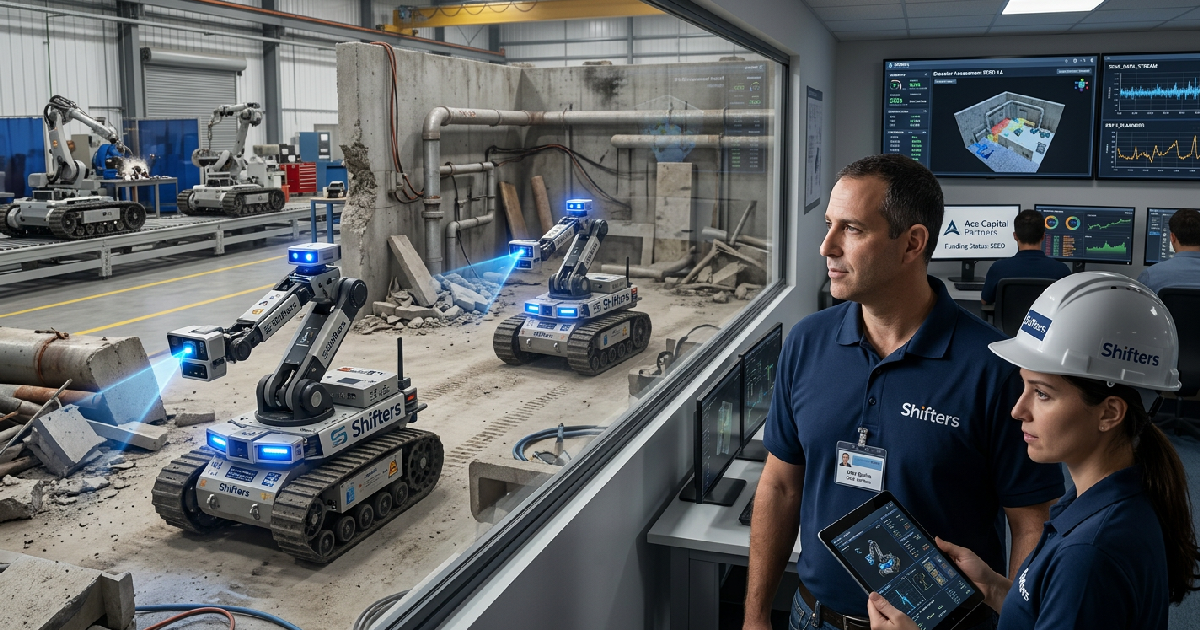
Shifters CEO Ofer Ballin and CTO Assaf Chaprak have secured $10.2 million in seed funding to move their autonomous ground robotic teams from prototypes into industrial-scale production. The funding round, announced on June 3, 2026, was led by Ace Capital Partners and brings the total capital raised by the Washington, D.C.
-headquartered startup to $15 million. This capital injection is earmarked for establishing new manufacturing lines and expanding the company’s engineering footprint across the United States, Europe, and the Middle East.
The investment reflects a growing industrial demand for “supervised autonomy” in environments where aerial drones cannot operate. While the sector has seen a surge in unmanned aerial vehicles, ground-level navigation remains a significant engineering hurdle due to GPS-denied environments and unpredictable physical obstacles.
Shifters aims to solve this with its “Robots Go First” mission, which prioritises robotic entry into subterranean tunnels, collapsed structures, and hazardous material zones to ensure human personnel only enter once a perimeter is secured.
The seed round attracted a diverse group of deep-tech and national security investors, including Aurelius Capital Management, Corner Ventures, Arkin Capital, STEP World, and Fresh Fund. For industrial operators in mining and infrastructure, this marks a shift toward more resilient com/african-iot-sector-growth-industrial-impact/”>African IoT sector growth, where hardware must perform in “chaotic environments” rather than controlled factory floors. CFOs and operations managers are increasingly looking at these autonomous systems to reduce workplace insurance premiums and improve site safety protocols.
Engineering the TRUST platform for modular industrial applications
The core of the Shifters hardware offering is TRUST, a family of quadrupedal robotic platforms that the founders colloquially describe as “a tray with legs.” This design philosophy prioritises payload agnosticism, allowing engineers to swap mission-specific tools without redesigning the base locomotion system. The heavy-duty chassis can carry various sensors, ranging from high-definition mapping cameras to hazardous material scanners, depending on the specific operational requirement.
CTO Assaf Chaprak, a former major in the Israeli Air Force, explained that the challenge lies in the intersection of hardware stability and software intuition. The TRUST robots use a four-legged configuration to navigate extreme terrain that wheeled or tracked vehicles often find impassable.
By using a Modular Open Systems Approach (MOSA), the hardware integrates with existing military and commercial backend infrastructure through robust APIs. This open architecture prevents vendor lock-in, a common complaint among industrial procurement officers.
The company expects the TRUST platform to reach Technology Readiness Level (TRL) eight or nine by the end of 2026. This rating signifies that the system is ready for “flight-proven” operational Echoes of similar technological leaps can be seen in how AI systems address scarcity by optimizing resources in difficult conditions.
Shifters is now betting that its hardware can withstand the rigours of deep-shaft mining and high-risk construction inspections.
Proprietary AI and digital twinning for mission reliability
Beyond the physical robots, the “RITA” software layer serves as the autonomous brain for the robotic teams. RITA uses agentic AI to interpret human intent and adapt to shifting field conditions in real-time. This eliminates the need for a dedicated human pilot for each unit, allowing a single operator to supervise a coordinated team of robots as they execute complex tasks autonomously.
To support this, Shifters developed a high-fidelity Digital Twin tool. This virtual environment mirrors active missions and physical robots, allowing operators to run predictive simulations before a single motor turns on the ground. Engineers use the tool to:
- Assess mission risk in virtual replicas of real-world terrain.
- Analyse sensor data in real-time to adjust autonomous parameters.
- Train AI models on “edge cases” that are too dangerous to test physically.
- Evaluate the performance of various payload configurations before deployment.
This virtual-to-physical loop ensures that once the robots are deployed in a jammed or debris-filled area, their pathing is already somewhat optimised. The integration of these digital tools is becoming standard as AI infrastructure security and trust become paramount for companies handling sensitive geographical or industrial data.
Transitioning from low-rate prototyping to full-scale manufacturing
With $10.2 million in new capital, Shifters is pivoting from research and development to commercial output. The company currently employs 20 people and is actively recruiting in mechatronics, AI, and software engineering. The immediate focus is scaling production lines to meet “massive demand” from government and enterprise buyers, including components of the United States Army that have already field-tested the systems.
While the immediate go-to-market strategy revolves around Intelligence, Surveillance, and Reconnaissance (ISR) missions, the secondary applications are broad. In the commercial sector, the company targets precision agriculture, underground mining, and critical infrastructure inspections. CEO Ofer Ballin noted that even in hostile or unstable environments, the goal is to create systems with “very high throughput” that can reach areas previously inaccessible to human teams.
As the company expands its footprint, the focus will remain on the gradual progression toward full autonomy. This “copilot” approach ensures that while the robots handle the technical difficulty of the terrain, human oversight remains central to high-stakes decision-making.
The establishment of these manufacturing lines in 2026 will be the definitive test of whether quadrupedal robots can move from niche tech demonstrations to essential industrial equipment.
