


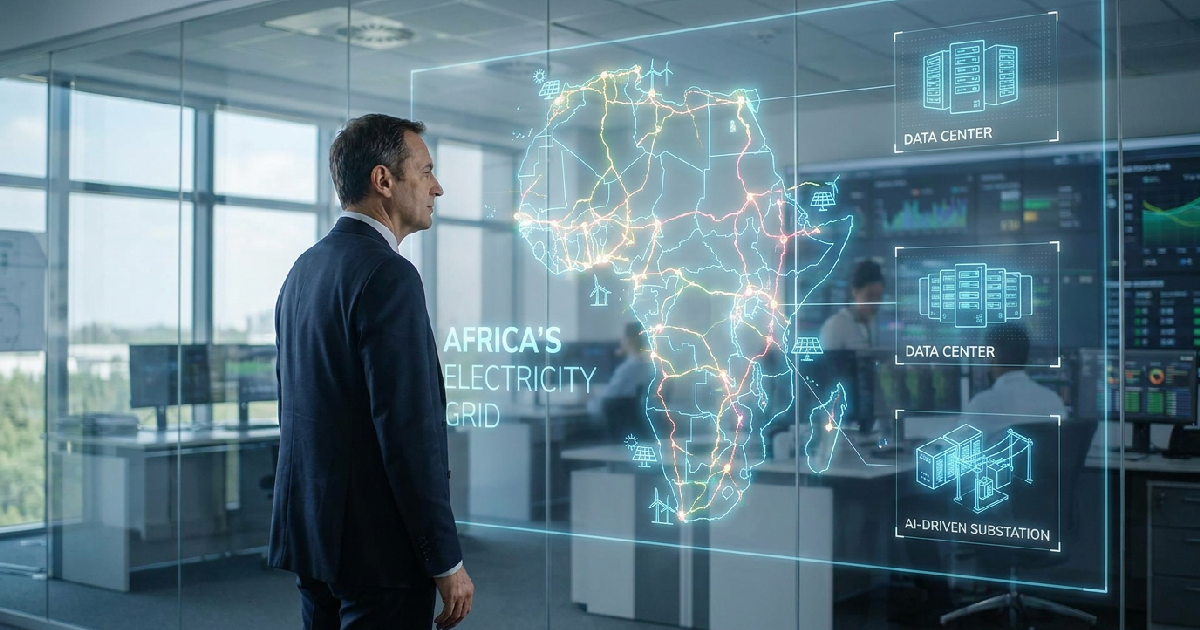
Artificial intelligence is driving demand for digital infrastructure, pushing African nations to rethink fundamental energy strategies for Africa’s electricity grid.
This challenge positions Africa’s electricity grid as a pivotal battleground for AI development, according to Schneider Electric, a global leader in energy management and industrial automation. Odoh told TechCabal that traditional grids are fast becoming obsolete. He emphasises the necessity for digitally enabled grids from the outset, reflecting the profound shifts in how electricity is generated and consumed across the continent.
Rebuilding Africa’s electricity grid for AI demands
Africa currently holds less than 1% of global live data centre capacity, with only 360 megawatts spread across 217 facilities in 33 countries. Yet, the continent is striving to secure its place in the burgeoning AI economy.
Every new AI model and hyperscale data centre will demand vastly more electricity than most existing African infrastructure can provide. This necessitates a fundamental re-evaluation of energy supply and distribution.
The energy consumption of AI server racks dwarfs that of conventional computing. A traditional server rack typically uses between 5 kilowatts (kW) and 15 kW. However, AI racks already draw between 40 kW and 120 kW, with next-generation systems set to approach 200 kW per cabinet.
This continuous, round-the-clock demand necessitates uninterrupted power and sophisticated cooling solutions. It fundamentally alters the economics of electricity supply and distribution across the continent.
Schneider Electric’s platform approach to grid modernisation
Schneider Electric isn’t just supplying electrical equipment; the company aims to become the operating system for Africa’s AI infrastructure. It already provides power infrastructure for over 38% of Africa’s installed data centre capacity and about half of East Africa’s facilities.
In these East African sites, more than 80% utilise a combination of Schneider Electric’s power management, automation, and secure power systems. The company believes countries that modernise their grids first will attract the next wave of AI investment.
Key Schneider Electric AI and grid initiatives in Africa
- NExT programme in Sub-Saharan Africa – A program launched by Schneider Electric to accelerate its evolution as the region’s leading energy technology partner, leveraging electrification, automation, and digitalization, including AI. (per Schneider Electric South Africa, Engineering News)
- Nontu Mkhize – Offer Marketing Manager: Power Services and Industry for Sub-Saharan Africa at Schneider Electric, who provided explanations regarding the NExT program. (per Schneider Electric South Africa, Engineering News)
- EcoStruxure Energy Intelligence – An AI-powered platform that represents a shift from EcoStruxure as an open architecture, designed to create intelligent ecosystems and real-time operational visibility. (per Engineering News)
- The Data Cube – Schneider Electric’s framework for unifying enterprise, operational, field, and ecosystem data, which integrates AVEVA technology, digital twins, and AI. (per Engineering News)
- AVEVA – Schneider Electric’s software unit, which is a component of The Data Cube and is involved in marketing a “connected worker” platform. (per Engineering News, BusinessDay)
- Elijah Daniel – Country Sales Director for process automation across Sub-Saharan Africa at Schneider Electric, who discussed the value of utilizing decades of plant and operational data for AI. (per Business Day)
- One Digital Grid Platform – A platform launched by Schneider Electric designed to use AI to help utilities enhance resilience and modernize faster. (per Schneider Electric South Africa)
- Shubbhronil Roy – VP Strategy & Marketing at Schneider Electric, who led the launch of the One Digital Grid Platform. (per Schneider Electric South Africa)
- Frédéric Godemel – Executive Vice President of Energy Management at Schneider Electric, who provided a statement regarding the One Digital Grid Platform. (per Schneider Electric South Africa)
- EcoStruxure ADMS, DERMS, and ArcFM – The foundational components upon which the One Digital Grid Platform is built, incorporating new AI-enabled capabilities. (per Schneider Electric South Africa)
- Estimated Time of Restoration (ETR) – A new AI-enabled capability of the One Digital Grid Platform, which integrates with storm preparedness tools from AiDASH. (per Schneider Electric South Africa)
- Grid AI Assistant – A new AI-enabled capability of the One Digital Grid Platform, embedded within EcoStruxure ADMS, supporting real-time troubleshooting and optimizing grid performance. (per Schneider Electric South Africa)
- AI-based Network Model Tuning – A new AI-enabled capability of the One Digital Grid Platform that uses AI to align mapping, operational, and customer data. (per Schneider Electric South Africa)
- AiDASH – A company whose storm preparedness tools integrate with the ETR capability of the One Digital Grid Platform. (per Schneider Electric South Africa)
- Ajibola Akindele – Country President, Schneider Electric, West Africa, who emphasized the critical role of software-driven infrastructure management for data centers in Nigeria. (per Techpoint Africa)
- Johan Potgieter – Cluster Industrial Software Lead at Schneider Electric, who discussed the application of AI in smart factories. (per Schneider Electric South Africa)
Schneider Electric’s NExT programme, launched in Sub-Saharan Africa in March 2026, aims to accelerate its role as a leading energy technology partner through electrification, automation, and digitalisation, including AI. Nontu Mkhize, Offer Marketing Manager for Power Services and Industry for Sub-Saharan Africa at Schneider Electric, has provided insight into the program’s objectives.
Central to Schneider Electric’s offering is the EcoStruxure Energy Intelligence platform, an AI-powered system designed to foster intelligent ecosystems and deliver real-time operational visibility. This marks a significant evolution from the company’s prior open architecture.
The platform unifies enterprise, operational, field, and ecosystem data through what Schneider Electric calls The Data Cube, integrating technology from its software unit, AVEVA, to create comprehensive digital twins and AI applications.
Additionally, Schneider Electric recently launched the One Digital Grid Platform. This platform is designed specifically to help utilities enhance resilience and modernise grids faster using AI. Shubbhronil Roy, VP Strategy & Marketing, and Frédéric Godemel, Executive Vice President of Energy Management, both highlighted the platform’s potential.
This platform builds upon foundational components like EcoStruxure ADMS, DERMS, and ArcFM. It incorporates new AI-enabled capabilities such as an Estimated Time of Restoration (ETR) system. This ETR system integrates with storm preparedness tools from AiDASH, alongside a Grid AI Assistant for real-time troubleshooting and grid optimisation. AI-based Network Model Tuning also plays a role in aligning mapping, operational, and customer data.
Diverse approaches to powering Africa’s digital future
Africa’s major data centre markets are already demonstrating varied strategies for power infrastructure to meet the demands of AI. South Africa has emerged as a preferred destination for hyperscale cloud providers, largely thanks to Eskom’s sustained recovery from prolonged load shedding. By June 2026, the country recorded over 400 consecutive days without nationwide rolling blackouts, restoring significant investor confidence.
This stability, coupled with expanded private renewable generation and streamlined power-wheeling regulations, has encouraged major investments. Microsoft, for instance, announced a R5.4 billion ($300 million) infrastructure expansion in its South African cloud region in March 2025. This clearly shows a correlation between grid reliability and attracting global technology investment.
Kenya has carved out a different path, leveraging its abundant renewable energy sources. More than 70% of Kenya’s electricity comes from renewables, primarily geothermal energy. This clean energy profile makes the country highly attractive to companies under pressure to lower their carbon emissions.
Consequently, developers are increasingly siting AI data centres directly adjacent to geothermal plants. This minimises reliance on the national grid and aligns with green energy mandates. Microsoft’s planned $1 billion AI campus with G42 is an example of this strategy, offering a compelling model for sustainable digital infrastructure development.
Nigeria, Africa’s largest digital market, presents the continent’s most significant electricity grid challenges. Despite having 13.6 GW of installed generation capacity, only about 4.3 GW remains consistently available. This forces data centres to rely heavily on captive gas plants, batteries, and other off-grid systems for operational continuity.
Ajibola Akindele, Country President, Schneider Electric, West Africa, has underscored the critical role of software-driven infrastructure management for data centres in Nigeria. Schneider Electric sees Nigeria’s extensive gas reserves as an opportunity to support a “gas-to-compute” model. This strategy would integrate dedicated power infrastructure directly into data centres, effectively creating localised, self-sufficient energy hubs.
This shift from centralised grid reliance to embedded power solutions is a pragmatic response to existing infrastructure deficits.
Building smarter grids from the ground up
Ifeanyi Odoh suggests that Africa’s current energy infrastructure weakness could be its greatest strength. Many of Africa’s electricity grids are old and require substantial upgrades. This very need, however, provides an opportunity. Instead of being locked into outdated designs, many African countries can build modern, digitally managed grids from the ground up.
These new grids can be designed specifically to integrate renewable energy sources, advanced battery storage solutions, and the intense, decentralised electricity demands of AI data centres and electric vehicles. Odoh believes Africa has a unique chance to completely rethink its energy infrastructure development.
Elijah Daniel, Country Sales Director for process automation across Sub-Saharan Africa at Schneider Electric, has emphasised the value of utilising decades of plant and operational data for AI, which can inform the design of these new systems.
Schneider Electric anticipates that future grids will increasingly function like sophisticated software platforms. Rather than a one-way flow of electricity from power station to consumer, these grids will continuously balance diverse energy inputs in real-time.
This includes solar farms, battery storage, gas plants, rooftop generation, and the specific power needs of AI facilities, all coordinated by intelligent systems. The goal is to integrate all these disparate energy sources into one intelligent, responsive grid, an industrial connectivity challenge that many regions are grappling with.
Digital tools and local assembly driving progress
This vision explains Schneider Electric’s expanding involvement in African data centres. The company now supplies a comprehensive range of solutions, from medium-voltage equipment and power distribution systems to specialised AI liquid-cooling systems. These liquid-cooling systems are particularly critical as they remove heat directly from processors, enabling much denser computing environments than traditional air-cooling methods.
Critically, Schneider Electric is increasingly assembling this equipment locally within Africa. Odoh confirms the ability to design and assemble these complex systems on the continent, fostering local technical expertise and supply chains. This commitment to local manufacturing means the entire digital economy’s potential hinges directly on addressing underlying electrification needs.
As Johan Potgieter, Cluster Industrial Software Lead at Schneider Electric, notes, AI also plays a role in smart factory operations, further reinforcing the importance of robust, local industrial capabilities.
AI-driven grid optimisation and global precedents
The global electricity consumption for data centres reached an estimated 415 terawatt-hours (TWh) in 2024, representing about 1.5% of global electricity consumption. Projections indicate this figure could more than double to approximately 945 TWh by 2030, with AI serving as the primary growth driver. This global surge underlines the urgency for grid modernisation across all regions, including Africa.
In the United States, power demand from AI data centres could see a thirtyfold increase by 2035, potentially reaching 123 GW from just 4 GW in 2024. Some new hyperscale data centres are being planned with capacities exceeding 1 GW, with early-stage campuses even targeting 5 GW. These figures illustrate the scale of the challenge and the massive infrastructure investments required.
Other regions are already implementing AI-enabled solutions. Countries like Vietnam, the Philippines, and Taiwan are using AI-enabled microgrids to modernise their power systems. Vietnam, for instance, deploys AI-integrated microgrids in industrial estates to ensure stable production for its electronics and electric vehicle sectors.
Similarly, in Europe, Google and grid technology firm CTC Global launched GridVista in February 2026. This AI-based system is designed to increase the usable capacity of existing electricity transmission lines. Hungary is already utilising it for modernisation and renewable energy integration. These examples provide valuable blueprints for African nations looking to harness AI for their own grid development.
NJ Ayuk, Executive Chairman of the African Energy Chamber, points out that AI infrastructure should not be seen as competing with Africa’s broader electrification goals. Instead, data centres can act as anchor customers, unlocking generation projects and strengthening grids, thereby expanding electricity access for millions.
McKinsey’s analysis supports this, suggesting that Africa’s data centre capacity could grow from around 400 MW today to as much as 2.2 GW by 2030. They also stress that Africa’s trajectory will need tailored strategies that align investors, operators, and policymakers, rather than simply replicating models from other regions.
This proactive approach will be critical for the continent to secure its industrial future in the age of AI, supported by foundational power infrastructure upgrades.
