


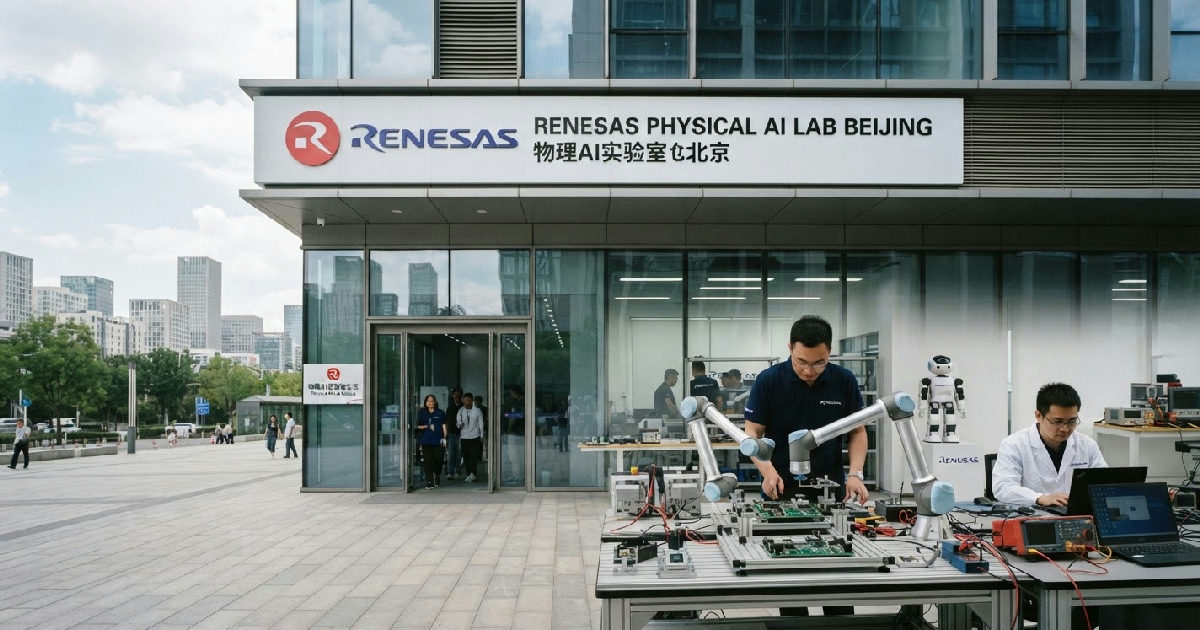
A dedicated Physical AI & Robotics Lab has opened in Beijing, a significant move to accelerate the development of robots that can perceive and act in the real world.
The lab is designed to be more than just a product showroom. It provides a hands-on environment for co-developing entire systems, from initial proof-of-concept to full-scale deployment. This investment underscores Renesas’s strategic pivot towards what it terms “physical AI,” a field it sees as a major area for future growth.
The Renesas Physical AI Lab Beijing: A hands-on hub for next-generation robotics
The new Beijing facility aims to shorten the notoriously difficult development cycle for advanced robotics. It integrates the essential building blocks of a modern robot: hardware, software, AI models, control systems, power management, and advanced sensors. By providing these tools under one roof, Renesas hopes to help its partners solve integration challenges much faster.
This is a place for joint engineering, not just sales pitches. The goal is to connect customer needs directly with Renesas’s technology and a wider ecosystem of partners. According to the company, the lab will support the complete engineering journey, offering system-level verification and validation services. This practical approach is crucial for moving complex machines out of the lab and into industrial settings.
Yvonne Liu, President of Renesas China, emphasised the strategic location. “China continues to lead in robotics innovation and adoption with a deep customer base, a highly collaborative ecosystem and a comprehensive supply chain service system,” she said. Liu added that the lab will work closely with customers, partners, universities, and startups to speed up the real-world application of advanced visual AI and other technologies.
Defining the frontier of physical AI
Renesas is making a clear distinction between the AI that powers digital applications and the intelligence required for physical systems. Physical AI, as the company defines it, is the next evolutionary step for artificial intelligence. It involves moving intelligence out of the cloud and data centres and embedding it directly into machines that operate in our physical environment.
Unlike a chatbot or a recommendation algorithm, a physical AI system must perceive its surroundings, make decisions, and act upon them safely and reliably—all in real time. There is no room for the kind of probabilistic error or latency that might be acceptable in a digital service. Behaviour must be deterministic and predictable, especially when robots work alongside people.
Humanoid robots are the quintessential example of this challenge. They demand a seamless fusion of embedded processing for “brain” functions, sophisticated sensing to understand the world, and precise actuation for movement. Power management is also critical to ensure these complex systems can operate efficiently for extended periods.
Renesas’s strategy to dominate the humanoid robot BOM
The Beijing lab is a cornerstone of an ambitious strategy. Renesas is aiming to dramatically increase its share of the components inside the next generation of robots, particularly humanoids. The company’s leadership is candid about its goals and the opportunity it sees ahead.
Ivo Marocco, a Vice President at Renesas, laid out the numbers plainly. “Today, Renesas can address roughly 30% of the humanoid robot BOM,” he stated. A Bill of Materials (BOM) lists every component in a product. Marocco continued, “we see an opportunity to expand that coverage to 70% through our strengths in control, power, sensing, AI, software and ecosystem solutions.”
This is a bold claim, signalling Renesas’s intent to become a one-stop-shop for the core technologies that make advanced robotics possible. “Our new lab will help customers validate complete systems and accelerate the deployment of next-generation robotics innovations,” Marocco concluded. It’s a direct pitch to robot makers: partner with us to build your machines faster and more effectively.
Building a comprehensive portfolio
This ambition is backed by a series of strategic acquisitions and internal developments. Renesas established a dedicated Physical AI Business Division on July 1, 2026, formalising its focus. The company has methodically built a portfolio that covers everything from motion control and power devices to the microcontrollers and system-on-chip solutions that act as the robot’s brain.
Drawing on decades of experience in the demanding automotive and industrial sectors, Renesas brings deep expertise in functional safety and edge AI. Recent acquisitions have filled key gaps. The 2022 purchase of Reality AI brought in expertise in endpoint AI for non-visual sensing, while the May 2026 acquisition of Irida Labs added powerful Vision AI software to its arsenal.
These software capabilities are being integrated into Renesas 365, the company’s cloud-based platform for embedded systems design. This approach, combining hardware with a sophisticated, cloud-enabled design platform, is central to its strategy of capturing a larger slice of the robotics value chain.
Why Beijing is the strategic choice
Placing this high-stakes R&D hub in Beijing is no accident. China is at the epicentre of the global robotics industry, both as a producer and a consumer. The government has made robotics and AI a central pillar of its industrial strategy, most recently in its 15th Five-Year Plan, which positions robotics as key to modernising its economy.
Initiatives like the “AI Plus” action plan, launched in 2025, aim for massive adoption of AI-powered devices across key industries. Beijing itself has its own “Embodied Intelligence Action Plan” to fast-track development. This top-down policy support has created a vibrant ecosystem of robot manufacturers, startups, and research institutions, all pushing the boundaries of what’s possible.
For Renesas, proximity to this ecosystem is critical. It allows the company to embed itself within the supply chain and work directly with the world’s most ambitious robotics companies.
The lab provides a physical space to collaborate with a customer base that is rapidly scaling up production of everything from warehouse logistics bots to advanced humanoid assistants. Such sophisticated robotic systems, for example, require the exact kind of integrated systems testing this lab enables.
What this means for industrial automation
While humanoid robots capture the headlines, the work done in the new Renesas lab will have more immediate implications for industrial automation. The challenges of integrating perception, control, and actuation are universal across robotics. Solutions developed for humanoids can be adapted for logistics robots, manufacturing arms, and autonomous mobile robots (AMRs) on the factory floor.
The progress made here could even inform heavy payload robotics, where integrated system testing is paramount.
By offering a platform for co-development, Renesas could help industrial customers de-risk their R&D and accelerate time-to-market. Building a new robotic system from scratch is incredibly complex and expensive. A platform that provides pre-validated, integrated hardware and software components could significantly lower the barrier to entry for many companies.
The move also signals the intensifying competition in the high-end semiconductor market. As AI moves to the “edge,” the battle is on to provide the chips and software that will power trillions of intelligent devices.
Renesas is positioning itself not just as a component supplier, but as a fundamental platform provider for the next era of physical computing. For manufacturers globally, this competition is good news. It promises to deliver more powerful, more integrated, and ultimately more affordable automation solutions in the coming years.
