


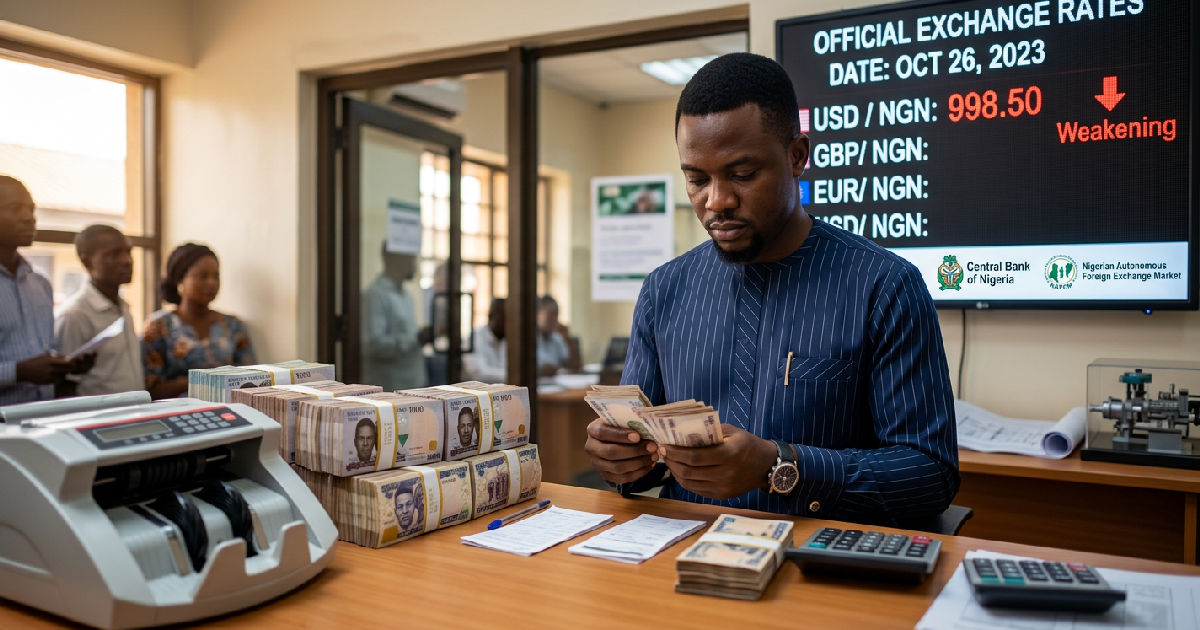
The Central Bank of Nigeria (CBN) has reportedly observed further depreciation of the local currency at the official window as the naira continues to face pressure against the United States dollar. Data indicates that the exchange rate moved higher during recent trading sessions, reflecting ongoing challenges in foreign exchange liquidity and demand from corporate importers. This shift in valuation occurs as fiscal and monetary authorities continue to evaluate intervention strategies within the broader currency market.
Market observers note that a gap between supply and demand is driving the current price action. While the federal government has expressed a commitment to stabilizing the exchange rate through various fiscal reforms, the immediate impact on the trading floor remains limited. The pressure on the naira is compounded by the structural needs of the manufacturing and energy sectors, which require dollar allocations to sustain operations. As the naira weakens at the official market, the central bank maintains its focus on utilizing monetary tools to manage volatility.
Monetary Policy Impact on Engineering and Construction Projects
The fluctuations in the dollar to naira exchange rate have a direct effect on the engineering and heavy industry sectors across Nigeria. Most large-scale infrastructure projects rely on imported specialized machinery, steel components, and electronic control systems that are often priced in foreign denominations. Engineering firms are finding that the unpredictability of the exchange rate makes long-term project bidding difficult, as cost projections can change rapidly. This environment often leads to project delays or requests for contract variations to account for the rising cost of materials.
To mitigate these risks, some domestic firms are looking toward localized solutions. For instance, initiatives such as the Agromeqa Engineering Initiative seek to boost domestic capacity and reduce the reliance on imported technical equipment. However, the transition to local manufacturing is a long-term process, and the immediate reality for many Nigerian engineers involves navigating a market where the cost of imported components is tied to the movement of the official exchange window.
Supply Chain Disruptions and Input Costs
The cost of industrial inputs has risen alongside the exchange rate, impacting everything from high-voltage electrical components to civil engineering consumables. Procurement officers at major firms note that suppliers are adjusting prices more frequently to protect their operations from currency erosion. This trend is particularly evident in the energy sector, where maintenance of existing plants and the construction of new ones require consistent access to foreign exchange for spare parts and technical services.
Despite these headwinds, there is a push to improve the underlying systems that support the economy. Financial leaders emphasize that the strength of the currency is ultimately tied to the reliability of the nation’s output. Efforts to ensure infrastructure reliability in the digital and physical sectors are seen as critical moves toward fostering a more self-sufficient industrial base.
Market Liquidity and the Role of the Central Bank
The Central Bank of Nigeria remains a primary source of dollar liquidity, though it has increasingly encouraged a willing-buyer, willing-seller model to find a market-clearing price. Financial analysts suggest that the current rate reflects a move toward more transparent price discovery. The bank’s updates to exchange rates are often viewed by market participants as a signal regarding the government’s approach to currency alignment with market realities.
Speculative activity continues to play a role in the volatility seen in the currency markets. When the official rate moves, it often triggers a reaction in the informal market, further complicating the landscape for businesses that rely on a blend of funding sources. The central bank has previously cautioned against panic buying, suggesting that market levels may eventually stabilize as anticipated foreign investment inflows materialize in the coming months.
Future Outlook for Currency Stability
Looking ahead, the movement of the dollar to naira exchange rate will likely depend on the ability to diversify foreign exchange earnings. Increasing the export of value-added engineering services and manufactured goods remains a stated priority for industrial development. If the country can successfully pivot toward becoming an industrial hub for the West African sub-region, the structural demand for the naira could improve, potentially leading to long-term stability.
For now, businesses and consumers are forced to adapt to a high-cost environment. The focus in the coming weeks will be on whether the central bank chooses to adjust its direct interventions or if it will allow the market to continue its current trajectory. Investors will be watching for upcoming policy announcements, where interest rate decisions could further influence the attractiveness of naira-denominated assets and the overall strength of the currency.
