


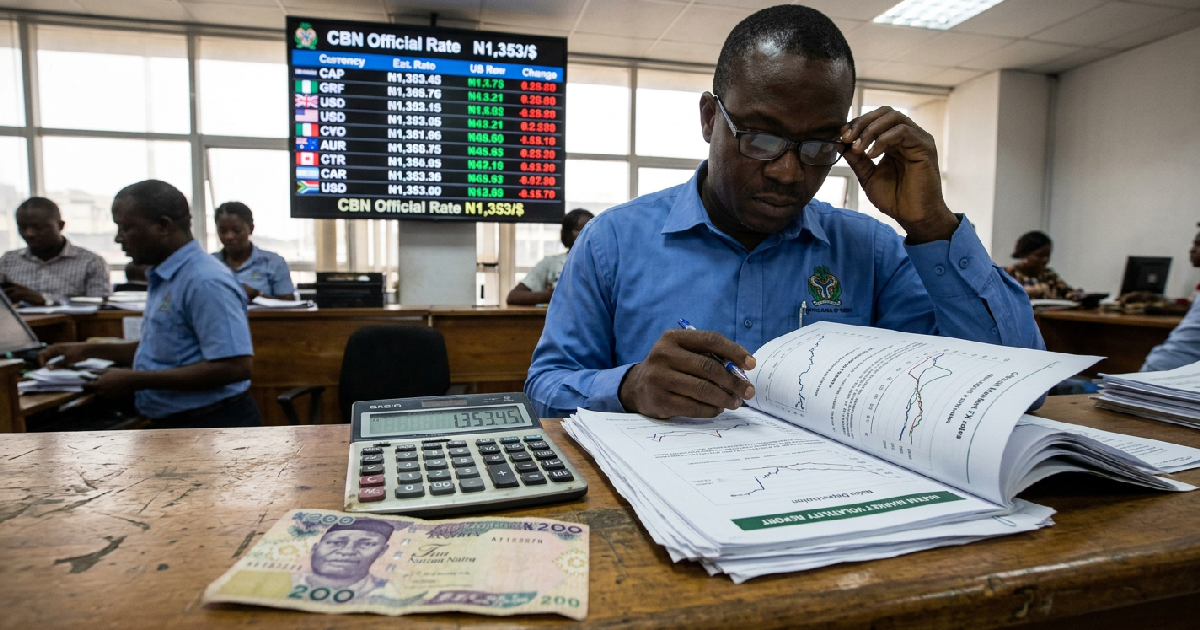
The Central Bank of Nigeria (CBN) has updated its official exchange rates following a session of depreciation for the local currency at the formal trading window. Recent market activity shows the Naira losing ground against the United States Dollar at the Nigerian Autonomous Foreign Exchange Market (NAFEM), continuing a period of volatility within the country’s foreign exchange ecosystem.
Data from the FMDQ Securities Exchange indicates that the Naira declined compared to previous trading cycles where it had reportedly shown brief signs of stabilization. Financial analysts suggest that heightened demand for foreign currency from importers, coupled with corporate requirements, has placed persistent pressure on the official window. This shift occurs as policymakers attempt to balance market liquidity with the need to curb inflationary pressures that have impacted the economy throughout the year.
The gap between official and parallel market rates remains a central concern for manufacturers and the broader engineering sector. The current movement in the NAFEM window suggests that the price discovery mechanism is still adjusting under the unified exchange rate regime. To mitigate some of these external economic pressures, some industries are looking toward African industrial connectivity and IoT solutions to optimize local production and reduce the heavy reliance on imported components.
Monetary Policy and Industrial Impacts
The Central Bank has remained active in its efforts to shore up the currency through various monetary tools and adjusted liquidity measures. These shifts in the financial architecture aim to make the Naira more attractive to foreign portfolio investors, though the immediate impact on local businesses has been challenging. The rising cost of borrowing, paired with foreign exchange fluctuations, has complicated long-term planning for major technical projects.
A significant hurdle remains the consistent supply of foreign exchange to meet the needs of the productive sector. While the federal government has characterized the liberalization of the FX market as a necessary step for long-term economic health, the short-term consequences are visible in the rising costs of imported machinery. Some government initiatives have sought to offset these costs by focusing on energy and power. For instance, the government upgrade of power infrastructure in Ebonyi and Enugu represents an effort to support local industry by improving the reliability of the national grid.
The CBN’s latest rate updates are intended to maintain transparency and provide a clear benchmark for legitimate transactions. By clarifying the official rate, the bank aims to discourage speculative activities that often lead to artificial currency scarcity. However, market participants note that speculative pressure remains a factor as various sectors compete for limited dollar reserves.
Infrastructure as an Economic Hedge
The volatility in the exchange rate affects more than just retail prices; it directly impacts the feasibility of large-scale engineering and construction projects. Higher exchange rates increase the cost of servicing foreign debt and purchasing specialized equipment required for national development. This has led to a strategic pivot toward domestic infrastructure projects that can be funded largely through local means.
Technical committees continue to advance plans for major energy routes, such as the gas pipeline projects connecting Nigeria and neighboring regions. Strengthening these energy ties is seen as a way to reduce domestic production costs and improve the competitiveness of Nigerian exports. A stronger export base would provide a natural hedge for the Naira, allowing the country to earn foreign exchange through trade rather than relying on volatile commodities.
Technological Resilience and Market Outlook
The shifting value of the Naira has also accelerated the adoption of financial technology. As the official rate fluctuates, more organizations and individuals are utilizing digital tools to manage their assets and maintain purchasing power. This technological push is not merely a matter of convenience; it represents the construction of a financial infrastructure designed to withstand global market shocks.
Looking ahead, market participants expect the Central Bank to maintain its interventionist stance, though the frequency of dollar injections may vary. The ultimate goal remains a balanced “willing buyer, willing seller” model, but the transition remains complex. Economists argue that until the nation can diversify its foreign exchange earnings beyond traditional sectors, the currency will stay vulnerable to external shifts.
The coming months will be critical for determining the direction of the economy. If liquidity can be maintained alongside controlled inflation, the Naira may reach a new point of equilibrium. For now, engineering firms and industrial players are bracing for continued volatility, adjusting their supply chains to reflect the current realities of the exchange market.
