


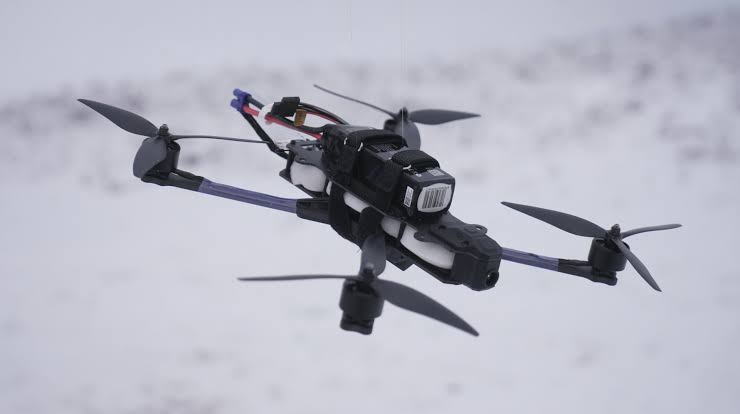
Occam, a British-Ukrainian defence technology company, has secured €3.8 million in early-stage funding to expand its autonomous drone technology.
The funding brings Occam’s total funding to €7 million and will support further development of its autonomous drone technology. The company said the funding will support product development and expansion across NATO markets.
Occam develops autonomous software for military drones
Occam develops artificial intelligence software designed to allow military drones to perform certain missions with reduced reliance on continuous operator links. The company says the system is designed to maintain drone operation when communications links are disrupted by electronic warfare.
The software is designed to integrate with existing drones from different manufacturers without requiring hardware modifications, according to the company. It runs on a computing unit and uses Occam’s Ludus platform to manage its autonomous functions.
Founders Dr Stefan Schaufler, CEO, and Dr Florian Smidt, CTO, developed the system for autonomous drone operations. The applications include reconnaissance, surveillance and target acquisition.
Occam raises €3.8m in funding round
The latest funding round was led by Danish investment firm North Ventures. Finnish firm Sparkmind and UK-based fund Grenadyr also participated, alongside existing investors Antler, Tech Horizons, T|Y|R.vc and Freedom Fund. Atlantic Labs, a previous pre-seed investor, also contributed.
Uwe Horstmann, General Partner at Project A, a participating investor, commented on the investment. “Occam’s technology represents a significant leap forward in drone autonomy, with the potential to revolutionise defence operations,” he stated.
Horstmann added, “We are proud to support their vision and believe their solution will be critical for enhancing the security and operational effectiveness of NATO forces”. Horstmann’s comments focused on the potential application of Occam’s technology to NATO defence operations.
Occam CEO and co-founder Dr Stefan Schaufler said the funding would support the company’s expansion plans. “Our mission is to empower NATO forces with cutting-edge drone autonomy, enabling them to operate effectively and safely in the most challenging environments,” he explained.
He added that the funding would support product development and expansion across NATO markets. The company intends to make its technology available to additional NATO customers as it expands.
Expanding Reach to NATO Markets
The company plans to expand deployment of its drone autonomy software across NATO countries. Occam is targeting applications in environments where communications or GPS signals may be disrupted.
Occam says its technology could reduce the need for personnel to remain directly involved in some drone operations. The company also says autonomous operation could support mission execution in situations where communications links are disrupted.
AI is increasingly being incorporated into defence systems and unmanned platforms. Occam’s hardware-agnostic approach is intended to allow the software to be deployed across different drone platforms. This kind of flexibility is a hallmark of strong simulation and integration tools across industries.
Impact on Modern Defence Engineering
The development of autonomous drones is also changing engineering requirements for unmanned systems. Engineers developing autonomous systems must design software and hardware capable of processing sensor data and responding to changing conditions in real time.
Occam’s approach illustrates the growing role of software-defined capabilities in unmanned aerial systems. The company emphasises software-defined capabilities that can be updated as operational requirements change.
Developing AI systems for defence applications presents engineering challenges including data security, system reliability and resistance to adversarial manipulation. Testing and iterative development are therefore important, particularly when systems are evaluated in operational environments. Occam says its technology is being tested with Ukrainian military units.
A software-focused approach can also change the balance between hardware and software development. For systems such as Occam’s, some functionality can be delivered through software rather than dedicated hardware for each drone platform. This approach can support greater interoperability between software and different drone platforms.
Supporting development in Ukraine
Occam, which operates offices in London and Kyiv, plans to use the funding for research and development and to expand its engineering team in Ukraine. The expansion will increase the company’s engineering capacity in a location where it says its technology is being deployed and tested.
The company expects the additional funding to support faster product development and the deployment of new features. The company is developing the technology in an environment where operational requirements and technical conditions can change rapidly.
The company says its expansion in Ukraine is supported by deployment and testing with Ukrainian manufacturers and military units. Feedback from operational users informs product development, according to the company.
Future Outlook for Autonomous Systems
The development of autonomous drone technology is likely to remain an area of interest in defence applications. Occam’s funding will support its plans to develop the technology and expand into NATO markets.
As autonomous systems develop, the ethical, regulatory and operational frameworks governing their deployment may also need to evolve. Engineers, policymakers and military organisations will also need to consider how such systems are tested, deployed and governed.
Occam says its technology is intended to support autonomous operation while reducing reliance on continuous communications links. The new funding will allow Occam to continue developing its autonomous drone technology and expand its engineering operations in Ukraine and across NATO markets.
