


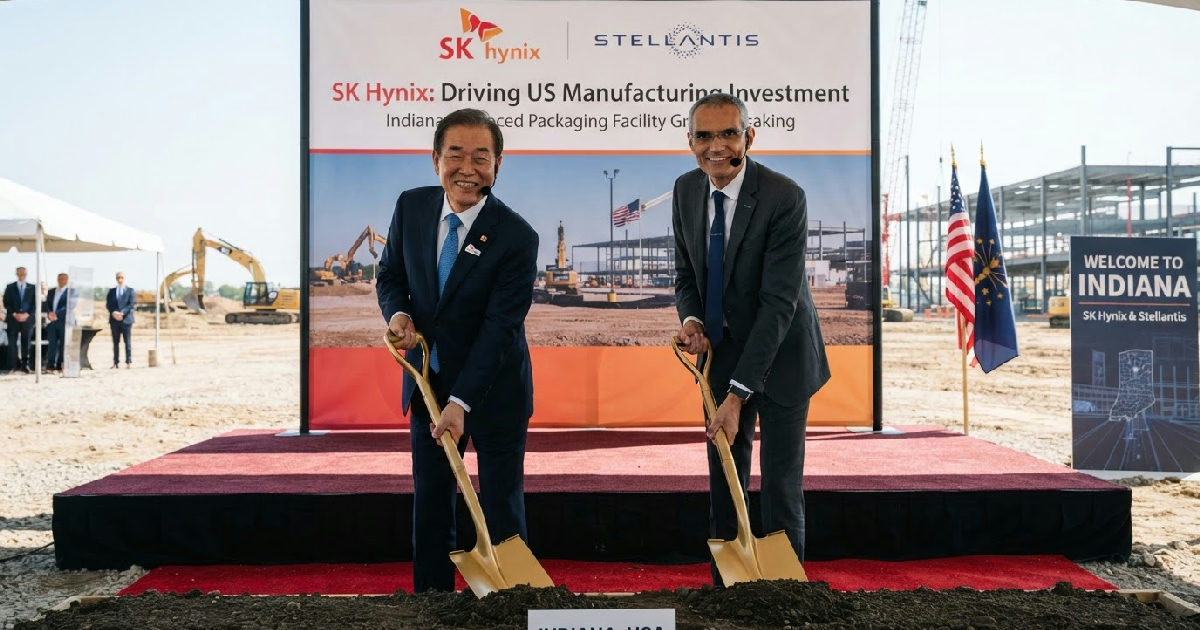
South Korean semiconductor powerhouse SK Hynix has officially broken ground on its new $4 billion advanced packaging facility in Indiana. The ceremony, held on August 27, 2026, marks the company’s first U.S. venture into AI memory manufacturing, highlighting a wider trend of substantial industrial investment across the country.
This wave of capital expenditure also includes a major commitment from automotive group Stellantis, signalling a strategic drive to reinforce and localise supply chains for critical technologies. These projects represent billions of dollars directed towards next-generation AI components and future vehicle platforms.
SK Hynix’s $4 billion US manufacturing investment
The relentless demand for artificial intelligence components underpins SK Hynix’s decision to establish its Indiana facility in Purdue Research Park, West Lafayette. This plant will specialise in advanced packaging, a vital process for integrating memory chips into high-bandwidth memory (HBM) packages that are essential for AI system performance.
The facility, spanning a 133-acre site, is specifically designed to house a high-bandwidth memory production line and an Advanced Packaging R&D Testbed. It aims to package and test DRAM wafers produced in South Korea for its US-based customers, streamlining the supply chain for critical AI components.
The company states this investment was “propelled by Purdue’s track record of innovation, research excellence, and long-standing success in developing talent.”
SK Hynix has partnered with Purdue University for R&D collaboration on next-generation advanced packaging technology, reinforcing the talent pipeline. The cleanroom is slated for completion by October 2028, with mass production scheduled to commence in the second half of 2029, representing a slight adjustment to earlier plans.
This plant is expected to create approximately 1,000 direct jobs, with the broader ecosystem potentially generating around 7,000 direct and indirect positions.
The investment benefits from significant governmental support, including up to $458 million in CHIPS Act funding from the U.S. Commerce Department and up to $500 million in federal loans.
Indiana has also provided incentives, including up to $3 million in training grants, $3 million in manufacturing-readiness grants, up to $80 million in conditional performance payments, and $45 million for surrounding infrastructure.
“We will become the most trusted partner in the U.S., where top-tier customers, R&D capabilities, and partners align,” stated SK Hynix CEO Kwak Noh-Jung, outlining the strategic importance of the facility. The security and resilience of these new high-tech facilities are crucial, especially as manufacturing faces cyber attacks with increasing frequency.
Global expansion: South Korea’s massive chip investment
While the Indiana plant represents a significant overseas expansion, SK Hynix is also undertaking a major investment programme in its home market. The company’s board approved plans on August 7, 2026, to invest approximately $38 billion (54.3 trillion won) to expand semiconductor production capacity in South Korea.
This includes 35.2 trillion won for new chip fabrication facilities in Yongin, south of Seoul, and 19.1 trillion won for new facilities in Cheongju, central South Korea. Longer-term plans involve a total investment of 700 trillion won across the two sites, with the aim of meeting escalating demand fuelled by the artificial intelligence boom.
Additional investments include KRW 100 trillion ($64 billion) in its Cheongju campus for 3D NAND and HBM packaging, KRW 400 trillion ($259.5 billion) for a new Southwestern semiconductor cluster, and KRW 600 trillion ($389.3 billion) for its Yongin site.
These investments are designed to significantly ramp up the output of DRAM and NAND flash memory. Industry analyst Omdia projects that demand for these critical components will grow 19% annually through 2030.
The first new fab in Yongin is anticipated to commence operations by May 2027, with the M17 fab in Cheongju slated to begin construction next year and come online earliest in 2029. This dual strategy reinforces SK Hynix’s core production capabilities while securing advanced finishing processes in key markets.
Stellantis commits billions to US automotive production
In the automotive sector, Stellantis is making its largest U.S. investment in more than a century, committing $13 billion over the next four years to bolster its American manufacturing footprint and market presence. This substantial sum covers research and development, supplier costs, and direct manufacturing operations.
A cornerstone of this investment is the Belvidere Jeep Cherokee assembly plant in Illinois. Stellantis has allocated an additional $200 million, bringing its total investment in the plant to $800 million, aimed at reopening and expanding production.
The facility, which was idled in 2023, had already received more than $60 million in upgrades and operational assessments by July 2026 to facilitate its restart. This revitalisation is projected to create approximately 3,300 new jobs.
The next-generation Jeep Cherokee will be built on Stellantis’ new, modular STLA One platform, which is designed for efficient manufacturing and reduced development costs. Pilot production for the Cherokee is targeted to begin in 2028, with retail production following in 2029.
Stellantis CEO and North America COO Antonio Filosa noted that “Launching the next-generation Cherokee on STLA One allows us to deliver a more competitive product while leveraging the strength of our U.S. manufacturing operations.”
Beyond Belvidere, Stellantis is channelling nearly $400 million into its Toledo Assembly Complex in Ohio to assemble an all-new midsize truck, a role previously designated for the Belvidere plant. This investment also supports new technologies and product programmes for the Jeep Wrangler and Jeep Gladiator, along with critical components at the Toledo Machining Plant.
The Ohio facility could generate over 900 jobs, with production targeted to begin in 2028. Additionally, the Warren Truck Assembly Plant in Michigan will receive nearly $100 million for retooling to produce a new range-extended EV and a large internal-combustion-engine SUV, adding more than 900 jobs by 2028.
Another $130 million is allocated to the Detroit Assembly Complex – Jefferson in Michigan to prepare the facility for the next-generation Dodge Durango, with production set for 2029. The company also confirmed more than $100 million for its Kokomo Facilities in Indiana.
Broader implications for industrial manufacturing
These investments from SK Hynix and Stellantis reflect a clear strategic pivot towards securing and expanding high-value domestic manufacturing capabilities. The initiatives are not just about capital investment but also about fostering innovation and building resilient supply chains within the U.S. This trend underscores a broader industrial policy aimed at consolidating critical technological processes closer to home.
However, the long lead times associated with such large-scale projects mean that the full impact on supply chains will not be immediate, with many production timelines stretching to 2028 or 2029. Furthermore, the expansion highlights an increasing demand for a skilled workforce.
SK Hynix’s partnership with Purdue University exemplifies the need for ongoing investment in training and education to meet the complex requirements of advanced manufacturing. Initiatives such as new engineering pathways in the UK are emerging to help bridge this skills gap for future generations.
These developments in Western economies could create opportunities for industrialising nations, including those in Africa, as global manufacturing footprints continue to evolve. Ultimately, these investments demonstrate a strong commitment to shaping the future of industry while strengthening strategic domestic capabilities.
