


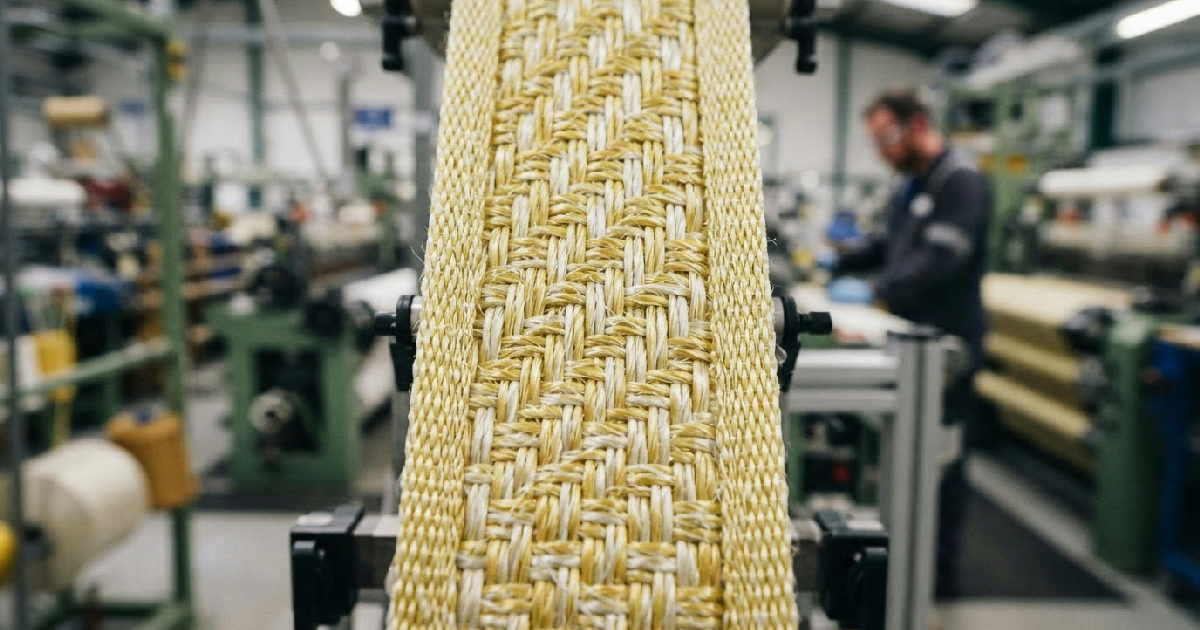
When NASA’s Perseverance Rover needed a parachute to survive its descent onto Mars in 2021, the agency turned to Heathcoat Fabrics in Devon. The £1.93 billion rover’s safe landing depended not on a complex sensor but on a highly engineered fabric designed to endure extreme temperatures after a 140-million-mile journey.
That parachute is a perfect symbol of the UK’s modern technical textiles sector: a high-value, export-driven industry hiding in plain sight.
Technical textiles: a global industry in the shadows
This is a sector built on engineering and materials science, a world away from the fashion and heritage mills that dominate public perception. Technical textiles are not designed for appearance; they are engineered for performance.
They form an invisible but critical part of modern industry, underpinning a global market valued at over $250 billion in 2025 and projected by Fortune Business Insights to reach $426.71 billion by 2034.
The UK’s technical textiles industry was valued at approximately £3.6 billion in 2024, with the UK Fashion & Textile Association (UKFT) projecting that it will grow to £5.3 billion within a decade. Between 750 and 1,000 UK companies are active in a field that touches almost every aspect of life.
Yet, as UKFT CEO Adam Mansell notes, these companies are largely unseen because their materials are embedded components rather than consumer products.
This shift from traditional textiles is stark. Paul Daynes, Sales Manager at Toray Textiles in Nottinghamshire, reports that fashion fabrics now constitute just 10% of his firm’s sales, down from 100% just 25 years ago. The future lies in advanced applications.
Globally, the industry is vast, with the Asia-Pacific region accounting for a 47.6% revenue share in 2025, according to Grand View Research. While the UK cannot compete with Asia on production volume, it has carved out a leadership position in high-value, specialist innovation.
These materials are ubiquitous. The average car contains around 30 different technical textiles, from seatbelts to battery components. Roads sit on stabilising geotextiles, and transatlantic data cables are wrapped in protective fabrics. As Katie Robinson, UKFT’s Textile Membership Manager, puts it, the sector provides fibres for Elon Musk’s rockets, challenging the misperception that UK textiles are all “tweeds and tartans”.
Defence and aerospace drive new demand
Across the industry, the story is consistent: the most significant growth is coming from defence, aerospace, and medical applications. This demand is reshaping companies that once relied on other sectors. Automotive demand, for instance, has weakened over the past decade, but the geopolitical push for resilience is creating new opportunities for firms with the right expertise.
At Arville, a 75-year-old weaver in West Yorkshire, CEO Steve Gill lists ejector seat parts, aircraft flotation tanks, and ballistic textiles for helmets as core products. The company is one of only two global suppliers of trilaminate materials for special forces dry suits.
It has also re-engineered firefighter suits to reduce the risk of severe steam burns caused by trapped moisture, a problem now considered as critical as flame resistance.
This move towards advanced functionality is a common thread among UK manufacturing leaders in the sector. Carrington Textiles, part of the RTS Textiles Group, produces military fabrics with infrared reflective properties to conceal personnel and vehicles from drone surveillance. Sales and Marketing Director Paul Farrell explains that this technology is a core part of modern camouflage and is built directly into the textile itself.
Britain’s procurement problem
Despite this homegrown expertise, industry leaders express deep frustration with UK government procurement, particularly procurement by the Ministry of Defence (MoD). Steve Gill of Arville criticises the focus on lowest-price tenders, arguing that it ignores the wider economic value of using a domestic manufacturer. He also points to a serious security risk in offshoring the production of textiles that incorporate sensitive nanotechnology and electronics.
Gill and others highlight the contrast with the United States’ Berry Amendment, which requires the US military to buy domestically produced textiles. Adam Mansell of UKFT notes that the EU is also moving towards procurement rules that weigh quality and performance more heavily than cost. Meanwhile, he laments, “pretty much everything that our armed forces wear is made abroad.”
From component supplier to engineering partner
As the products have become more complex, so have the commercial relationships. Customers no longer want transactional suppliers; they seek long-term engineering partners. “The biggest play that we have is they want a one-stop shop,” says Steve Gill, describing demand for a single, technically capable partner that can provide a competitive edge. This shift involves engagement at multiple levels, moving beyond the traditional salesperson-to-buyer dynamic.
This trend is coupled with a noticeable push towards onshoring, as clients seek to de-risk their supply chains after recent global disruptions. Sustainability has also moved from a “nice-to-have” consideration to a core requirement. Paul Farrell notes that customers at Carrington now demand transparency on fibre origin, carbon footprint, and circularity. However, the industry faces a unique challenge in which performance must take precedence over sustainability.
As the UKFT team explains, materials like Kevlar for stab vests are incredibly difficult to recycle. For these life-saving applications, performance and durability are the absolute priorities, even if they create end-of-life challenges. The focus, therefore, is on engineering products to last as long as possible before considering circularity. This is where new advanced materials could play a future role.
The critical challenge of the skills gap
Like many advanced manufacturing sectors, the technical textiles industry faces a demographic challenge. Five years ago, the average age of the workforce at Arville was 56. A concerted apprenticeship programme has lowered that to 43. Steve Gill is blunt about the threat: “The biggest threat to the industry is the failure to extract expert knowledge from people’s heads, and that knowledge is usually tacit.”
This tacit knowledge—the ability to recognise a problem through experience rather than diagnose it from a manual—is irreplaceable once lost. To attract new talent, Arville is introducing digital shop-floor technology, which Gill says makes the work “more attractive” to a younger generation.
Carrington Textiles is tackling the same issue by launching a student placement scheme, rotating interns through every part of the factory to ensure knowledge transfer.
The root of the problem, however, is visibility. Many firms in the aerospace, medical, or automotive supply chains don’t identify primarily as textile companies. This creates what UKFT’s Katie Robinson calls a “double-down challenge” in attracting new talent. It is a key reason why broader initiatives to create new engineering pathways are so crucial for securing the sector’s long-term future.
A future built on innovation, not volume
While facing pressures from high energy costs and international competition, the UK technical textiles industry is not trying to compete with the Far East on price. The strategy is to innovate. “We can create new technologies, better and more productive ways of working and the next generations of products,” says Katie Robinson. “That’s what we want to compete on rather than price and volume.”
There are signs this approach can succeed. Steve Gill recently recounted winning a significant contract for a highly technical product in which his firm’s bid was cheaper than that of a Chinese competitor—something once considered unthinkable. He sees it as proof that targeted innovation can still compete successfully against mass production. The sector’s optimism is grounded in this bet on technical capability and speed.
Paul Farrell of Carrington calls it the intersection of materials science, manufacturing, and innovation. It’s an industry of the future, not the past. The frustration is that this “enabling technology”, as UKFT calls it, remains invisible and undervalued by policymakers.
With a global push for resilient supply chains, the conditions for the UK sector to thrive are finally aligning. The question is whether government procurement policy will align with them.
