


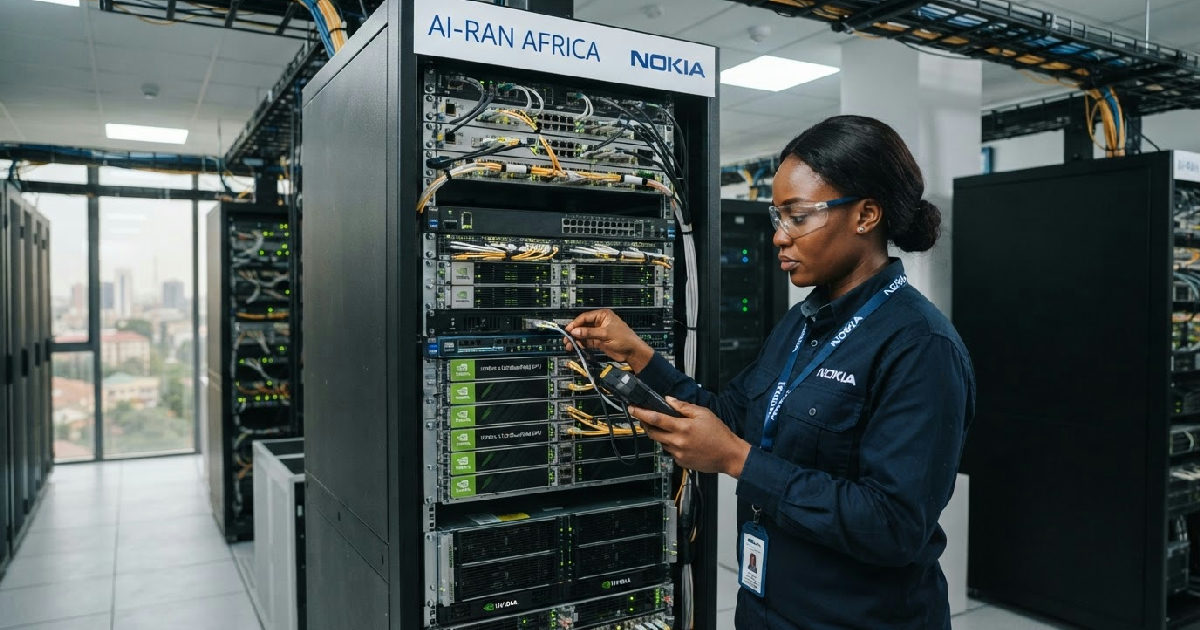
Nokia is making a significant strategic pivot in Africa, betting its future on artificial intelligence to move beyond selling network hardware and secure a more valuable position in the continent’s digital evolution. The Finnish technology giant is pushing its AI-driven Radio Access Network (AI-RAN) platform, a move designed to transform telecommunications infrastructure from simple data pipes into intelligent, programmable systems.
The strategy, underpinned by a crucial partnership with NVIDIA, aims to embed high-performance computing directly into the network fabric. However, it’s a high-stakes gamble. Nokia faces intense competition from traditional rivals such as Ericsson and Huawei, as well as cash-rich technology giants such as Microsoft and Google, which are aggressively investing in Africa’s underlying digital infrastructure.
The engineering behind Nokia’s AI-RAN Africa bet
At its core, Nokia’s strategy hinges on rethinking network architecture. For decades, the focus has been on hardware for connectivity. Now, the goal is to create AI-native, software-defined networks capable of real-time processing and automation, representing a significant shift in engineering philosophy that sees full-stack AI infrastructure as the new frontier.
The company’s commercial AI-RAN platform combines its anyRAN software with NVIDIA’s Aerial software and powerful GPU hardware. This creates an architecture in which GPU-based computing sits alongside Nokia’s traditional baseband systems. This allows standard 4G and 5G traffic to run uninterrupted while the GPU layer handles demanding AI workloads such as model training and inference.
This ‘merchant-compute’ model gives Nokia access to advanced AI processing without developing its own accelerator. It is a pragmatic approach, yet one that comes with inherent trade-offs. NVIDIA can supply similar computing infrastructure to other network vendors, potentially making this hardware advantage accessible across the industry and posing a challenge for Nokia’s position.
The approach contrasts sharply with that of Huawei, which has pursued deeper vertical integration with its own Ascend AI processors and a more closed technology stack. The open question for the industry is which model will deliver superior performance, power efficiency, and cost-effectiveness at scale. Nokia is betting that an open ecosystem model will ultimately prove more flexible and powerful.
A crowded battlefield for Africa’s digital future
Nokia is not making its move in a vacuum. Africa’s telecom market is attracting fresh investment from global technology companies such as Meta, Google and Microsoft, which are building infrastructure to support the continent’s digital growth.
Their investments in subsea cables, cloud infrastructure, and AI are giving them greater control over the infrastructure underpinning Africa’s next phase of digital development. While Nokia has long-standing relationships with major African operators such as Airtel, Vodacom, Safaricom, and Maroc Telecom, these partnerships do not guarantee a competitive edge in the new AI-driven landscape.
The company’s market position is already under pressure. This makes its entry into AI-RAN a challenging proposition, particularly as other global players with vertically integrated AI stacks also vie for market dominance.
This competitive pressure is compounded by rival advancements. Other vendors are also exploring AI-RAN, intensifying the pressure on Nokia to prove its edge. The company is targeting up to a 2.5-fold improvement in spectral efficiency. These figures are currently roadmap projections rather than results from widespread commercial deployment.
To succeed, Nokia must prove that its approach delivers a significantly better return on investment than the solutions offered by its larger, more entrenched rivals. It’s a battle being fought not just on technical merit, but on market share and established trust.
The enterprise prize: a new revenue model
The ultimate prize for Nokia and its competitors is enterprise revenue. The vision is to create networks that can support a new generation of industrial applications. Mining companies, for instance, could use dedicated low-latency networks for autonomous machinery, drawing on lessons from pioneers in mining autonomy. These applications are directly relevant to network providers.
Similarly, ports and logistics hubs could deploy networks that combine connectivity with computer vision and sensor data for real-time tracking and management. Manufacturers could coordinate robotic systems with a precision that current networks cannot guarantee. In this model, operators sell network capabilities—such as guaranteed latency, reliability, and security—rather than just data allowances.
Edge computing is the enabling technology for this vision, allowing data to be processed near its source rather than in a distant data centre. However, the market for these advanced services in Africa is still nascent. Many businesses are still in the early stages of cloud adoption, making the leap to sophisticated AI at the network edge a distant prospect.
The difficult economics of advanced networks in Africa
Perhaps the greatest challenge for Nokia’s AI-RAN strategy in Africa is the economic reality on the ground. The technology is inherently more expensive than conventional network infrastructure due to the addition of high-performance computing. Industry estimates suggest that GPU-accelerated processing can represent a significant cost for operators, with costs varying according to configuration and deployment size. This represents a major capital outlay for operators.
Power consumption is another significant cost. High-density AI processing consumes several kilowatts per node, a major consideration in markets where operators already spend heavily on generators, diesel, and batteries to keep their networks online. These costs are difficult to justify when operators are still investing heavily in expanding 4G coverage, rolling out 5G, and laying essential fibre backhaul.
This economic pressure is amplified by low average revenue per user (ARPU) across most of the continent and exposure to currency risk, as equipment is priced in dollars. As a result, AI-RAN is unlikely to be rolled out across the continent. Instead, deployments are likely to be targeted, focusing on high-traffic urban areas and specific enterprise environments where a clear return on investment can be demonstrated.
Nokia’s architecture reflects this reality. Danial Mausoof, Nokia’s Vice President of Technology and Portfolio for MEA, explained that operators can add the GPU-based computing layer alongside their existing baseband infrastructure. This incremental approach avoids a costly “rip-and-replace” scenario, making the technology more appealing to cost-conscious operators.
Automation and efficiency as the immediate value proposition
While the long-term vision focuses on enterprise services, the more immediate and compelling case for AI in African networks lies in operational efficiency. In a region with high power costs and logistical challenges in deploying field engineers, automation that reduces energy consumption and simplifies network maintenance can deliver immediate financial returns.
AI-powered automation allows networks to dynamically adjust resources to match traffic patterns, reducing power consumption during off-peak hours and enabling faults to be addressed before they cause disruptions. Nokia itself highlights scenarios in which AI-powered automation can manage thousands of network interactions and changes during periods of intense demand, demonstrating AI’s potential to manage complex network operations.
This could serve as the foot-in-the-door strategy for AI-RAN. By solving today’s pressing operational problems, Nokia can build a business case for the more advanced capabilities of its platform. This could include using AI to improve spectral efficiency, allowing operators to squeeze more capacity from their existing spectrum licences—a highly valuable proposition.
This focus on practical automation could also extend to industrial settings, with visual AI for factory automation emerging as a potential growth area for intelligent networks.
Nokia is currently discussing these use cases with African operators. Danial Mausoof expects widespread adoption across the continent to extend beyond 2030, given the varying levels of market maturity. Africa, with its unique operational challenges, could become a crucial testbed for determining whether AI-RAN can pay for itself.
