


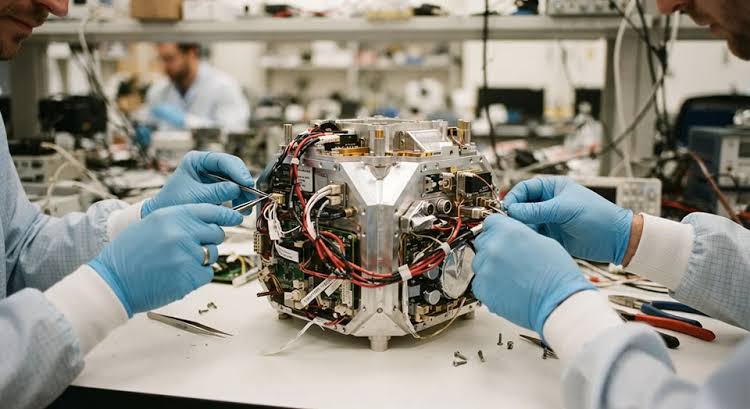
American aerospace developer Redwire Corporation and Japanese trading firm Kanematsu Corporation have formed a strategic partnership to expand space infrastructure and microgravity technology within Japan’s space market. Under a teaming agreement announced on 12 August 2026, the two companies will help integrate advanced spaceflight hardware into Japan’s growing aerospace sector.
The collaboration draws on Kanematsu’s deep domestic commercial network to navigate public and private procurement channels. Establishing this footprint allows the partners to bring Redwire’s hardware to the Japanese market more efficiently.
Navigating procurement hurdles in the Japan space market
Under the terms of the agreement signed at Kanematsu’s Tokyo headquarters during the SPACETIDE event, the trading house will serve as Redwire’s strategic commercial partner. The partnership does not grant Kanematsu exclusive brokerage rights. Instead, it positions Kanematsu to facilitate market access and government procurement for Redwire’s core technology lines.
Kanematsu Aerospace Corporation, a wholly owned subsidiary of the trading house, has long-standing relationships with key agencies. The firm regularly imports and sells defence and aerospace hardware to organisations such as the Japan Aerospace Exploration Agency (JAXA) and Japan’s Ministry of Defence. These existing connections provide Redwire with a reliable pathway to supply national security and scientific missions.
Establishing a structured commercial presence will streamline procurement procedures for Japanese satellite manufacturers and research organisations. Redwire aims to reduce the administrative delays that typically hinder cross-border technology transfers in high-security industries. This approach allows local engineers to obtain components directly without dealing with complex export bureaucracies.
This operational approach reflects a broader trend among aerospace contractors seeking to enter international markets. Partnering with local firms allows manufacturers to navigate complex regulatory environments without establishing large, independent foreign offices. It provides an immediate local presence while keeping overhead costs manageable.
Scaling microgravity payloads for orbital manufacturing
The strategic agreement places heavy emphasis on the commercialisation of microgravity payloads. Redwire has steadily expanded its manufacturing capabilities, acquiring specialist firms such as Made In Space to strengthen its spaceflight hardware portfolio. These acquisitions have positioned the manufacturer as a major supplier of low Earth orbit (LEO) processing equipment.
Processing materials in orbit reduces the effects of gravity-driven phenomena such as convection and sedimentatio. This environmental advantage allows engineers to produce high-quality optical fibres and advanced semiconductor components that are impossible to manufacture on Earth. These space-manufactured goods could offer superior performance for high-tech industrial applications.
Mike Gold, President of Redwire Space, emphasised that spaceflight capabilities can increasingly influence terrestrial industrial capacity. He stated that the partnership will drive innovation in areas such as biotechnology, power generation, and Earth observation. The agreement represents a practical step toward integrating orbital production with everyday global supply chains.
By manufacturing high-value products in low Earth orbit, companies can create highly specialized materials for Earth-bound industries. These space-based facilities offer industrial manufacturers unique processing environments that are difficult to replicate in terrestrial factories. Consequently, global firms are increasingly looking off-planet to solve complex materials science challenges.
The industrial science behind pharmaceutical payloads
The agreement will also make Redwire’s automated orbital processing tools available to Japanese research organisations. These systems include 3D bioprinting hardware and industrial crystallisation units designed to operate in low Earth orbit. These instruments can enable pharmaceutical firms to conduct automated chemical synthesis in microgravity.
Protein crystallisation in space can be less affected by gravity-driven effects that influence crystal formation on Earth. Researchers can grow larger, higher-quality protein crystals to map atomic structures with extreme precision. This technical capability could accelerate the design of targeted medical therapies.
Redwire has previously collaborated with local entities like the Japan Manned Space Systems Corporation (JAMSS) to support microgravity research. Japan’s established hardware heritage on the International Space Station provides a structured and mature market for these advanced payloads. This historical integration reduces the technical risks of deploying new commercial hardware.
In-space power generation and solar architecture
Beyond biological processing, the partnership will promote Redwire’s in-space power generation systems. The portfolio includes rollable solar array structures, space power distribution systems, and high-efficiency solar tracking mechanisms. These components help provide the electrical power required to keep small satellites and large orbital structures operational.
Spacecraft manufacturers face persistent pressure to deliver greater power output while minimising launch weight. Redwire’s rollable arrays are stowed compactly during launch and expand once in orbit to maximise their surface area. These power distribution systems help address key constraints facing orbital industrial facilities.
Establishing reliable supply chains for these components requires deep cross-border coordination. Just as global industrial partnerships help scale quantum hardware production for next-generation computing, aerospace manufacturers rely on trading partners to distribute and support advanced power systems. Coordinating with local partners helps ensure that sensitive electrical components are delivered safely to integration facilities.
To integrate these technologies, joint business development teams have planned immediate domestic commercial outreach. These efforts will focus strictly on the Japanese space market. The joint teams are targeting public and private satellite missions scheduled for launch in late 2026 and 2027.
Kanematsu expands its LEO commercial network
For Kanematsu, the agreement represents a deliberate step to expand its aerospace division.While the company has traditionally focused on aviation and defence hardware, it is actively building a commercial network for low Earth orbit (LEO) operations. This strategic pivot aligns with growing commercial interest in private orbital stations.
The firm previously signed a memorandum of understanding with the US-based Sierra Space Corporation to develop orbital space station infrastructure. Kanematsu also partnered with Spain-based space startup FOSSA Systems in April 2026 to deploy ultra-small satellite constellations for defence applications in Japan. These initiatives collectively position the trading house as a key gateway to Japan’s aerospace market.
Ryoichi Kidokoro, the chief operating officer of Kanematsu’s motor vehicles and aerospace division, welcomed the partnership. He noted that integrating Redwire’s robotics and microgravity systems with Kanematsu’s commercial expertise could deliver vital next-generation solutions to Japanese customers. This synergy combines advanced hardware capabilities with deep local market intelligence.
The trading house is positioning itself as a central bridge between foreign technology developers and Japan’s public sector. This strategy aligns with Japan’s broader initiatives to bolster national space security and scientific research through international collaboration. Leveraging existing trade networks could help Japan accelerate its domestic aerospace modernisation goals.
Strategic implications for emerging space economies in Africa
The collaborative model established in Tokyo provides a viable blueprint for emerging industrial regions, particularly across Africa. Building domestic aerospace manufacturing capabilities from the ground up requires substantial capital investment that many developing economies may struggle to justify. Strategic commercial partnerships offer a faster, more cost-effective way to establish an orbital presence.
By utilising established trading partners to source proven hardware, African space programmes could accelerate their development. Agencies in South Africa, Nigeria, and Egypt could focus their resources on downstream applications rather than spending years re-engineering core solar components. This division of labour enables rapid deployment of localized satellite services.
These downstream satellite applications directly support critical terrestrial infrastructure on the continent. While massive satellite constellations support terrestrial mobile connectivity for global consumers, African operators require localised satellite telecommunications solutions to bridge connectivity gaps in vast, underserved rural areas. Reliable communications remain essential for driving agricultural and industrial productivity.
Ultimately, Redwire’s expansion highlights the increasingly globalised nature of the aerospace supply chain. As orbital manufacturing and satellite operations become standardised, nations with efficient procurement networks will be better positioned to capture the resulting industrial benefits. Trading houses will continue to play a pivotal role in this international market.
