


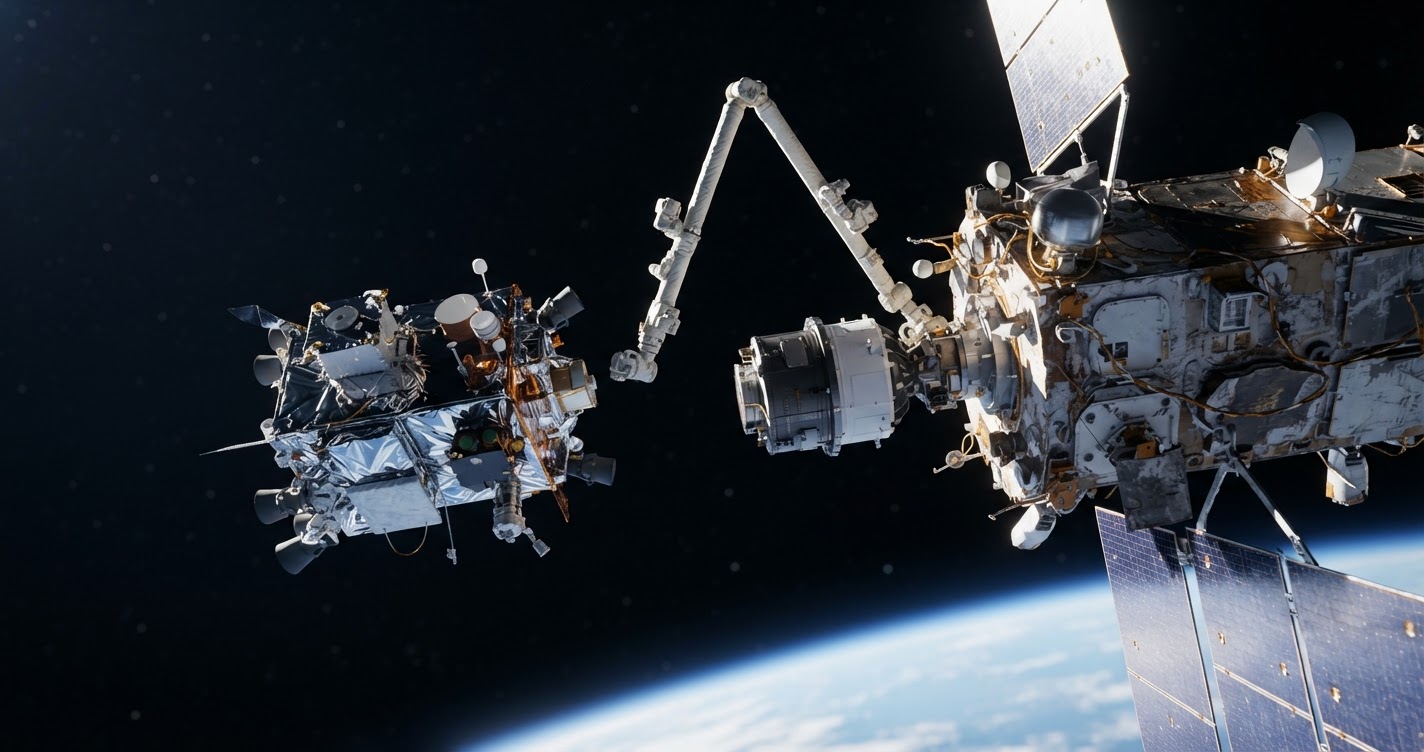
Northrop Grumman Corporation is advancing in-orbit servicing technology with its next generation of satellite-servicing robots, marking a crucial step towards sustainable space infrastructure. Its subsidiary, SpaceLogistics LLC, saw its Mission Extension Vehicle-1 (MEV-1) undock from the Intelsat 901 (IS-901) satellite in April 2025, after five years of service.
This successful mission, along with MEV-2’s continued service to Intelsat 10-02 (IS-10-02), demonstrates the viability of extending satellites’ operational lives. It also sets the stage for a more advanced servicing system.In July 2026, Northrop Grumman launched its Mission Robotic Vehicle (MRV) and three Mission Extension Pods (MEPs) aboard a SpaceX Falcon 9 rocket.
New generation robotic servicing enhances satellite longevity
These four spacecraft are currently en route to targets in geosynchronous orbit (GEO), approximately 22,236 miles (35,786 kilometres) above Earth. In 2027, the MRV will use its robotic arms to attach one of the MEPs to the Optus satellite. This attachment should extend the satellite’s service life by several years.
This represents a significant evolution in in-orbit servicing. It reflects a strategic shift for satellite operators and promises considerable operational benefits.
Many communications and Earth-scanning satellites fail not because their electronics cease functioning, but because they deplete their fuel reserves needed to maintain orbit. The Optus satellite, for example, launched in 2009 with a 15-year design lifespan. With the MEP’s assistance, it could potentially operate for an additional six years.
Cassie Wong, Northrop Grumman’s director of logistics and servicing, articulates this as a “paradigm shift” towards a “sustainable” and “resilient” space architecture. This approach allows for repairs, life extension, and even upgrades of satellites. It changes how operators manage their valuable assets in geosynchronous orbit (GEO).
MEV missions provided initial proof of concept
Before the MRV and MEPs, Northrop Grumman had already deployed two Mission Extension Vehicles (MEVs). MEV-1, launched in October 2019, successfully docked with the Intelsat 901 (IS-901) satellite in February 2020.
It provided propulsion and attitude control for five years, extending the satellite’s operational life. After completing its mission in April 2025, MEV-1 undocked from IS-901 and will move the satellite into a graveyard orbit.
MEV-2, launched in August 2020, docked with Intelsat 10-02 (IS-10-02) in April 2021. It is currently undertaking a five-year life-extension mission, which was later extended by an additional four years.
These MEVs operate by using an extendable probe to clamp onto the client satellite’s main rocket motor nozzle. This method is compatible with roughly 80% of existing GEO satellites.
The shift to Mission Robotic Vehicles and Extension Pods
The MRV represents a significant evolution in the in-orbit servicing business model. Unlike MEVs, which remain permanently attached, the MRV is a multi-client robotic servicer. It carries the smaller, less expensive MEPs, which are modular propulsion units.
Satellite operators purchase and own the MEPs, which are then permanently attached to their spacecraft by the MRV’s robotic arms. This frees up the MRV to service multiple vehicles. It creates a more cost-effective offering for a wider range of robotic servicing applications in space.
Overcoming complex engineering challenges in orbit
Successfully performing in-orbit servicing missions requires overcoming immense technical hurdles. The vehicles must autonomously approach and safely dock with target satellites, which are travelling at thousands of miles per hour. The precision required for these manoeuvres is extraordinary, especially when dealing with client satellites that may not have been designed for such interactions.
Northrop Grumman’s MEVs are equipped with advanced sensors, including visible spectrum imagers and active-scanning lidar, to facilitate precise rendezvous, proximity operations, and docking (RPOD). The MRV, equipped with two advanced robotic arms developed by the Defense Advanced Research Projects Agency (DARPA), faces even greater challenges. It needs to carefully attach MEPs, a task demanding fine motor control in a zero-gravity environment.
Refuelling and autonomous navigation capabilities
A key feature of the MRV is its design for in-orbit refuelling. TThis capability serves as a proof of concept for future satellites. It highlights the potential for a more flexible and sustainable approach to space operations.
Currently, the extra cost and weight associated with such adaptations deter many spacecraft operators from investing in them. The ability to refuel in space could dramatically extend the operational lifespan of satellites. It transforms them from disposable assets into maintainable infrastructure.
This development could reshape the economics of satellite design and deployment. It could also accelerate the development of robotic servicing technologies and AI-enabled space operations.
Economic and strategic implications for satellite operators
One of the primary benefits of satellite-servicing robots is the significant economic advantage they offer. By extending the life of existing satellites, operators can generate additional revenue for years without incurring the high cost of launching a replacement. This is especially true for older, still-functional satellites that are simply running low on propellant.
Cheaper launch costs and lower-cost space components also make these repair missions more financially viable than ever before. This trend extends beyond servicing to areas like terrestrial mobile networks, indicating a wider transformation in space utilisation.
Maximising asset value and operational efficiency
The MRV’s ability to service multiple satellites with interchangeable MEPs further optimises costs. Instead of dedicating an entire MEV to a single client for years, the MRV can install an MEP and move on to its next mission. This creates a flexible, on-demand servicing model. It improves the operational efficiency of a satellite fleet.
This approach helps operators maximise the asset value of their existing infrastructure. It can defer the capital expenditure associated with building and launching new satellites. In an increasingly competitive space industry, this cost-saving measure could provide a crucial advantage.
National security dimensions and dual-use technology
The involvement of DARPA in developing the MRV’s robotic arms underscores the strategic importance of in-orbit servicing. Defence customers, particularly those operating expensive satellites in high orbits, stand to benefit greatly from life extension and potential upgrade capabilities. Such technology has clear national security implications.
However, robotic arms in space also raise dual-use concerns. The U.S. Space Force has previously characterised Chinese servicing spacecraft with robotic arms as potential weapons, citing their theoretical ability to grapple and degrade rival satellites. Northrop Grumman maintains that its vehicles are solely focused on servicing missions, providing crucial assurance in a sensitive operational domain.
The future of in-orbit servicing and space sustainability
The deployment of MRVs and MEPs marks a pivotal moment in the evolution of space infrastructure. It transitions space operations from a “launch-and-forget” model to one based on active maintenance and sustainability. This shift is crucial for managing the growing number of objects in orbit and mitigating space debris.
Northrop Grumman expects the MRV to take on even more diverse missions in the future. These could include adding new components to satellites, adjusting their orbits, or even performing more complex repairs. This vision points towards a future where satellites are routinely maintained and upgraded, much like infrastructure on Earth.
Expanding capabilities for next-generation space infrastructure
The company envisions a future where fluid and gas replenishment, inspection, repair, and replacement of parts become commonplace. It also plans for the incorporation of auxiliary propulsion, navigation, power systems, and payloads. This would allow satellites to adapt to changing mission requirements. It also prolongs their utility far beyond their original design life.
While some operators, such as Starlink and Amazon Leo, are pursuing large constellations of relatively inexpensive, replaceable satellites in low Earth orbit, there remains a significant demand for extending the life of larger, more expensive satellites in GEO. These assets are vital for critical communication and observation services, making in-orbit servicing an indispensable technology.
A new paradigm for space operations and economic viability
This commitment to in-orbit servicing transforms the economic viability of space assets. It also creates a more resilient space architecture. The ability to keep high-value satellites operational longer means less frequent and costly replacements. It promotes more efficient use of orbital slots. This is especially important as space becomes increasingly crowded.
For industries relying on satellite communications, navigation, and Earth observation, Northrop Grumman’s advancements mean more reliable and uninterrupted services. This technological progression underscores a broader move towards industrial practices in space, treating satellites not just as single-use launches but as long-term, maintainable investments. It’s a testament to the ongoing innovation driving the space sector.
