


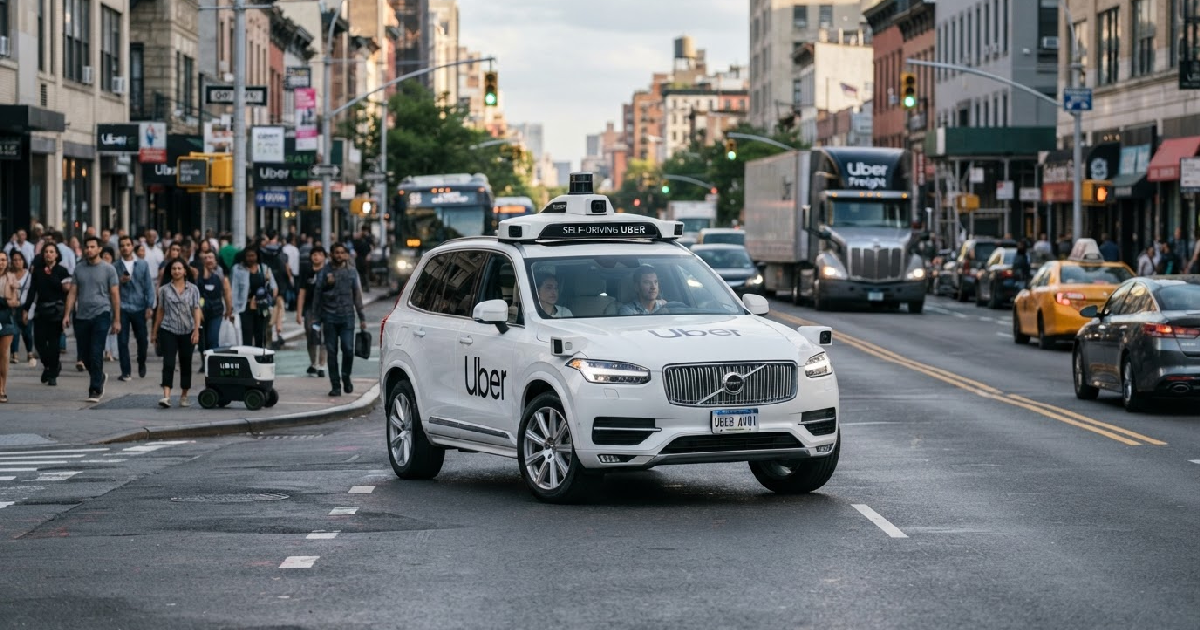
Uber has fundamentally reshaped its approach to autonomous vehicles (AVs), pivoting away from developing its own self-driving technology towards an expansive network of partnerships and strategic investments. The mobility giant has committed over $10 billion to this revised strategy, building a formidable roster of more than 30 companies across robotaxis, self-driving trucks, and last-mile delivery robots.
This calculated shift, which gained momentum between 2024 and 2026, aims to establish Uber as a dominant distribution layer for autonomous mobility. Rather than shouldering the technical and regulatory burdens of AV development, the company now focuses on fleet orchestration, demand aggregation, and navigating complex regulations. In February 2026, Uber formally established a dedicated business unit, “Uber Autonomous Solutions”, solidifying this strategic direction.
A deliberate pivot from in-house development
Uber’s initial foray into autonomous driving began with significant internal investment. In 2014, the company, then led by Travis Kalanick, launched Uber Advanced Technologies Group (ATG) and brought in robotics talent from Carnegie Mellon University. By 2016, it acquired the self-driving truck firm Otto and commenced testing AVs on public roads in California, Pittsburgh, and Arizona.
This early progress faced considerable setbacks. A trade secrets lawsuit from Waymo, Kalanick’s 2017 resignation, and a fatal crash in Tempe, Arizona, in 2018 involving an Uber AV ultimately halted its in-house ambitions. The incident, where a self-driving Volvo XC90 struck and killed a pedestrian, prompted an immediate suspension of testing and a major programme reorganisation.
Under CEO Dara Khosrowshahi, Uber executed a strategic reset in 2020, divesting from “moonshot” projects like AVs to concentrate on its core ride-hailing and delivery services. Uber sold its ATG unit to Aurora in December 2020, but critically, it retained an equity stake. After a brief hiatus, Uber began cautiously re-engaging with AV technology providers in 2022, with deal flow intensifying significantly by 2024.
Investing in autonomous fleet deployment
Uber’s financial commitment to this partnership model is substantial, with total investment exceeding $10 billion. Over $2.5 billion of this has gone into direct equity stakes in various autonomous technology companies, underscoring Uber’s deep integration with its partners’ futures.
Uber, through its holding company Neben Holdings, owns 325.97 million Aurora Class A shares, representing a 19.7% Class A equity stake and 6.9% voting power as of April 2026. This originated from a $400 million investment in Aurora as part of the 2020 ATG sale, a deal that valued Aurora at $10 billion.
The company also has an equity stake in Lucid Motors, having reportedly invested around $300 million to facilitate the deployment of robotaxis based on the Lucid Gravity platform. For Rivian, a deal worth up to $1.25 billion includes an initial $300 million investment from Uber, aiming for 50,000 R2 vehicles by 2028.
The fleet is scheduled for an initial rollout in San Francisco and Miami in 2028, expanding to 25 cities in the U.S., Canada, and Europe by the end of 2031.
Canadian robotaxi company Waabi partnered with Uber in a deal valued at $1 billion, specifically to deploy 25,000 robotaxis on the platform. Uber was also among the investors who participated in Waabi’s $83.5 million Series A round. Furthermore, Uber holds equity stakes in Nuro and Wayve, among others.
Building a diverse partner ecosystem
Uber’s network spans the full spectrum of autonomous mobility, from passenger transport to logistics and last-mile delivery. Each partnership brings specialised technology and market access, creating a diversified ecosystem.
In the robotaxi segment, Uber and Israel-based Autobrains announced plans in June 2026 to launch a robotaxi programme in Munich, pending regulatory approval. This programme will feature Autobrains’ agentic AI driving system running on Nvidia’s Drive Hyperion platform.
Chinese tech giant Baidu entered a multi-year strategic partnership with Uber in July 2025, which will see thousands of Apollo Go autonomous vehicles deployed on the Uber platform in markets outside the U.S. and mainland China, beginning in Asia and the Middle East.
Waymo, owned by Alphabet, first partnered with Uber in May 2023, bringing some of its robotaxis onto the Uber platform in Phoenix. The following year, the companies expanded to Austin and Atlanta, though Waymo robotaxis there are only accessible via the Uber app. However, the Phoenix partnership ended in July 2026, and Waymo plans to conclude its remaining contractual relationship with Uber by May 2028.
Specialised fleet management solutions
For fleet operations, Uber holds a 30% stake in Avomo, a European fleet operator. Avomo handles fleet services such as cleaning, maintenance, and charging for Uber’s Waymo partnership in Austin and its WeRide robotaxi service agreement in Madrid.
On April 30, 2026, Uber formed strategic fleet partnerships with Hertz and its affiliated operating company Oro Mobility. Oro Mobility provides integrated fleet management solutions for Uber’s autonomous robotaxi programme of Lucid vehicles equipped with Nuro AV technology.
The fleet management services are expected to launch, with expansion opportunities explored in 2027. Andrew Macdonald, President and COO of Uber, stated that this partnership will “accelerate the transition to a hybrid network.”
UAE-based Tawasul is another operator, partnering with Uber in 2024 to provide fleet management services for Uber’s WeRide robotaxi service in Abu Dhabi. This network of specialised operators ensures the complex logistics of autonomous fleets are managed efficiently.
Delivery robots and self-driving trucks
In the last-mile delivery segment, Uber works with sidewalk robot companies like Cartken and Coco for delivery services. Uber also made a small, undisclosed investment in drone delivery firm Flytrex in September 2025.
Uber Freight, the logistics business spun off from Uber in 2018, is deepening its autonomous capabilities through a multi-year collaboration with Aurora, announced in June 2024. Aurora’s self-driving trucks have been completing round-trip hauls between Dallas and Houston via the Uber Freight platform since May 2025. Aurora is also extending Level 4 autonomy to long-haul freight in collaboration with NVIDIA.
Powering the network with data and AI
Uber isn’t just signing deals; it’s investing in the underlying infrastructure critical for AV deployment. The company has earmarked $100 million for building fast-charging networks across ten targeted autonomous-vehicle cities by the end of 2026. This infrastructure is vital for the widespread adoption of electric autonomous fleets.
Data collection and artificial intelligence are central to Uber’s AV ecosystem. The company is deploying 500 sensor-equipped Hyundai Ioniq 5 electric vehicles as full-time data collectors. Approximately 50 of these cars are expected to be online by summer 2026., to capture millions of miles of high-fidelity data monthly.
NVIDIA plays a crucial role across several partnerships. Uber aims to scale its global autonomous fleet to 100,000 vehicles by 2027, supported by a joint AI data factory built on the NVIDIA Cosmos platform. The Autobrains robotaxi program in Munich, planned for June 2026, will utilise Nvidia’s Drive Hyperion platform, further enhancing AI engineering for autonomous systems.
Outlook: Uber as the AV orchestrator
This diversified, asset-light strategy represents a profound shift for Uber. By moving away fromin-house AV development, the company significantly reduces the immense technical and regulatory risks associated with bringing complex self-driving systems to market. It also mitigates technical debt accumulated during its earlier, ultimately unsuccessful, ATG programme.
This approach preserves crucial optionality. The AV landscape continues to evolve, with various technological architectures and regulatory pathways emerging globally. By partnering with a wide array of specialists, Uber avoids betting on a single solution, positioning itself to integrate whichever technologies prove most viable and scalable.
Uber’s core strength lies in its expansive global network and user base. The company now aims to be the seamless consumer-facing interface for autonomous mobility, regardless of which AV provider powers the ride or delivery.
This strategy allows Uber to focus on its expertise in demand aggregation, efficient dispatch, and managing the user experience, while partners handle the intricacies of the autonomous driving stack and vehicle manufacturing. As these partnerships mature and deployments expand, the impact on industrial productivity and urban planning worldwide will be substantial.
