


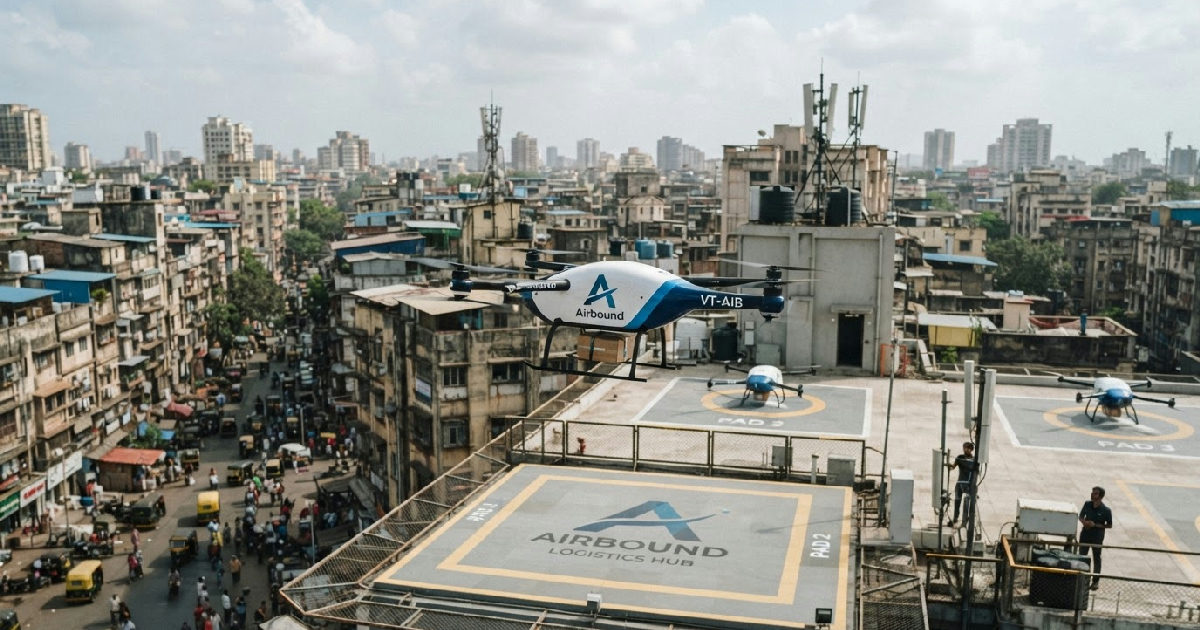
Bengaluru-based aerospace startup Airbound has secured $37 million in a Series A funding round to scale its drone delivery operations and develop larger aircraft. Announced on August 25, 2026, this latest investment brings the company’s total funding to nearly $50 million since its launch in 2023. This capital injection will accelerate Airbound’s engineering, commercial-scale manufacturing, and go-to-market initiatives, primarily in India.
The funding round was led by Greenoaks, with significant participation from DoorDash, Lachy Groom, Lightspeed, and Humba Ventures. This recent capital injection follows an $8.65 million seed round completed in October 2025. Such backing signals strong investor confidence in Airbound’s novel approach to aerial logistics.
The engineering behind Airbound’s drone delivery aircraft
At the core of Airbound’s strategy is a fundamental re-imagining of aircraft design. Naman Pushp, Founder and CEO of Airbound, is pursuing a “physics-first” approach. His goal is to create aircraft so efficient that moving goods by air becomes more cost-effective than road transport.
The company’s current aircraft, a blended wing body “tailsitter,” demonstrates this philosophy. It’s engineered for vertical take-off and landing, like a helicopter, but transitions to fly horizontally with the energy efficiency of a fixed-wing plane. This design choice aims to mitigate the energy waste commonly associated with traditional drone lift-off.
This efficiency defines Airbound’s market differentiation. Neil Shah, a partner at lead investor Greenoaks, observed that logistics has historically presented a dilemma between speed and cost. “Trucks are cheap and slow, planes are fast and expensive,” Shah stated, suggesting that Airbound offers a solution to this trade-off.
redefining payload efficiency for aerial logistics
Airbound’s initial drone model, the TRT, exemplifies its design philosophy. This aircraft weighs 1.5 kilograms (3.3 pounds) and can carry a payload of 1 kilogram (2.2 pounds). This represents a payload-to-aircraft weight ratio three times better than the industry norm of 4:1.
The company is also developing larger aircraft designs, with the new funding supporting further engineering and production scaling for these more capable drones. These efforts aim to expand the range and capacity of Airbound’s fleet for commercial deployment. Expanding hardware production is a significant focus.
from initial deliveries to a statewide logistics grid
Airbound began its operations delivering small packages, including medical supplies. This early work demonstrated the potential for autonomous aerial systems in time-sensitive logistics. The startup is now engaging with quick commerce and e-commerce companies to broaden its delivery services for everyday items.
A significant step towards this expansion is a commercial deployment agreement with the Indian state of Andhra Pradesh. This project involves building a comprehensive drone delivery network connecting three major cities: Amaravati, Vijayawada, and Guntur. The network will support retail, e-commerce, and healthcare deliveries across the region.
Airbound targets a capacity of 10,000 flights per day within this network. Naman Pushp believes that proving the model in India, with its demanding consumer expectations, offers a robust test. “The bar for delivery in India is high,” Pushp explained. “The benchmark is 10 minutes to your doorstep, at an extremely low cost.”
He added that if a system functions effectively in India, it likely possesses the resilience to operate anywhere globally. This regional program is also viewed as a blueprint for wider aerial delivery operations throughout the country. Securing drone factory capabilities will be key to such expansion.
investor confidence and a vision for aerial movement
The calibre of investors behind Airbound highlights confidence in its technical and commercial strategy. DoorDash, a global leader in last-mile logistics, notably participated in this round. Harrison Shih, Head of Product at DoorDash Labs, indicated his team’s interest in Airbound’s approach to complex logistical challenges.
For investors like Greenoaks, the potential extends beyond small package deliveries. It involves establishing a new transport modality that could fundamentally reshape freight and, eventually, human mobility.
Shah of Greenoaks articulated this vision: “When one autonomous aircraft can move a single package with the cost efficiency of a fully loaded 20-ton truck, fast delivery and cheap delivery are no longer in tension, and roads stop being the default.”
Pushp’s own vision is even broader. He envisions a future where aerial transport becomes the primary mode of movement. “We believe in a world where all movement happens in the air. Not some of it. Not most of it. All of it,” he stated.
He foresees a time “where flying is cheaper than taking the bus… and where we look at cars the way we look at horses today.”
the path ahead: scaling production and navigating regulation
Despite significant funding and a clear vision, Airbound faces considerable challenges. These include scaling manufacturing to a commercial level, navigating the complex and evolving regulatory landscape for autonomous aerial vehicles, and managing the operational intricacies of a large-scale delivery network. Investments in AI optical interconnects also reflect this push for advanced infrastructure.
The capital from this Series A round is specifically earmarked to address these issues. A substantial portion will fund aircraft engineering and expand manufacturing capabilities. The company must transition from prototype development to mass-producing reliable, certified aircraft for widespread use.
Building a commercial-scale drone fleet is a demanding industrial undertaking. It requires robust supply chains, rigorous quality control, and streamlined assembly processes. While the Andhra Pradesh project will serve as a crucial testbed, replicating this success across India and potentially internationally will challenge the company’s operational and manufacturing prowess.
Airbound is betting its superior physics-based design will create compelling economic advantages. As Pushp puts it, “Better physics leads to better economics, which unlocks the potential to move people and goods for a fraction of a cent.” If the company delivers on this promise, it could redefine the future of logistics.
