


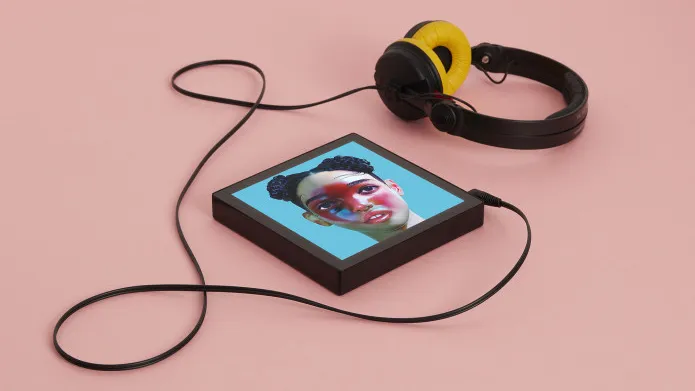
Musician and graphic designer Tom Vek has launched the latest iteration of his Sleevenote digital music player, a device crafted to rekindle the tactile and visual appreciation of album art in the digital realm.
Vek, who began developing the Sleevenote concept in 2020, envisions a player that makes every pixel dedicated to the “canonical album cover shape”. His work aims to demonstrate how bespoke technology can foster a deeper connection between listeners and their music. The device offers a unique intersection of aesthetic design and advanced audio capabilities.
Reimagining the digital album experience with the Sleevenote player
Sleevenote, as Vek describes it, is a “cross-pollination of a vinyl record and an iPod”, purposefully blending familiarity with forward-thinking design. Vek’s fundamental belief is that album art and music are “utterly interlaced”, serving as the primary “handle” for engaging with an artist’s work. This philosophy underpins every aspect of the player’s interface and functionality.
The device prioritises the visual aspect of music, offering an immersive interface where users interact directly with digital artwork. Unlike typical digital players that reduce album covers to mere thumbnails, Sleevenote elevates the art. Vek argues this approach cultivates a more profound relationship with music, moving beyond passive consumption to active appreciation.
From conceptual app to crowdfunded hardware
The journey for Sleevenote began even before its hardware manifestation, initially as an app that allowed users to view LP-style artwork on their phones. This early software concept, developed six years prior to the 2020 hardware launch, laid the groundwork for Vek’s vision. He collaborated with software engineer and CTO Chris Hipgrave to translate these ideas into a physical product.
In November 2020, Vek initiated a significant crowdfunding campaign on Indiegogo. He aimed to raise over $655,000 USD (approximately £497,734) to fund the initial production run of the hardware. To meet minimum production goals without external investment, Vek needed to sell at least 1,000 units, priced at roughly £533 ($707 USD) each.
Engineering the compact Day One Edition
The latest development in this project is the release of the “Day One Edition”, a limited pre-production prototype of the Sleevenote digital music player. Restricted to just 100 units, this version serves as a paid hardware beta program. It focuses exclusively on owned music files, intentionally omitting streaming service integration.
This edition features a more compact body, measuring 87 x 87 x 27mm. It houses a 4-inch square touchscreen display and offers 256GB of storage for music files. Physical playback buttons are positioned along one side, allowing users to skip tracks without needing to touch the main display, preserving the artwork on screen.
High-fidelity audio and interactive design
While the “Day One Edition” simplifies functionality, the original crowdfunded design outlined robust audio and display specifications. That version showcased a 7.5-inch high-resolution touchscreen and a 250 GB solid-state drive. Connectivity included Wi-Fi and Bluetooth, supporting popular streaming platforms like Apple Music and Spotify, with more services planned.
For audio fidelity, Sleevenote integrates a Cirrus HQ Digital Audio Converter (DAC) and a Wolfson Class W headphone amplifier. This setup supports high-resolution audio playback up to 24-bit/96-kHz, accessible via a 3.5mm headphone jack.
The interface allows users to engage directly with digital album art, with track listings appearing on the back of the digital cover for song selection. This design decision deliberately separates the user interface controls from the artistic display.
Vek’s stance: beyond retro, towards ownership
Tom Vek is unequivocal in his rejection of the “retro” label often applied to dedicated audio devices. He views the recent trend for new retro-style CD and cassette players as missing an opportunity for genuine innovation. Vek advocates instead for new ideas that specifically encourage digital music purchasing, highlighting its benefits for artists.
He argues that digital downloads offer significantly greater financial support to musicians than second-hand physical media or some streaming models. Vek contends that digital purchases provide users with offline, “time-stamped” access to art, fostering a more mindful engagement with curated music collections. This perspective underpins Sleevenote’s core purpose.
As Vek puts it, he was “resistant to the iPod because it wasn’t a good replacement for the visual side of CDs”. His ambition is to create a device that not only plays music but also celebrates the comprehensive artistic package. This commitment to the visual experience differentiates Sleevenote in a crowded market.
Fostering artist collaboration and future development
The “Day One Edition” units, whose first shipments were estimated for March 2026, are now fully pre-ordered. Purchasers gain access to a private Discord channel, fostering a community where their feedback on bugs and feature requests directly informs the beta software’s evolution. This collaborative development model ensures the product grows in line with user needs.
Vek and Chris Hipgrave have also created “Sleevenote for Artists,” a dedicated platform for musicians and labels. Here, artists can upload high-resolution lyrics, credits, photographs, and complete booklet designs. This comprehensive approach ensures the Sleevenote database, which already held over 1,000 album covers as of November 2020, remains rich with content.
This initiative reflects a broader commitment to supporting artists and enriching the digital model for music distribution.
Implications for independent hardware innovation
Sleevenote represents a compelling example of “thoughtfully created indie tech products” carving out a niche in a market dominated by multi-functional devices. This approach demonstrates a viable pathway for specialised hardware development. It highlights how focusing on a distinct user experience can create significant value and attract a dedicated user base.
For industrial design and manufacturing globally, Vek’s project offers insights into the potential of niche markets and direct community engagement in product development. It underscores that innovation isn’t solely about broad appeal but also about meticulously addressing specific user needs and artistic values.
This model provides an interesting blueprint for others considering bespoke hardware ventures, particularly in areas where digital experiences can be enhanced through dedicated devices.
