


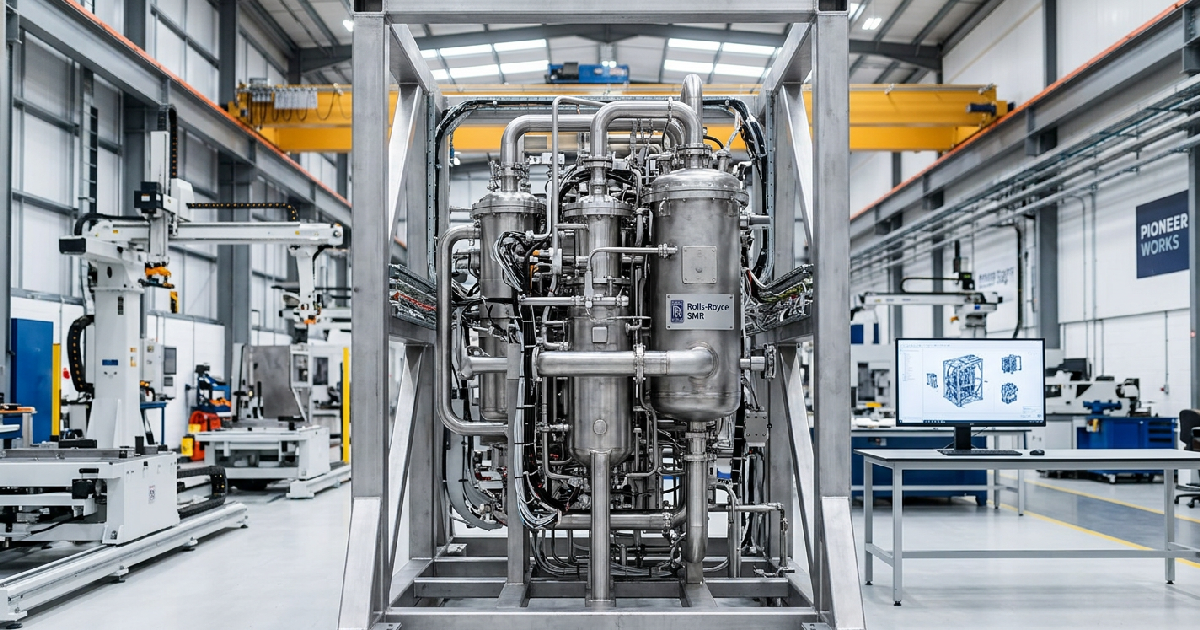
Rolls-Royce SMR is investing £12 million in a new manufacturing development centre in Derby to de-risk the deployment of its fleet of factory-built nuclear power plants.
The 470 MWe small modular reactor (SMR) design relies on a manufacturing philosophy where approximately 90% of the unit is fabricated and tested in a factory environment before being delivered as modules for on-site assembly. Pioneer Works will focus on validating these methods, particularly for high-integrity components and the primary circuit.
Industrialising nuclear assembly through precision engineering
This industrialised approach mirrors broader shifts in the sector, where manufacturers pivot to manufacturing execution systems to manage complex production data and maintain plant agility during the rollout of new technologies.
Operations at the Derby site will be conducted alongside Rolls-Royce SMR’s existing EXPERI facility at the University of Sheffield’s Advanced Manufacturing Research Centre. While the Sheffield site handles initial modular manufacturing R&D, Pioneer Works will focus on the transition from prototype manufacture to full-scale commercial deployment.
This dual-facility strategy is intended to ensure that assembly sequences are perfected in a controlled environment, reducing the construction delays that have historically affected large-scale civil nuclear engineering projects.
The £12 million investment in Pioneer Works represents a significant step in transforming nuclear power into a repeatable industrial product. Engineers at the facility will develop and validate specialist manufacturing projects, including the assembly of the primary circuit, which is the heart of the pressurised water reactor.
By using a non-nuclear site for these developments, Rolls-Royce SMR can iterate on engineering methods and testing rigs more rapidly, ensuring that the “factory-built” model is refined before the first units reach their final destinations.
Validating SMR manufacturing processes
The Pioneer Works development centre will be Rolls-Royce SMR’s first dedicated hub for manufacturing evolution. It will establish the build processes, precision assembly techniques, and advanced testing required to support the deployment of the company’s reactor fleet.
This includes the careful validation of manufacturing methods for high-integrity components and the primary circuit. The attention to detail at this stage is crucial for ensuring the long-term reliability and safety of the SMR units.
De-risking SMR fleet deployment
A core objective of the Derby facility is to de-risk the delivery of the small modular reactor (SMR) fleet. By perfecting the production processes in a controlled, non-nuclear environment, Rolls-Royce SMR aims to minimise potential challenges and delays during actual power plant construction.
This proactive approach helps to ensure that when SMRs are deployed in the UK, Czechia, and Sweden, the manufacturing aspects are already thoroughly proven. This strategy addresses a common hurdle in complex engineering projects by shifting risk away from final assembly sites.
Developing essential skills for nuclear production
Pioneer Works will also serve as Rolls-Royce SMR’s first dedicated training centre. This commitment to workforce development aims to create a skilled labour force capable of supporting an expanding global reactor production pipeline.
The site expects to create approximately 40 long-term, highly skilled positions. These roles include advanced engineering, precision assembly, welding, testing, and manufacturing development, reflecting the diverse expertise required for SMR production.
Local impact and career opportunities
Ruth Todd CBE, Operations and Supply Chain Director at Rolls-Royce SMR, highlighted the facility’s role in driving forward the next generation of nuclear power through British engineering know-how. She emphasised the creation of skilled jobs and support for the wider supply chain.
Local Members of Parliament, Catherine Atkinson MP for Derby North and Baggy Shanker MP for Derby South, welcomed the investment. They noted Derby’s existing engineering capabilities and the new training and apprenticeship opportunities it brings to the local community, ensuring local people benefit from these new career pathways.
Accelerating global SMR deployment
The £12 million investment, equivalent to US$15.8 million or US$16 million, reinforces Derby’s standing as a leading advanced manufacturing and nuclear engineering hub in the UK. This facility will be crucial in supporting the growing international demand for Rolls-Royce SMR technology.
The company has already secured a landmark agreement to supply three SMR units for Sweden’s first new nuclear project in more than 40 years. This international order book underscores the global interest in modular nuclear solutions.
Expanding presence in Europe
In October 2024, the Czech utility ČEZ selected Rolls-Royce SMR to deploy up to 3 GW of electricity in the Czech Republic. ČEZ subsequently acquired a 20% stake in Rolls-Royce SMR, solidifying their partnership.
An early works agreement is already in place with ČEZ to advance licensing, permitting, and site-specific design activities for deployment, with the first SMR planned for the Temelín site. This demonstrates robust progress towards international deployment.
Supporting the UK’s energy transition
Domestically, Rolls-Royce SMR was selected as the UK government’s preferred technology partner for the country’s first SMR project in June 2025. This was a significant endorsement for the modular reactor concept.
A final investment decision for the UK’s first SMR project is anticipated in 2029. In November, the government designated Wylfa on the island of Anglesey, North Wales, as the site to host three Rolls-Royce SMR units, with potential for up to eight SMRs.
Collaboration with Great British Energy – Nuclear
In April 2026, Rolls-Royce SMR signed a contract with Great British Energy – Nuclear (GBE-N) to begin site-specific design and delivery work for the SMRs at Wylfa. This contract is a critical step towards bringing the first units online.
The Rolls-Royce SMR design has also successfully completed Step Two of the Generic Design Assessment (GDA) by UK independent nuclear regulators. This regulatory approval is vital for progressing the technology within the UK.
The modular SMR advantage
Each Rolls-Royce SMR is designed to produce 470 MWe, capable of powering a million homes for at least 60 years with low-carbon energy. The modular design, where approximately 90% of the SMR is factory-fabricated, reduces complexities and costs associated with traditional nuclear construction.
This factory-built approach aims for faster deployment, with an estimated build time of two to three years. The ability to add capacity incrementally also allows for better scalability as energy demand dictates.
Derby as a nuclear engineering gateway
The new Derby facility will provide the manufacturing capability and skilled workforce necessary to fulfill a growing international order book. It is critical for the transition from prototype manufacturing to full modular assembly and commercial deployment.
As the industry moves toward these automated and highly repeatable processes, the cobot market growth highlights a similar trend in collaborative automation where high-tolerance tasks are increasingly supported by advanced robotics. In Derby, the objective is to establish a blueprinted manufacturing environment that can support an international order book spanning Europe and beyond.
Looking ahead: a future of factory-built nuclear
The manufacturing methods validated at Pioneer Works will be critical as the company moves toward a final investment decision for the UK’s first SMR project, which is expected in 2029.
By standardising the assembly of the primary circuit and other core components in a dedicated facility, Rolls-Royce SMR aims to deliver a predictable, cost-effective alternative to traditional nuclear construction. The Derby centre provides the physical infrastructure needed to transition from the design phase to the production of the next generation of low-carbon energy infrastructure.
This strategic investment not only enhances the UK’s domestic capability but also positions Rolls-Royce SMR as a key player in the global shift towards more flexible and efficient nuclear energy solutions. It sets a new benchmark for how complex nuclear projects can be industrialised.
