


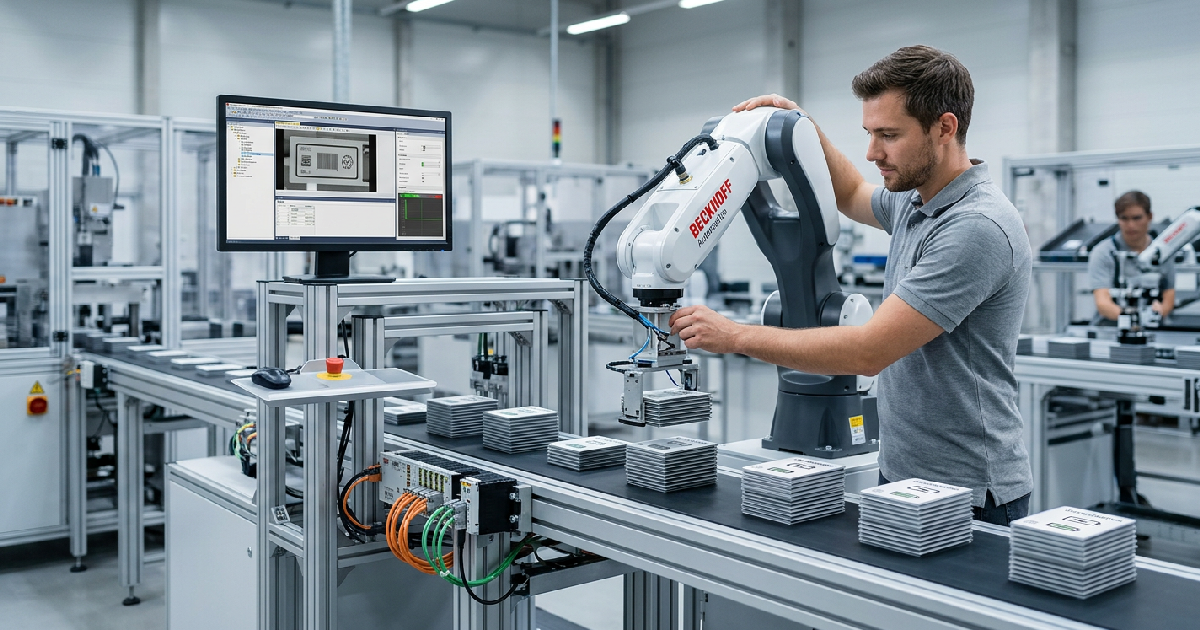
London-based Reelables has increased its smart label production speed by 150% after implementing an automated manufacturing system developed in collaboration with Beckhoff Automation. The expansion, supported by a $10.4 million Series A funding round, allows the startup to transition from manual assembly to a high-speed line capable of producing tens of thousands of active tracking tags per shift. Co-founder and CEO David Stanton confirmed the company added two new manufacturing lines as part of a strategic plan to scale production to 100 million labels per year.
The company addresses a significant industrial challenge: approximately 1.7 million packages are lost or stolen daily. Unlike traditional barcodes or QR codes that require manual scanning at specific waypoints, Reelables’ Bluetooth and 5G labels broadcast their location in real-time. This active visibility is critical for high-value logistics and cold chain applications, where the company’s temperature-sensitive labels maintain accuracy within 0.5 degrees Celsius for perishable goods.
Reelables is the only manufacturer producing labels with an integrated printed battery, a design that allows the hardware to be categorised as standard packaging. This engineering choice simplifies international trade, as the labels do not require customs declarations and are compatible with standard waste streams. Such advancements in African IoT sector growth through industrial connectivity mirror this global push for low-cost, disposable tracking hardware.
Advanced automation via EtherCAT and TwinCAT platforms
To move beyond a manual proof-of-concept, Reelables adopted the Beckhoff TwinCAT and EtherCAT platform. The new system replaces an ad-hoc hardware setup with discrete manufacturing modules integrated into a unified PC-based control environment. The hardware suite includes industrial PCs (IPCs), high-precision drives, and human-machine-interface (HMI) touchscreens, enabling a small team of ten to manage complex production cycles.
The facility was also the first in the United Kingdom to deploy the Software Platform Toolkit (SPT) Framework. This Beckhoff-engineered framework provides a modular, PackML-compliant approach to machine sequencing. This level of software standardisation allows the engineering team to expand capacity predictably, ensuring that as new lines are commissioned, the underlying logic remains consistent and scalable.
Beckhoff product engineer Chris Knight worked on-site with Mechatronics Engineer Oliver Boswall-Perks for several months to refine the machine code. This partnership was essential for perfecting a manufacturing method that combines printed RFID approaches with complex radio circuitry. The resulting process embeds the circuit directly into the battery substrate, maintaining a paper-thin profile for the final product.
Real-time vision systems replace manual quality control
Automation has completely overhauled the quality inspection process, which previously relied on human oversight. The integrated TwinCAT Vision system now captures high-resolution images of multiple labels simultaneously as they move through the line. The software calculates rotational and positional offsets to ensure that dispense heads apply epoxy and glue with micron-level accuracy.
The vision system actively mitigates waste by flagging defects early in the sequence. When the system detects a failing unit, it takes corrective action by skipping further value-added steps, such as chip placement or epoxy application, for that specific label. This ensures material efficiency while maintaining the consistency required for high-volume logistics contracts. As seen when AI systems provide blueprint solutions for industrial bottlenecks, this data-driven approach maximises yield.
In April 2026, the company broadened its product range with the “Anywhere” label, a 2×4-inch tracker for global shipments priced from $8 per label. This specific product line is approved for air transport and meets standard recycling criteria. Every label produced across the facility now contributes to a digital record, allowing Reelables to monitor dispensing quality and substrate conditions at multiple checkpoints.
Future domestic and international logistics implications
The scaling of smart label production coincides with projections that the asset tracking market will reach $88 billion by 2033. Beyond simple transit tracking, Reelables launched an indoor tracking solution in February 2026. This system achieved real-time accuracy down to 10 centimetres using Bluetooth Low Energy technology, a level of precision that allows for exact pallet and tool location in large-scale warehouses.
These breakthroughs have clear parallels in emerging markets where infrastructure reliability is a primary concern. Much like how government authorities upgrade power infrastructure to support manufacturing, the availability of low-cost trackers provides a foundation for more efficient supply chains. CEO David Stanton argues that the next phase of logistics involves “cargo starts talking,” where inventory identifies its own location and condition.
The transition from founder Brian Krejcarek’s original concept to an automated high-speed facility demonstrates the role of mechatronics in solving global logistics gaps. Reelables is now developing a next-generation vision system with multiple cameras managed by a single IPC. This infrastructure will support machine learning models to classify failures as manufacturing or field-related, closing the loop on the production data cycle.
