


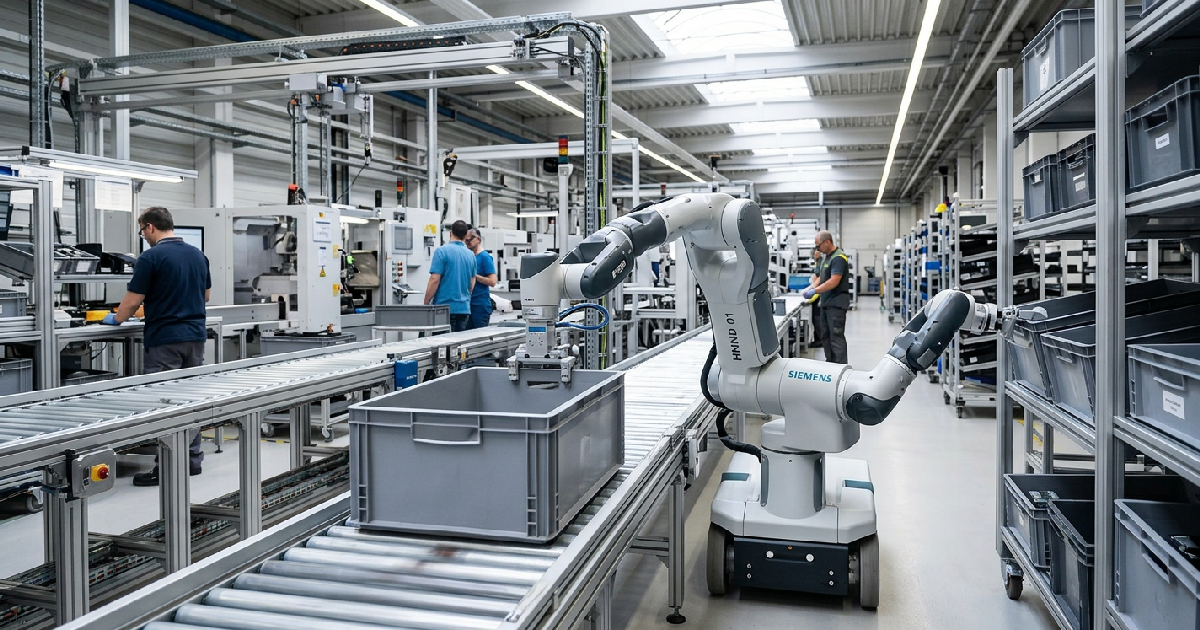
UK-based robotics firm Humanoid and global technology giant Siemens have completed a proof of concept at the Siemens Electronics Factory in Erlangen, Germany, demonstrating that humanoid robots can autonomously manage industrial logistics tasks. The trial involved the HMND 01 wheeled Alpha robot, which successfully executed tote-to-conveyor destacking in a live production environment. This announcement, made in January 2026, marks the first step in a broader strategic partnership aimed at validating robotic performance in real-world settings.
The proof of concept (POC) took place over two weeks and focused on repetitive logistics sequences. The HMND 01 Alpha autonomously picked totes from a storage stack, transported them to a conveyor, and placed them at a designated pickup point for human operators. This process repeated until the stack was empty, showcasing the robot’s ability to handle high-frequency logistics work.
Artem Sokolov, founder and CEO of Humanoid, and Stephan Schlauss, Siemens AG Global Head of Manufacturing Motion Control, oversaw the project to tackle production automation. Unlike standard stationary systems, the wheeled humanoid format allows the machine to traverse the factory floor and interact with existing infrastructure like conveyors and tote stacks. This initiative follows Humanoid’s previous successful POC with Schaeffler, which was completed earlier in October 2025.
Performance metrics confirm humanoid reliability for factory logistics
The engineering teams measured the success of the Erlangen deployment using specific performance and reliability metrics. The HMND 01 Alpha achieved a throughput of 60 tote moves per hour while operating with two different tote sizes. This consistency is vital for maintaining production speed in facilities where industrial and engineering stocks often depend on the efficiency of underlying automation systems.
During the two-week on-site phase, the robot demonstrated continuous autonomous task execution for more than 30 minutes. It also maintained an operational uptime exceeding eight hours. Both the overall pick-and-place success rate and the autonomous success rate were recorded above 90%, meeting the target metrics set by the partners for reliability.
To reach this stage, the Humanoid team employed a “simulation-first” design philosophy. By building a physical twin to support testing and rapid iteration, the company claims it reduced the prototype development cycle from an industry average of 18–24 months to just seven months. Such rapid development is critical as the African IoT sector expands through industrial connectivity, requiring fast-tracked hardware solutions.
NVIDIA AI stack integration drives robot autonomy
The HMND 01 platform integrates the full NVIDIA physical AI stack to handle complex environmental perception and movement. This includes the use of NVIDIA Jetson Thor for edge compute, which allows the robot to process data locally. The development process also utilised NVIDIA Isaac Sim for simulation and NVIDIA Isaac Lab for refining the robot’s autonomous capabilities before it arrived in Erlangen.
This technical integration aligns with a broader collaboration between Siemens and NVIDIA to develop AI-driven, adaptive manufacturing sites. The use of advanced AI stacks allows humanoid robots to be more flexible than traditional automation, which typically requires fixed safety cages or extensive manual reprogramming for every new task.
Stephan Schlauss described the Erlangen facility as “customer zero” for this technology. The factory serves as a testing ground for Siemens to discover new opportunities in production automation across its global network. By validating these systems in a real production environment, the partners aim to move humanoid technology out of the laboratory and into widespread commercial use.
Long-term rollout and industrial scalability
Following the successful POC, Humanoid and Siemens are evaluating a broader rollout of humanoid robots across more Siemens facilities. The companies have indicated they are open to adding additional use cases and expanding the scope of the robot’s tasks based on the specific skill set of the HMND 01 platform.
Artem Sokolov emphasized that Humanoid is focused on creating robots that deliver measurable value in real-world settings. The transition from the Schaeffler pilot in late 2025 to the Siemens milestone in early 2026 suggests a steady progression toward industrial maturity for the HMND 01. The ability to handle diverse tote sizes and maintain high uptime suggests these machines are nearing the reliability levels required for multi-shift industrial operations.
Future phases of the collaboration may see the deployment of a greater number of robots to handle more complex material handling roles. As these systems become integrated into global supply chains, the experience gained in German electronics manufacturing provides a template for applying advanced robotics to other high-capacity industrial sectors.
