


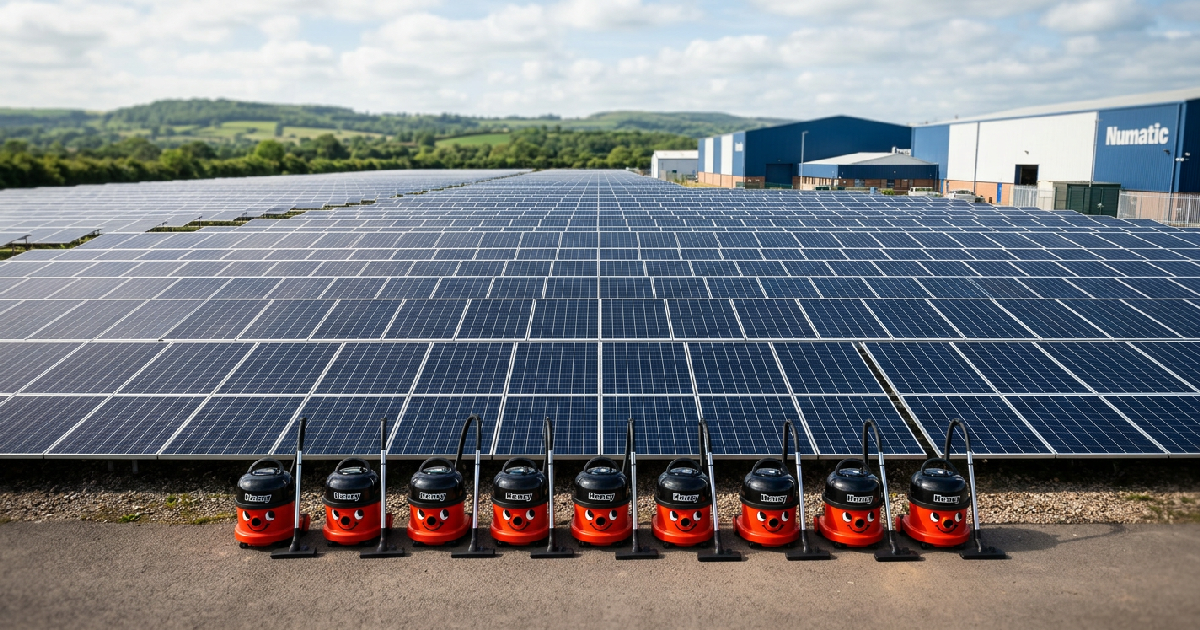
Numatic International has switched on a £1 million “micro-solar-park” at its Chard manufacturing facility in Somerset, marking the UK’s first commercial application of high-efficiency solar technology typically reserved for residential use. The five-acre installation, which official reports indicate was switched on between May 18 and May 19, 2026, generates power directly for the company’s energy-intensive plastic moulding operations. By deploying 2,672 advanced panels, the maker of the iconic Henry vacuum cleaner expects to meet approximately 20% of its annual on-site electricity demand while insulating production from volatile energy markets.
The system, developed by SunGift Solar, uses AIKO All-Back-Contact (ABC) solar cells that deliver more than 7% additional energy output per panel compared to conventional ground-mounted systems. This engineering choice allows Numatic to generate up to 1.73 MWp of power in a footprint that would normally only support 1.6 MWp. This spatial efficiency is a critical factor for the Somerset site, where the manufacturer has operated since 1989 and continues to expand its production capacity within constrained boundary lines.
Stephen George, Regulatory Affairs and Sustainability Manager at Numatic International, stated that the investment is a milestone for “Operation Cleansweep,” the company’s internal sustainability framework aimed at reaching Net Zero by 2035. He noted that the array provides enough renewable energy to manufacture the equivalent of 500,000 Henry vacuums a year from sunshine. As industrial and engineering stocks rally around green infrastructure, this project demonstrates how high-output renewables can be integrated into existing factory footprints.
Technical integration and future-proofing
The solar park’s electrical infrastructure relies on 14 Sigenergy 110kW HYA hybrid inverters. These units were selected for their ability to integrate directly with DC battery connectivity, allowing the company to add energy storage in a planned second phase of development. This future integration will enable the site to manage peak demand charges more effectively by storing surplus solar generation for use during high-tariff periods. Currently, the system is capable of supplying 100% of the site’s electricity requirements on peak production days.
Directly feeding the plastic moulding plant addresses the facility’s highest energy burden. This department is essential for the 1,100 people employed at the Chard site, where Numatic is currently constructing nearly 2,000 square metres of new operational space. By generating power “behind the meter,” the company reduces its carbon footprint by 266.91 tonnes of CO2 annually. This proactive approach to utility management is mirrored in other regions, where firms are increasingly focusing on infrastructure reliability to safeguard industrial output from external grid fluctuations.
Financial viability of micro-solar-parks
The £1 million capital expenditure carries a projected payback period of under five years. However, Finance Director Steve Whitlock indicated that this timeline could shorten significantly if grid electricity prices remain high. He emphasized that the investment offers a strong return on capital compared to other traditional corporate investments, providing a hedge against rising operational costs. This mirrors broader trends in the African IoT and industrial connectivity sectors, where localized energy and data tracking are becoming standard for large-scale makers.
This is not Numatic’s first foray into renewable generation; the company previously installed a 250 kWp rooftop system in 2013 and a 151 kWp extension in 2019. The move to a ground-mounted micro-solar-park represents a significant scaling of their energy strategy. Gabriel Wondrausch, Director of SunGift Solar, noted that the project serves as a blueprint for other manufacturers with limited land who need to convert small adjoining parcels into high-output power generation centres.
Industrial implications and Net Zero targets
The successful commissioning of the Chard array provides a technical template for “high-energy-use” manufacturers to bypass land availability issues by using higher-spec domestic-style cells in a commercial setting. For Numatic, the solar park is a vital component of its Climate Change Agreement and its journey as a responsible manufacturer. The company remains focused on maintaining its UK production base while scaling its output to meet global demand for its cleaning products.
In the wider industrial context, the ability to export surplus electricity back to the grid during low-demand periods provides an additional secondary revenue stream. As battery technology becomes the next phase at the Chard site, the facility will move closer to a self-sustaining model. This strategy ensures that the production of heavy-duty industrial equipment remains economically viable despite the rising costs of traditional energy procurement across the UK manufacturing sector.
