


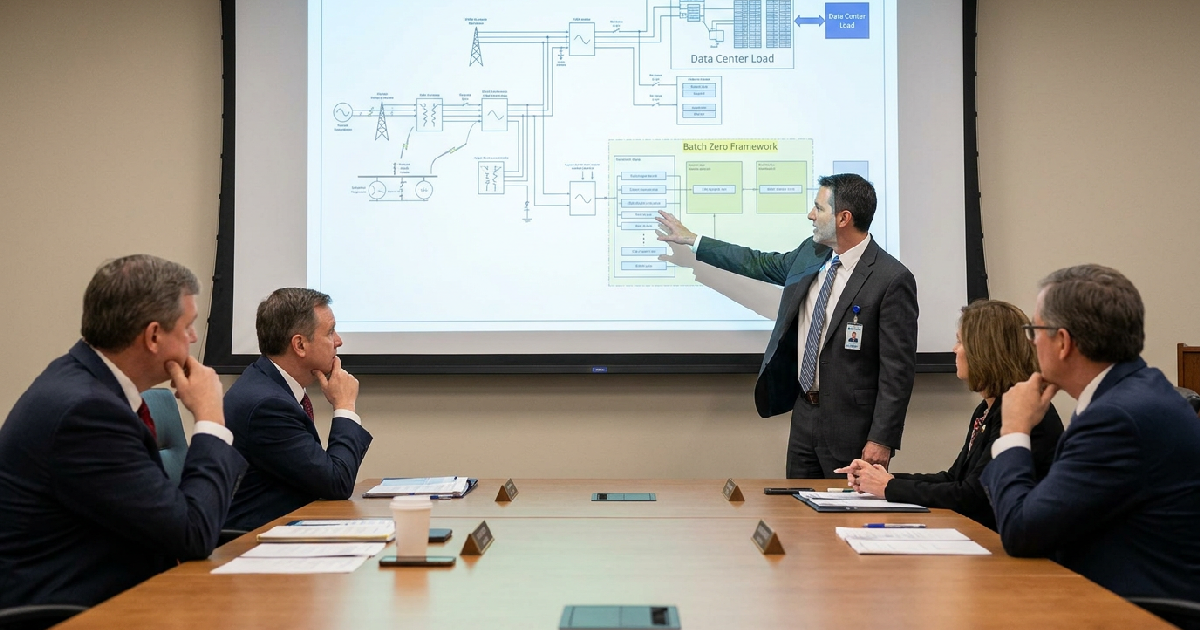
The Public Utility Commission of Texas (PUCT) recently approved a regulatory overhaul known as ‘Batch Zero’, a new framework designed by the Electric Reliability Council of Texas (ERCOT) to manage a staggering 438,000 megawatts (MW) of large load connection requests. This transition to a batch study process, which officially brings Batch Zero and Withdrawal-Limited Private Use Network (WLPUN) provisions into effect on 11 July 2026, aims to replace a project-by-project evaluation system that had become slow and repetitive.
With nearly 89% of these requests originating from data centers, the initiative defines a new engineering standard for how North American grid operators balance massive industrial growth with utility reliability.
An ERCOT representative at the Infocast Transmission & Interconnection Summit described the implementation of Batch Zero as a ‘moonshot’ for the organization, noting that the rules were written in just 4.5 months. The 438,000 MW queue is more than five times the size of ERCOT’s all-time peak demand record of 85,508 MW, set in August 2023. By moving toward a batch-based study, engineers can assess regional demand simultaneously, allowing them to allocate available grid capacity and identify necessary transmission upgrades more effectively.
Engineering a system-wide study for industrial scale loads
The Batch Zero framework represents a departure from the traditional serial queue, which treated each new factory or data center as an isolated event. Under the new protocols — specifically PGRR145 and NPRR1325 — any large electricity user requiring 75 MW or more is grouped into a single, comprehensive study. This allows ERCOT to conduct simulations that account for how hundreds of gigawatts of new load interact across the high-voltage network. By studying these projects collectively, grid operators aim to prevent individual approvals from degrading system frequency and voltage stability.
According to Jeff Billo, ERCOT Vice President of Interconnection and Grid Analysis, the depth of industry feedback was critical in shaping these rules. Engineering teams must now consider Batch Zero as the foundation for future transmission planning. The process defines the technical constraints under which these facilities must operate, including a two-phase study approach. The first phase produced Year 1 through 6 MW allocations, while the second phase identifies physical infrastructure, such as substations and 345kV lines, needed to support the cohort.
Strategic planners in the manufacturing sector often look toward more agile solutions during such transitions. Just as engineers optimize grid connections, manufacturers pivot to Manufacturing Execution System options to ensure their internal plant operations match the external constraints of their energy supply. In Texas, the requirement for these large loads to provide detailed dynamic data by 10 July 2026 underscores the high technical bar set for entry into the market.
Technical milestones and the transition timeline
The implementation of Batch Zero follows a strict engineering and regulatory calendar that requires immediate action from developers. Following the 11 July effective date, ERCOT will begin sorting through the 65 GW of requests expected to qualify for this initial batch, alongside roughly 35 GW of existing committed base load. This 100 GW cohort is a significant trial for a process never attempted at this scale in the United States. ERCOT expects to notify Batch Zero applicants of their project classification in August 2026, which will clarify the full scope of the initial group.
The timeline extends through next year, with the final Interconnection Study report due on 9 April 2027. This document will deliver specific megawatt allocations and Load Commissioning Plans. For the engineering firms designing these data centers and industrial plants, the 30-day window following this report is critical for signing interconnection agreements. If a project fails to meet commitment deadlines — which include proving site control and posting financial security of $100,000 per MW — it risks removal from the queue.
New pathways for onsite generation and curtailment
To ease pressure on the public grid, the framework introduces two optional engineering pathways that reward flexibility. The first is the Withdrawal-Limited Private Use Network (WLPUN). This allows an industrial customer to pair their load with onsite or co-located generation. Under this model, the facility can access capacity above its grid limit by offsetting demand with onsite supply, subject to an ERCOT-determined withdrawal limit at the point of interconnection.
The second pathway involves Controllable Load Resources (CLRs). Facilities that register under this status agree to let ERCOT engineers curtail their power use in real-time when the system is stressed. com/africa-digital-payments-infrastructure-reliability/”>infrastructure reliability at the grid level.
Projects that choose this pathway are prioritised because they act as a safety valve for the grid rather than just a drain.
These technical workarounds respond to the reality that major transmission construction takes years longer than building a data center. By using software-defined curtailment and onsite power engineering, ERCOT hopes to bridge the gap until 2027, when the final transmission plan covering the batch is published.
FERC and the national push for interconnection reform
Texas is not acting in isolation. The Federal Energy Regulatory Commission (FERC) recently issued show-cause orders to six other regional grid operators, including PJM Interconnection and the California ISO. These orders require operators to either justify their current rules or adopt reforms to speed the integration of large loads like data centers. FERC aims to prevent cost-shifting and force transparency into transmission costs while accommodating co-location and behind-the-meter generation.
In the PJM region, a fast-track proposal was recently approved to handle a massive influx of shovel-ready projects. PJM’s Expedited Interconnection Track (EIT) allows up to 10 projects per year greater than 250 MW to proceed through an independent queue if they can achieve commercial operation within three years. While PJM’s approach is an expedited track for specific projects, ERCOT’s Batch Zero is a comprehensive shift in how the entire large-load queue is managed.
The success of Batch Zero will be measured by whether it moves projects toward a final investment decision without compromising Texas’s electrical stability. As the industry looks toward the opening of applications for ‘Batch 1’ in Summer 2027, the results of this ‘moonshot’ will determine the future of high-capacity industrial development in the United States. For now, the sheer volume of 438,000 MW shows the appetite for expansion remains high, but physical limits are forcing a total rethink of power allocation.
