


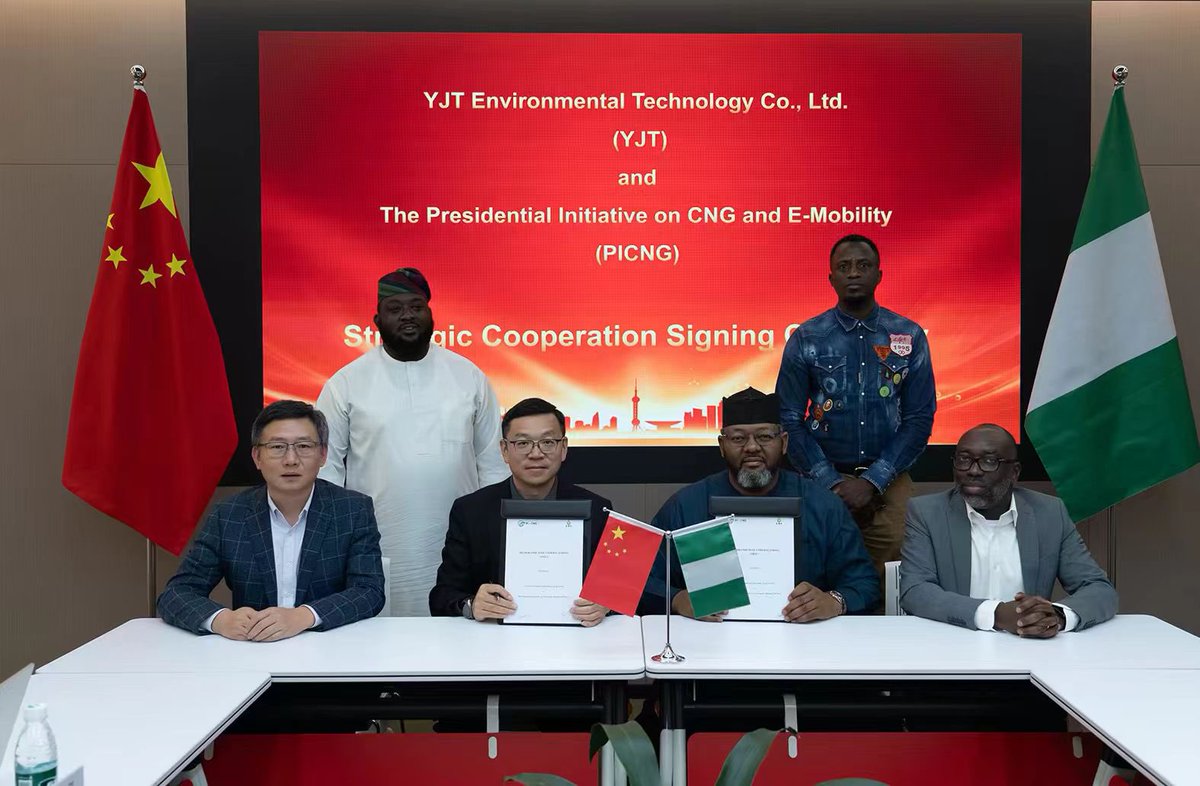
Nigeria recently entered into a strategic manufacturing-focused partnership with Chinese infrastructure and Internet of Things (IoT) solutions firm, You Jie Te Environment Technology Ltd (YJT).
The goal of the partnership is to establish local production and assembly lines for Compressed Natural Gas (CNG) and electric vehicle (EV) infrastructure in Nigeria.
The Memorandum of Understanding (MoU), signed through the Presidential Initiative on Compressed Natural Gas (Pi-CNG) and Electric Vehicles, is designed to shift Nigeria away from heavy reliance on imported equipment by developing in-country manufacturing capacity for critical clean-energy transport infrastructure.
The agreement was finalised during a five-day working visit by a Nigerian delegation to YJT’s manufacturing plants and corporate facilities in Chengdu and Hangzhou, China.
The delegation was led by the Executive Chairman of Pi-CNG, Barrister Ismaeel Ahmed, The Independent reported.
YJT, which operates across the downstream oil and gas value chain, is known for producing CNG refuelling equipment, EV charging systems, and smart, IoT-enabled infrastructure solutions.
Under the partnership, Nigeria and YJT will jointly develop local assembly plants and, over time, full manufacturing lines for CNG dispensers, refuelling stations, and EV charging facilities within the country.
The localisation drive is expected to deepen Nigeria’s industrial base, stimulate domestic manufacturing, and reduce foreign exchange exposure associated with importing finished equipment.
It is also projected to create skilled jobs, encourage technology transfer, and strengthen Nigeria’s role in the growing clean transport value chain.
See here: Pan-African EV maker Kemet Automotive secures 10,000+ pre-orders ahead of production
In addition to physical production, the MoU covers the integration of advanced IoT technologies into Nigeria’s emerging CNG and EV infrastructure.
YJT’s smart monitoring systems will be embedded into Pi-CNG’s National Gas Vehicle Monitoring System (NGVMS), allowing for real-time tracking of locally assembled refuelling equipment, operational performance, safety compliance, and economic output across stations nationwide.
Ahmed described the partnership as a critical step in repositioning Nigeria not just as a consumer, but as a producer within the clean energy ecosystem.
As part of the China engagement, the Pi-CNG team also toured the facilities of Sichuan Witent Technology Co., Ltd., a manufacturer of CNG conversion kits.
Talks centred on attracting investments into Nigeria for the local assembly of conversion kits and the eventual establishment of full-scale manufacturing operations to meet the rising demand for gas-powered vehicle conversions.
The Presidential Initiative on Compressed Natural Gas (Pi-CNG) was established to accelerate the adoption of CNG and electric vehicles as cost-effective alternatives to gasoline and diesel, particularly for public transportation operators and commercial fleets.
