


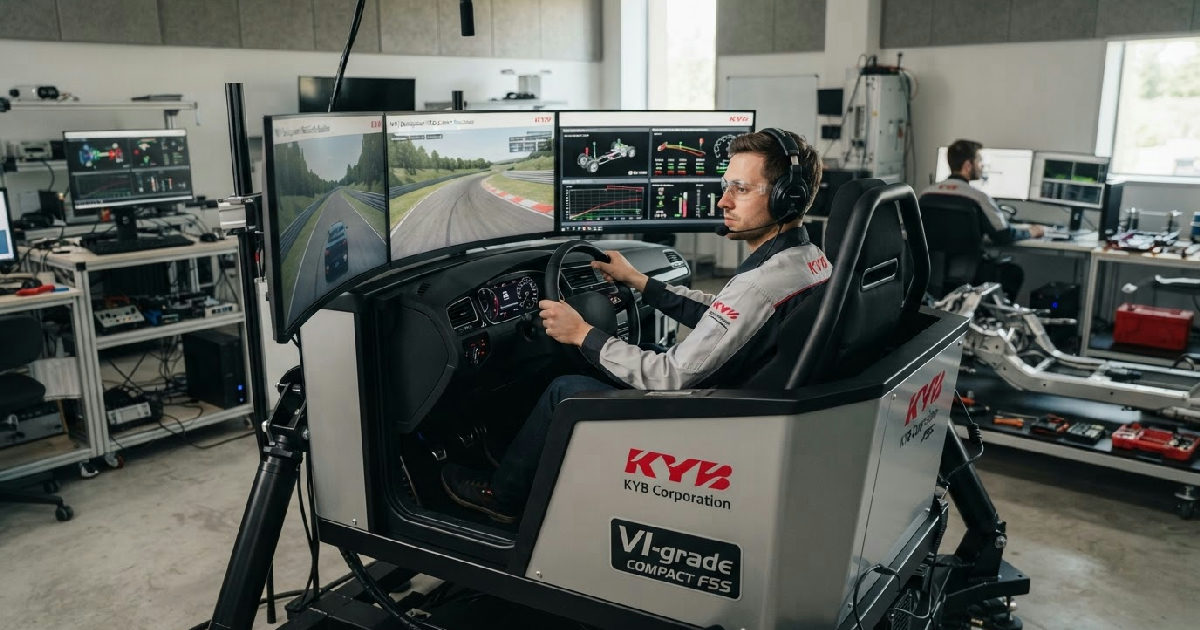
Tokyo-based automotive component manufacturer KYB Corporation integrated VI-grade’s COMPACT Full Spectrum Simulator (FSS) into its virtual development processes in September 2026.
This adoption, announced by VI-grade, marks a significant step for KYB in leveraging human-in-the-loop simulation. It allows engineers to assess suspension and steering technologies with precision during the early stages of vehicle development.
Precision Engineering with the KYB Simulator
The COMPACT FSS is a sophisticated platform capable of reproducing vehicle motion, vibration, and sound across a broad spectrum. It operates across a frequency range of 0.5 Hz to 20 kHz, providing an environment for evaluating automotive components.
This full-spectrum simulation combines objective data with subjective driver feedback. It enables KYB engineers to experience and refine the interplay between shock absorbers, suspension systems, and electronic power steering (EPS) technologies.
The system is powered by VI-grade’s AutoHawk real-time computer and VI-NVHSim software, providing high fidelity and responsiveness. This setup is crucial for effectively isolating and addressing critical performance attributes like ride comfort and NVH.
Digital Transformation Driving Innovation
KYB’s integration of the COMPACT FSS forms part of its broader digital transformation efforts. The company seeks to foster “innovation through chemical reactions”, combining its century of hydraulic expertise with advanced evaluation capabilities.
This initiative aims to create new avenues for research and development, particularly for next-generation solutions that improve vehicle refinement. The goal is to accelerate the development and commercialisation of advanced technologies.
The manufacturer is also exploring the use of artificial intelligence to improve and accelerate the analysis of large datasets. This includes data gathered during product development, testing, and manufacturing. These digital investments reflect a broader push towards industrial advancement, similar to investments in US manufacturing aimed at strengthening productive capacity.
Addressing Noise, Vibration, and Harshness (NVH)
NVH is a critical engineering consideration in automotive design, involving the mitigation of unwanted noise and vibration to create a more comfortable cabin environment. Simulators such as the COMPACT FSS offer a solution for evaluating these factors.
The simulator allows KYB to test and refine components under varied conditions, potentially reducing the need for costly physical prototypes. It provides an immersive representation of vibration and sound generated from Computer-Aided Engineering (CAE) models.
This includes the ability to simulate powertrain and road vibrations, enabling effective communication of “Vibration + Sound” characteristics to development teams. This approach can save time and resources during the design cycle.
A Century of Hydraulic Expertise Meets Virtual Reality
KYB’s rich history, spanning over 100 years in hydraulic technologies, underpins its pursuit of advanced simulation. Traditionally, the company relied on skilled drivers to conduct physical ride comfort evaluations alongside statistical analysis.
The COMPACT FSS complements this established expertise with virtual testing, creating a powerful hybrid development methodology. This combination allows engineers to develop a more comprehensive understanding of vehicle behaviour.
KYB’s Digital Transformation Improvement Department is also developing an IoT platform using cloud technology. This platform collects, analyses, and visualises large volumes of data, with AI at its core. This investment in digital infrastructure supports KYB’s future development capabilities. Similar technological developments are taking place across industrial sectors, from advanced automotive systems to the foundational improvements seen in metalworking equipment.
Recent Advancements and Market Impact
The adoption follows a series of recent technological advancements from KYB. For example, the company developed Prosmooth™, a technology that controls shock absorber friction using new materials.
Prosmooth™ is designed to provide both a comfortable ride and responsive cornering performance. It exemplifies KYB’s focus on engineering solutions that balance comfort with dynamic handling.
In 2024, Volkswagen Group adopted KYB’s electronically controlled shock absorbers for vehicles such as the Tiguan and Passat Variant equipped with DCC Pro. This adoption demonstrates the application of KYB’s suspension technology in Volkswagen Group vehicles.
KYB also introduced ActRide in February 2026. This aftermarket suspension system offers smartphone app-based control, with Comfort, Normal, and Sport presets, as well as customisable options.
Outlook for Automotive Development
The investment in the COMPACT FSS strengthens KYB’s capabilities in automotive component development. It reflects the industry’s broader shift towards more iterative and data-driven design processes.
For manufacturers, this can support faster development cycles and the optimisation of products to meet growing consumer expectations for comfort and refinement. The simulator may also reduce the need for late-stage design changes, which can be costly.
This integration also aligns with KYB’s long-term vision of developing technology from the driver’s perspective. It keeps human perception central to the design of next-generation suspension and steering systems.
The growing sophistication of simulation tools, coupled with advancements in artificial intelligence and real-time processing, continues to reshape product development across industrial sectors. These technologies can help companies such as KYB accelerate development and bring complex solutions to market more efficiently.
The automotive sector, in particular, is affected by these developments as consumer expectations for vehicle performance and comfort continue to evolve. Similar developments are also taking place in other technology-intensive innovation sectors, advanced aerospace applications involving continuous composites.
Moreover, virtual evaluations can reduce the need for extensive physical prototyping, potentially lowering costs and improving resource efficiency. This approach also reflects broader efforts to improve efficiency. KYB’s move reflects the growing role of digital technologies in highly competitive industries.
