


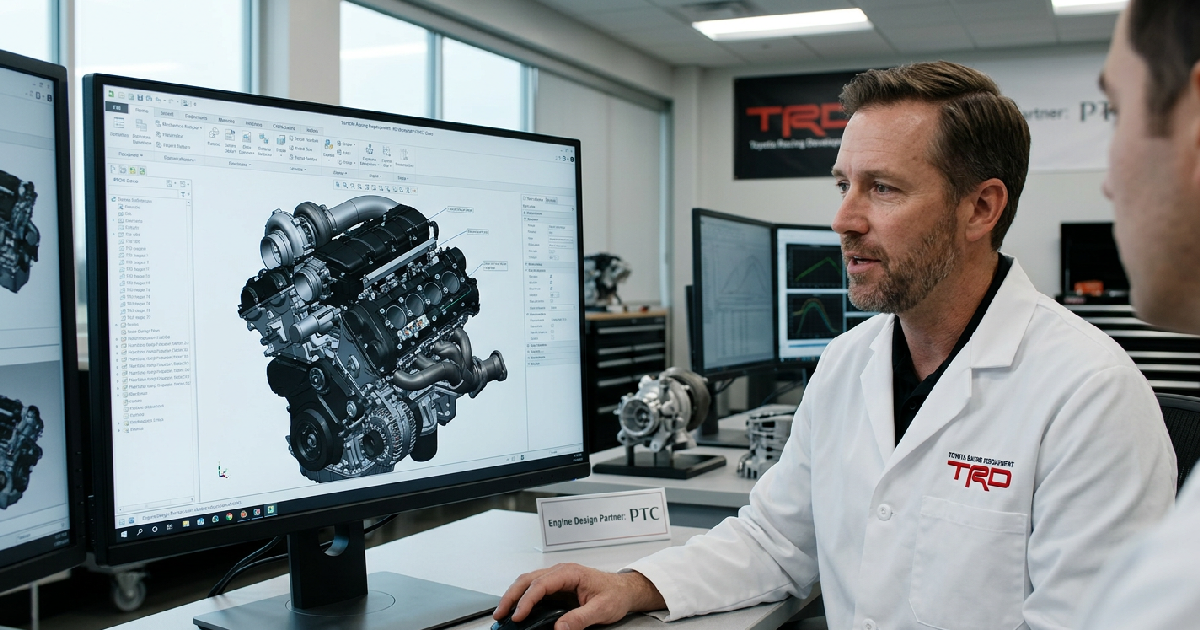
TRD U.S.A. (Toyota Racing Development) has appointed PTC as its Official Engine Design Software Partner to streamline the development of high-performance powertrains for NASCAR and off-road racing. The partnership, announced on May 28, 2026, formalises a long-standing engineering relationship between the two companies. TRD U.S.A. will rely on PTC’s CAD and PLM solutions to accelerate its speed to market and improve design efficiency at its Costa Mesa engineering facility.
The deal integrates PTC’s Creo computer-aided design software and Windchill product lifecycle management tools into the heart of TRD’s motorsport operations. These systems act as the digital backbone for every generation of racing engine the company builds. Engineers use these tools to manage complex data from the initial conceptual sketch through to the final, race-ready production units that compete on the track.
Tyler Gibbs, President of TRD U.S.A., noted that the collaboration allows the division to better leverage technology as its engineering programs evolve. He stated that PTC has been a trusted component of their engine development for years. This formal partnership aims to boost collaboration across the organisation, ensuring that trackside teams and design engineers remain in sync during tight racing schedules.
Advanced CAD and PLM integration for racing engines
In the world of professional motorsport, the timeframe between a design iteration and physical testing is remarkably short. TRD U.S.A. uses Creo to model intricate engine components that must withstand the extreme stresses of NASCAR and the GR Cup. By using a unified software suite, the engineering team can run simulations and make adjustments without losing time to data translation or manual entry errors.
Windchill provides the necessary control over the product lifecycle, managing the vast amounts of data generated by modern racing programs. This level of industrial connectivity through integrated software allows TRD to track the history of every part. If a component fails during an off-road event, engineers can quickly trace the design file, material specs, and production date to implement a fix before the next race.
The partnership also aligns with PTC’s broader “Intelligent Product Lifecycle” strategy. This focuses on creating a seamless thread of data that flows through every stage of manufacturing. For a company like PTC, which supports over 30,000 customers globally from its Boston headquarters, the TRD partnership serves as a high-pressure proving ground for its AI-driven engineering workflows.
Driving performance across diverse racing series
The scope of this agreement extends beyond a single racing category. TRD U.S.A. is responsible for the performance engines used in NASCAR, the GR Cup, and various off-road competitions. Each of these disciplines requires a unique engineering approach—NASCAR engines prioritise sustained high-RPM reliability, while off-road units must handle massive torque and environmental debris.
Engineers at the Costa Mesa site use PTC’s software to manage these distinct requirements simultaneously. As manufacturers move toward more complex systems, including the “electrified” elements seen in Toyota’s consumer fleet, the need for sophisticated design tools grows. Toyota (NYSE: TM) reported that over 47% of its North American sales in 2025 were electrified vehicles, indicating a shift that often trickles down from racing research.
The move to formalise PTC as the official software partner also reflects a trend where industrial and engineering stocks rally based on the strength of digital transformation. Companies that can prove their software works in the split-second environments of professional racing are better positioned to sell those same tools to broader manufacturing sectors.
What this means for the future of Toyota Racing
Looking ahead, the partnership suggests a deeper move into AI-driven design. PTC has been vocal about integrating artificial intelligence into its CAD platforms to help engineers optimise parts for weight and thermal efficiency automatically. For TRD, this could mean lighter engine blocks or more efficient cooling systems developed in a fraction of the usual design time.
While the immediate focus remains on the current season’s performance, the infrastructure being built today will support the next decade of Toyota’s racing engines. The ability to iterate faster than competitors is often the difference between a podium finish and a mid-pack result. With PTC’s technology firmly embedded in its workflow, TRD U.S.A. is betting that digital efficiency will lead to physical dominance on the track.
As the automotive industry continues to face pressure to innovate, the lessons learned in Costa Mesa will likely influence the broader manufacturing landscape. The rigorous demands of motorsport force a level of software excellence that eventually benefits civilian vehicle production and industrial machinery design alike.
