


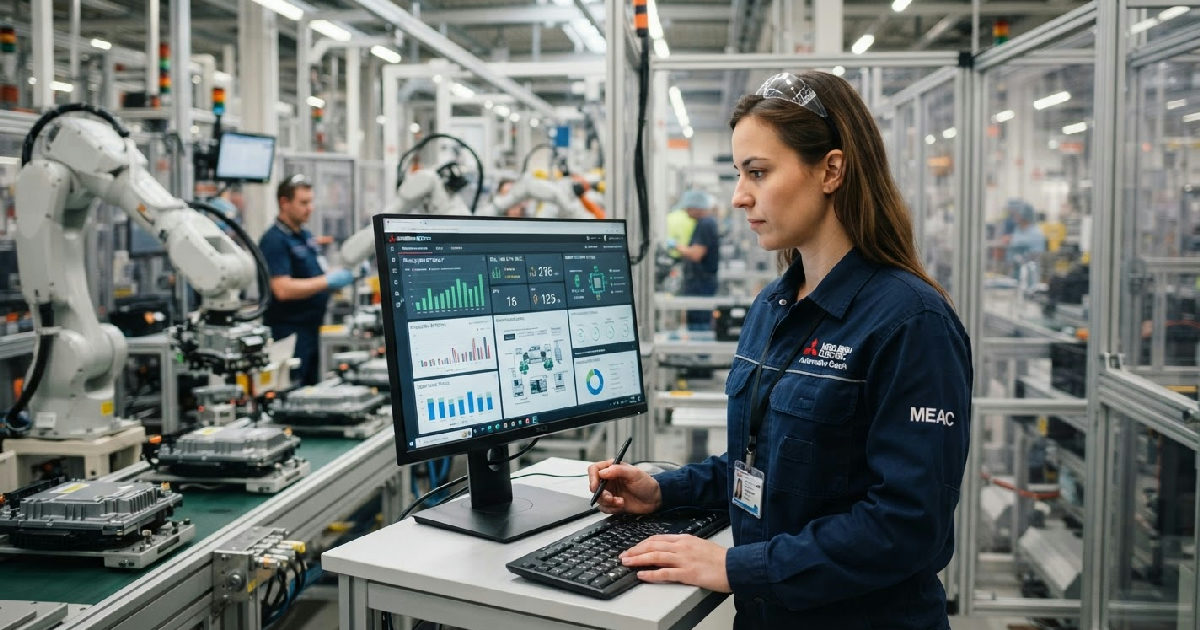
Mitsubishi Electric Automotive Czech has transformed its Slaný manufacturing plant into a data-driven hub.
Established in June 2000, the MEAC plant, which employs more than 500 people, has moved beyond traditional operational methods. Its approach prioritises enhancing existing, proven automation systems with advanced data layers to improve production lines. This method allows significant improvements in efficiency and quality without the prohibitive costs associated with wholesale machinery replacement.
Pragmatic digital transformation at Mitsubishi Electric Czech reaps rewards
MEAC’s journey into advanced digitalisation stands out for its pragmatic approach to existing infrastructure. Instead of replacing operational machinery, the company chose to integrate a connected data layer, thereby extending the value and performance of its established equipment. This has helped the company sidestep the significant capital expenditure often associated with factory modernisation.
Jan Kabát, Manufacturing Engineering Manager at MEAC, explained the company’s philosophy clearly. He noted that its Q-Series control units have operated reliably for more than ten years. Modernisation, he said, comes through a data layer that uses MES interfaces to connect machines and generate operational insights without disrupting output.
“On the production side, we keep what works,” Kabát stated. “We do not modernise machines simply for the sake of modernisation. The stable Q-Series control remains in place, while connectivity and data capabilities are added where they deliver measurable gains: less downtime, better visibility and faster troubleshooting.” This strategy has allowed MEAC to connect more than 100 machines.
This comprehensive connectivity is facilitated by Mitsubishi Electric’s e-F@ctory architecture, which creates a digital layer that provides plant-wide performance visibility. Engineers now use the generated data daily to inform decision-making, create custom reports, and deploy additional sensors as needed for greater process insight.
Boosting quality and cutting costs with real-time data
The real strategic value for MEAC lies in its ability to drive continuous manufacturing performance improvements through digital tools and analytics. Teams gain detailed visibility into processes, allowing them to identify issues rapidly. They can then implement corrective actions before issues affect product quality or customer deliveries.
Dalimil Bartoň, General Manager at MEAC, highlighted the central role of data in the company’s continuous improvement strategy. He emphasised the use of data to enhance both process and product quality. Analysing detailed manufacturing data enables teams to identify defect patterns, optimise processes, and reduce scrap.
“The result is more consistent quality for customers and lower manufacturing costs for the business,” Bartoň explained. He stressed that the point is not technology for its own sake, but knowing how to deploy systems to support production within a true Plan-Do-Check-Act (PDCA) cycle. This pragmatic approach safeguards quality and delivers tangible results on the shop floor.
Satoshi Takeda, Senior Vice President and Chief Digital Officer at Mitsubishi Electric, echoed this sentiment. He maintained that the true value of data lies in its ability to uncover customer challenges. This perspective aligns with MEAC’s focus on using data to deliver tangible benefits for clients and the overall business.
Putting people at the centre of factory digitalisation
Beyond equipment and processes, MEAC has also applied data-driven techniques to enhance employee working conditions. The company has leveraged RFID technology and workstation data to gain a deeper understanding of how work is performed across the facility. This insight helps identify opportunities to mitigate physical strain on operators.
Petr Soukup, Manufacturing Senior Manager, detailed this human-centric approach. He explained that the company uses RFID to identify operators and track their working locations. This information is then combined with muscle-load and workstation-level data to plan job rotations and organise work more effectively.
The outcome is a reduction in ergonomic strain for employees, coupled with more consistent performance across shifts. This demonstrates that digitalisation is not solely about machine efficiency; it can also improve the human element of manufacturing by fostering a safer and more productive working environment. This kind of industrial AI integration benefits both people and processes.
Beyond the production line: the smart factory building
MEAC’s comprehensive digitalisation extends to its physical infrastructure, with the building itself managed as part of the overall production environment. The facility operates as a software-defined building. This system is built on Mitsubishi Electric iQ‑R PLCs and ICONICS GENESIS64 software.
Milan Koňarik, Facility Manager, noted that this system provides a unified view of critical facility infrastructure. It allows active management of the plant environment and the factors that directly affect production. This holistic approach recognises how environmental conditions can affect manufacturing performance.
The software-defined building monitors HVAC, the data centre, pre-cooling systems, UPS systems, and other technical utilities, drawing data from more than 3,000 measurement points. This integrated data view facilitates faster decision-making for facility managers. The system can trigger SMS and email alarms, support smarter energy purchasing strategies, and help the energy-saving team react quickly to issues.
Koňarik views it as a practical tool for reducing energy costs and operational risk. It also helps MEAC maintain its carbon-neutrality ambitions, integrating sustainability directly into its operational management.
Mitsubishi Electric’s wider push for digital engineering
The achievements at MEAC reflect a broader effort by parent company Mitsubishi Electric Corporation to embrace data-driven strategies globally. This initiative is spearheaded by its “Circular Digital-Engineering” strategy. The strategy aims to integrate digital innovation and sustainability by leveraging data and cross-disciplinary collaboration.
Nobuo Asahi, Senior General Manager of the DX Innovation Center, actively promotes this strategy across the company’s global operations. The DX Innovation Center, established in 2023 with around 30 members, plays a crucial role. It devises transformation strategies, guides investments, and initiates product experiments to foster digital advancement.
Mitsubishi Electric’s “Circular Digital-Engineering” framework rests on four core elements: data aggregation, insight generation through data analysis, the creation of new value, and the redistribution of that value. This systematic approach ensures that data not only informs but actively drives innovation and problem-solving across its diverse business areas.
Central to this strategy is Serendie®, a new cross-collaboration digital platform. Serendie integrates and analyses data from various components and services to identify latent customer needs and generate new insights. It uses Dataiku and Snowflake as foundational components for data preparation, modelling, visualisation, and application building.
Mitsubishi Electric further strengthened its capabilities by developing multi-agent AI technology by 20 January 2026. This technology uses an argumentation framework to automatically generate adversarial debates among expert AI agents. This enables rapid, expert-level decision-making with transparent reasoning, representing a significant step in AI integration for industrial applications.
The company also invested in Sakana AI on 14 April 2026. This investment aimed to integrate Sakana AI’s next-generation foundation model technologies directly into the Serendie digital platform for industrial AI solutions. Ren Ito, Co-founder of Sakana AI, noted that this partnership would expand Sakana AI’s focus on industrial applications, signalling a clear direction for advanced analytics.
Daniel Sperlich, Strategic Product Manager Controllers EMEA at Mitsubishi Electric Europe B.V., highlighted a common industry hurdle. He noted that many manufacturers already possess the necessary data but struggle to convert it into practical, actionable insights on the shop floor. Mitsubishi Electric addresses this with solutions such as the DataNavigateApp, which was launched on 20 June 2026 and simplifies shop-floor visibility to improve machine performance and energy use.
Bob Miller, Solutions Marketing Manager at Mitsubishi Electric Automation, Inc., reinforced this point by stressing that empowering customers to make more informed decisions is critical to increasing overall equipment effectiveness. The MEAC case exemplifies this principle, showcasing how targeted digital upgrades can yield substantial improvements without requiring a complete overhaul of established, reliable systems.
Mitsubishi Electric’s commitment to data-driven decision-making, from factory operations in the Czech Republic to broader corporate digital strategies and AI investments, positions it at the forefront of industrial innovation. Its practical implementation at MEAC provides a useful case study for manufacturers seeking to improve efficiency, quality, and sustainability in an evolving industrial landscape.
