


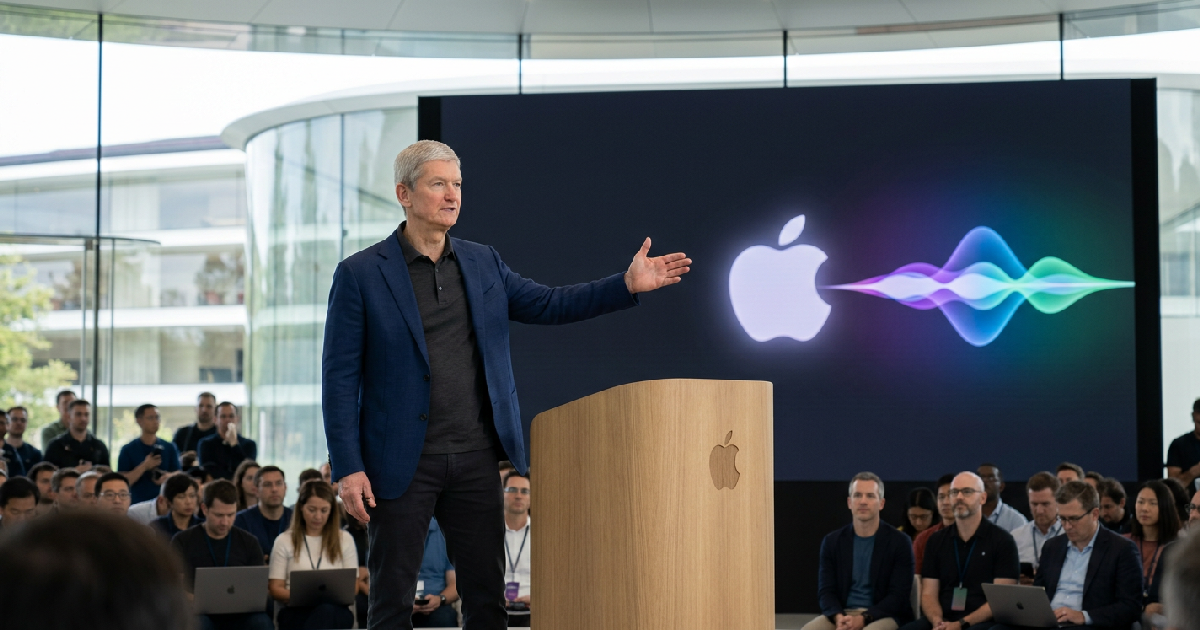
Apple CEO Tim Cook will take the stage on Monday, June 8, 2026, at 10:00 a.m. Pacific Daylight Time (PDT) to deliver what is expected to be his final keynote before transitioning to executive chairman.
The Worldwide Developers Conference (WWDC) 2026 at Apple Park arrives as the company faces intense pressure to deliver on delayed artificial intelligence features.
John Ternus, currently the Senior Vice President of Hardware Engineering, is scheduled to succeed Cook as CEO on September 1, 2026, marking the end of a pivotal era for the company’s product development strategy.
The centerpiece of the event is a comprehensive reconstruction of Siri, which Apple promised to modernize back in 2024. Engineering delays and unmet promises regarding the iPhone 16’s AI capabilities resulted in a $250 million settlement, according to reports from BBC News.
Monday’s presentation must now prove that the “Apple Intelligence” framework is stable enough for a global rollout, moving beyond the fragmented updates that characterized the previous software cycle.
For industrial and software engineers, these shifts represent more than just consumer updates. The integration of high-parameter models into local hardware environments is a major challenge for AI systems designed to operate within restricted power and thermal envelopes. Apple’s attempt to bridge the gap between cloud-based intelligence and on-device processing will be the primary technical narrative of the week-long conference.
Engineering the new Siri with Google Gemini technology
The new Siri is expected to function as a full-scale AI chatbot, departing from its history as a basic command interface. Bloomberg’s Mark Gurman reported in November 2025 that Apple licensed a custom 1.2-trillion-parameter Gemini model from Google, though neither company has officially confirmed the reported $1 billion annual price tag.
Google Cloud CEO Thomas Kurian noted in April 2026 that the partnership focuses on building the next generation of Apple Foundation Models.
Technical details suggest Siri will move into a standalone app across iOS, iPadOS, and macOS. A new “Search or Ask” bar will replace Spotlight, while the Dynamic Island will glow to indicate AI activation.
To address privacy, chat history will sync via iCloud with manual settings to expire data after 30 days, one year, or never. This granular control is essential for maintaining AI infrastructure trust and security among professional users who handle sensitive data.
Functionally, the rebuilt engine aims for “context awareness,” allowing Siri to read on-screen data and execute multi-step instructions across different apps. However, internal reports from Apple engineers in February 2026 indicated that reliability remained inconsistent. Consequently, the new Siri will likely carry a “beta” label at launch, with some features potentially limited by a waitlist when iOS 27 ships in September.
Multi-model flexibility and developer extensions
Apple is introducing an Extensions system that ends the exclusivity previously held by OpenAI. Users can reportedly choose which model handles their intelligence features, with the UI supporting ChatGPT, Google Gemini, and Anthropic’s Claude. If no change is made, accounts will default to the Gemini-powered engine.
Each model can be assigned its own distinct voice so users can identify which specific AI is answering their query.
This decentralized approach allows Apple to lean on established LLM providers while its internal teams continue refining proprietary models. For the global developer community, including African DevRel engineers, this openness creates new opportunities to build plugins that interact with diverse AI backends. The Platforms State of the Union, scheduled for 1:00 p.
m. PDT on Monday, will provide the specific APIs required to tap into these new Extension protocols.
iOS 27 and the hardware compatibility cutoff
iOS 27 is being framed internally as a “clean-up” release, focusing on the stability issues that plagued iOS 26. Engineering resources have been diverted to fix overheating, battery drain, and UI glitches rather than introducing radical aesthetic changes. The “Liquid Glass” design language introduced last year remains, but it gains a system-wide slider to adjust transparency and contrast for better readability.
New “Visual Intelligence” features will be embedded directly into the Camera app, allowing users to scan nutrition labels into the Health app or QR codes into the Wallet. However, these compute-heavy tasks require significant hardware overhead. A leaked compatibility list suggests iOS 27 will require an A14 Bionic chip or newer, effectively dropping support for the iPhone 11 and the second-generation iPhone SE.
Advanced Siri features carry an even stricter requirement. Due to RAM and neural engine constraints, only the iPhone 15 Pro and newer models will support the full suite of “Apple Intelligence” tools. This underscores a growing trend in mobile engineering where software capabilities are increasingly tied to specific tiers of hardware architecture rather than broad generation compatibility.
Phasing out Intel and the future of macOS 27
The conference will also signal the final stages of the transition to Apple Silicon. macOS 27 will require an M1 chip or later, cutting off the remaining Intel-based 2019 and 2020 Mac models. While Rosetta 2 remains in this version to support older apps, expectations are mounting that the translation layer will be removed entirely in macOS 28.
Engineers have also spotted code for a touch-optimised interface in macOS 27 builds. While Apple has long resisted touchscreen laptops, these findings suggest the OS is being prepared for a touchscreen MacBook Pro reportedly planned for 2027. This shift would require a fundamental rethink of the macOS interaction model, blending iPadOS touch targets with traditional desktop precision.
The keynote will be broadcast live at 10:00 a.m. PDT (6:00 p.m. WAT for viewers in Nigeria and West Africa). Attendees at Apple Park will include 350 winners of the Swift Student Challenge, 50 of whom were invited for a special three-day experience. These young developers represent the next wave of engineers who will build on the AI-centric foundations Apple is laying this week.
