


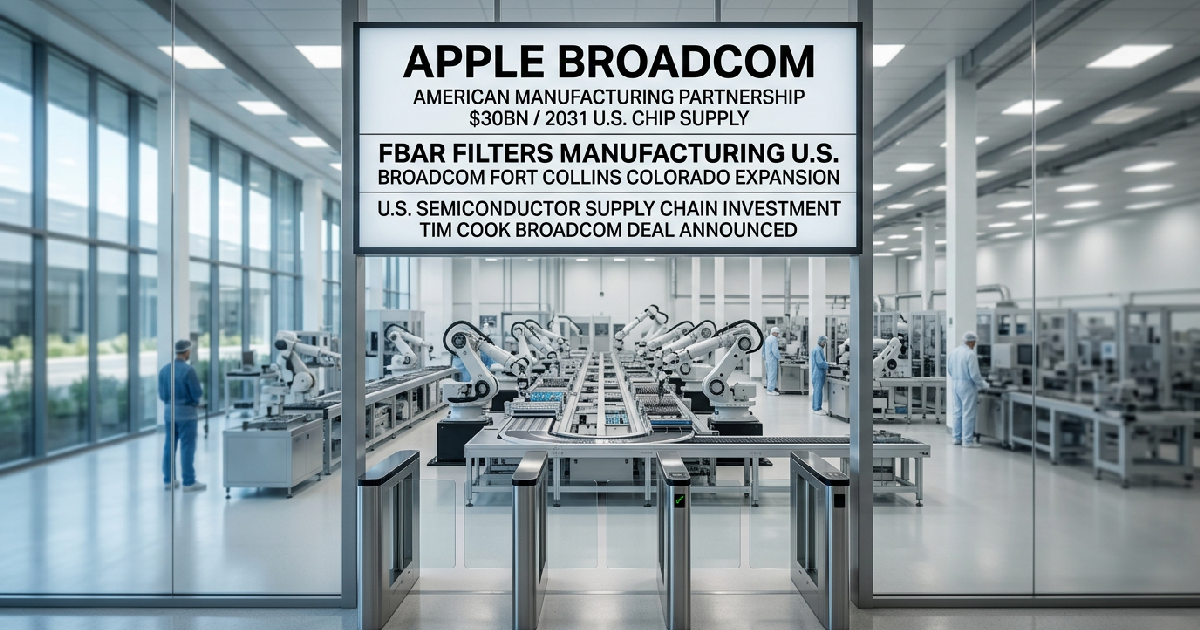
Apple and Broadcom have finalised a multi-year deal worth more than $30 billion to design and produce custom silicon and wireless connectivity components within the United States. Apple CEO Tim Cook confirmed the agreement on 8 July 2026, marking the largest single-company commitment under the tech giant’s American Manufacturing Program (AMP). The partnership secures a domestic supply of critical radio frequency hardware through 2031.
This agreement acts as a primary pillar of Apple’s broader pledge to invest $600 billion in the American economy over a four-year window. Under the terms, Broadcom will manufacture more than 15 billion U.S.-made chips, specifically focusing on advanced wireless technologies like Film Bulk Acoustic Resonator (FBAR) filters. These components allow 5G devices to isolate specific frequencies, a technical requirement for maintaining high data throughput in increasingly crowded cellular bands.
The deal follows years of political pressure on Apple to reduce its structural reliance on East Asian semiconductor foundries. By reshoring the production of critical connectivity silicon, the company aims to build a more resilient end-to-end supply chain. This strategic pivot matches a wider industrial trend where companies like Mach Industries spent $50 million to verticalise their own motor production, prioritising supply security over offshore cost savings.
Modernising the Fort Collins semiconductor facility
Broadcom will invest $1.5 billion in capital expenditure to expand and modernise its manufacturing site in Fort Collins, Colorado. This facility has a lineage dating back to 1978 and currently employs nearly 1,600 workers. The new investment will fund the integration of advanced production systems required to fabricate high-precision RF components at a massive scale for the iPhone and other Apple hardware.
Hock Tan, Broadcom’s President and CEO, indicated that the expansion would solidify the company’s manufacturing footprint in Colorado. The technical focus on FBAR filters is significant because these components are notoriously difficult to manufacture with high yields. By upgrading existing lines rather than building a greenfield site, Broadcom can tap into the deep engineering expertise already present in the regional workforce.
This modernisation reflects how global Manufacturers pivot to Manufacturing Execution System strategies to drive efficiency in high-cost labor markets. For Broadcom, the goal is to improve wafer yields and maintain the high margins necessary for specialised analog and RF engineering. The project is expected to support hundreds of new American jobs while securing the facility’s long-term utility in Broadcom’s global network.
Strategic scale of the American Manufacturing Program
The $30 billion agreement is the centerpiece of the American Manufacturing Program (AMP) launched in 2025. While Apple initially pledged $100 billion to the program, it has since grown as more suppliers move production to U.S. soil. In March 2026, Apple added Bosch, Cirrus Logic, TDK, and Qnity Electronics to the AMP, committing $400 million through 2030 to support their domestic manufacturing transitions.
Among these partners, TDK recently agreed to produce iPhone sensors in the U.S. for the first time. However, the Broadcom deal operates at a much larger financial and technical magnitude. By guaranteeing such high order volumes through 2031, Apple provides the financial certainty Broadcom needs to invest in domestic fabrication capacity, which normally carries high capital risks.
This move toward domestic industrial hubs is consistent with the African IoT sector growth, where dedicated connectivity hardware is becoming more localised to meet regional infrastructure requirements. For Apple, the “reshoring” effort moves beyond final assembly, targeting the complex silicon “brains” that define device performance and connectivity.
Building an end-to-end domestic silicon chain
Tim Cook’s public remarks on the deal emphasise the goal of creating an “end-to-end” silicon supply chain. Historically, U.S. tech firms followed a “fabless” model—designing chips in California but outsourcing the difficult work of physical fabrication to foreign plants. This agreement bridges that divide by ensuring that both the design and the physical making of billions of chips occur within the same borders.
The arrangement also aligns with the incentives provided by the CHIPS and Science Act of 2022. While Broadcom and Apple are financing this specific $30 billion roadmap, the federal focus on domestic semiconductor subsidies has created a more viable environment for such scale. The act’s provisions for manufacturing equipment tax credits and workforce training are designed to help American facilities compete with lower-cost overseas alternatives.
As the industry moves toward 2031, the success of this shift will depend on maintaining technical parity with global competitors. With more than 15 billion U.S.-made chips now guaranteed for production, the Apple-Broadcom partnership sets a new industrial benchmark. It proves that large-scale corporate procurement can be used as a lever to rebuild national manufacturing capacity in the most advanced sectors of the technology economy.
The economic and geopolitical motivations
Apple’s increased investment in U.S. manufacturing comes amid a complex interplay of economic and geopolitical factors. The company’s pledge of $600 billion in the U.S. economy, initially made in 2025, reflects sustained political pressure from both the Trump and Biden administrations to reduce reliance on Asian manufacturing. This domestic commitment serves to mitigate potential future tariffs on Apple products and enhance national supply chain resilience.
The global semiconductor shortage, a persistent issue in recent years, has underscored the vulnerabilities of an overly globalised chip manufacturing ecosystem. By securing a significant portion of its custom silicon components and wireless connectivity technologies from a domestic supplier like Broadcom, Apple aims to insulate itself from future disruptions. This move is a direct response to the supply constraints and escalating component costs that have plagued the tech industry.
Furthermore, the growing rivalry between the U.S. and China in the semiconductor sector provides a strong strategic impetus. The U.S. government has actively promoted the creation of an end-to-end silicon supply chain within its borders, with measures such as the 2022 ban on the sale of certain chips to China. Apple’s partnership with Broadcom aligns with this national objective, contributing to America’s technological leadership and national security in an increasingly competitive global landscape.
Broadcom’s evolving role in the semiconductor industry
Broadcom has been a critical supplier of connectivity components to Apple for decades, providing radio frequency, Wi-Fi, and Bluetooth silicon for its devices. This new multi-year commitment solidifies that relationship and expands Broadcom’s integral role in Apple’s product development. Hock Tan, Broadcom’s President and CEO, highlighted this enduring partnership, stating the company is proud to continue its work with Apple.
While Broadcom often relies on third-party suppliers, such as TSMC, for production, its Fort Collins facility is key to its in-house manufacturing capabilities, particularly for specialised components like FBAR filters. The substantial investment in this facility allows Broadcom to enhance its capacity and technological sophistication, meeting Apple’s demanding specifications for performance and connectivity.
The company’s expertise extends beyond Apple’s requirements, however. Broadcom also produces application-specific integrated circuits (ASICs) for artificial intelligence (AI) and high-performance computing, working with other major tech firms like Alphabet and Meta Platforms. This broader portfolio positions Broadcom at the forefront of the AI boom, which continues to drive increasing demand for advanced semiconductors.
The CHIPS Act and its national impact
The CHIPS and Science Act of 2022, signed into law by President Joe Biden on 9 August 2022, underpins the broader effort to revitalise U.S. semiconductor manufacturing. This legislation authorises approximately $280 billion in new funding, with $52.7 billion specifically allocated for semiconductor initiatives. A significant portion of this, $39 billion, is designated for subsidies to boost chip manufacturing on U.S. soil, alongside a 25% investment tax credit for manufacturing equipment costs.
This act aims to shore up American supply chain resilience and address national security concerns stemming from the historical shift of the U.S. semiconductor industry overseas. It also includes restrictions, prohibiting federal fund recipients from expanding advanced semiconductor manufacturing in countries deemed national security risks for a decade. Managed by the National Institute of Standards and Technology (NIST) within the Department of Commerce, the CHIPS Act provides a framework that incentivises domestic production and innovation.
Projects like the Apple-Broadcom partnership directly benefit from the strategic environment fostered by the CHIPS Act, even if they are not direct recipients of its subsidy programs. The federal push creates a more favourable ecosystem for domestic investment, making large-scale commitments such as Apple’s more financially viable and strategically sound. The goal is to cultivate a robust domestic semiconductor ecosystem capable of meeting future technological demands.
Looking ahead: U.S. manufacturing in focus
This $30 billion commitment underscores a clear pivot towards strengthening U.S. manufacturing capabilities for high-tech components. Apple’s CEO Tim Cook stated that the components built in Fort Collins are crucial for the performance and connectivity consumers expect, expressing gratitude for government support of such projects. This sentiment highlights the collaborative nature of these large-scale industrial shifts, involving both private sector investment and supportive policy.
The agreement is more than just a procurement deal; it’s a strategic investment in intellectual capital and skilled labour. The expansion of the Fort Collins facility, which already employs nearly 1,600 workers, will create hundreds more American jobs. These positions contribute to a specialised workforce capable of advanced semiconductor fabrication, reinforcing the long-term viability of high-tech manufacturing within the U.S. border.
For Africa, where industrial connectivity and technological self-reliance are growing priorities, the trend of localising high-value manufacturing offers valuable parallels. While the scale differs, the principles of securing vital components and building domestic technological expertise resonate deeply, potentially informing strategies for localised production of essential industrial components. The shift demonstrates that even in complex global supply chains, strategic investments can forge new paths for domestic capability and resilience.
