


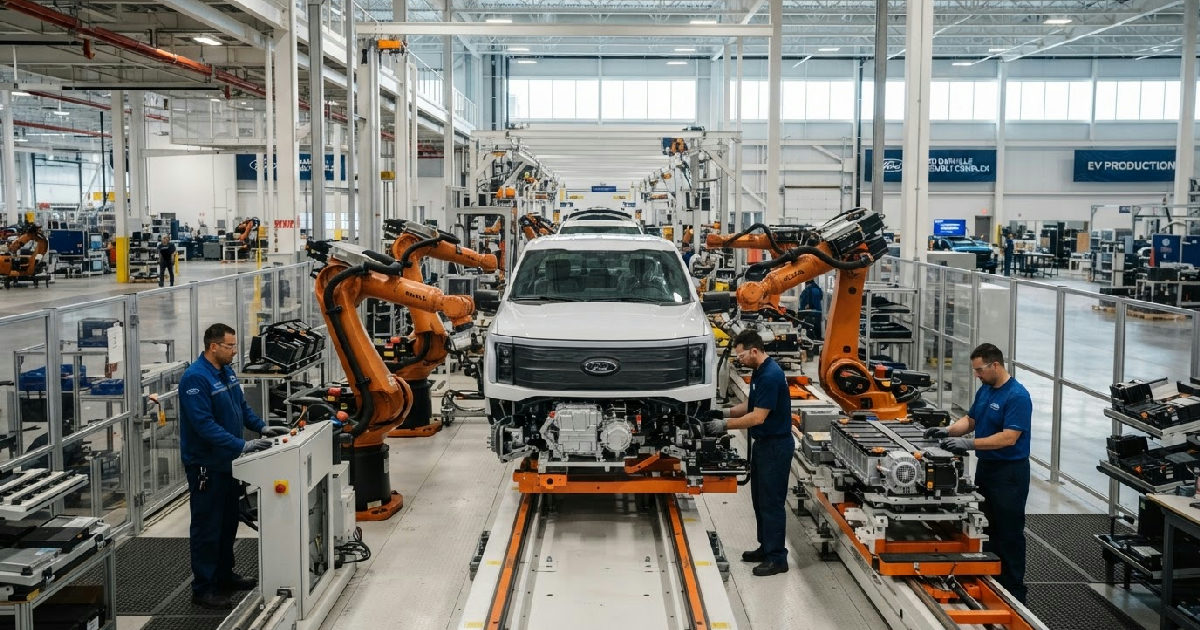
Ford is investing $2 billion to transform its Oakville Assembly Complex in Ontario, Canada, aiming for 40% faster electric vehicle production. This significant Ford EV assembly overhaul is set to revolutionize the manufacturing process at the facility.
This overhaul represents a strategic shift for Ford, central to its global push for electrification and manufacturing efficiency. The substantial capital injection, supported by Canadian and Ontario provincial government contributions, underpins the automaker’s ambition to simplify production processes and reduce costs across its EV portfolio. This investment positions Ford to compete aggressively in the evolving electric vehicle market.
Ford EV assembly overhaul begins
The core of Ford’s strategy at Oakville is the adoption of its Universal EV Production System. This innovative approach moves away from the conventional linear assembly line, a staple of automotive manufacturing for over a century. Instead, it utilises a three-branched process, allowing major vehicle sections to be built simultaneously, significantly condensing assembly time.
The system incorporates advanced unicasting techniques, alongside increased automation and ergonomic improvements for workers. These elements are designed to streamline operations and enhance worker efficiency. The adoption of unicasting, in particular, allows for fewer parts and simpler manufacturing.
This push for a 40% reduction in vehicle assembly time is a direct effort to achieve higher output and lower unit costs for future electric models. It responds to increasing consumer demand for EVs and the fierce competition among global automakers to produce these vehicles at scale.
Such technological advancements reflect a broader trend within the automotive sector towards more advanced robotics and manufacturing technology to meet evolving market demands.
Ford’s commitment here signals a profound change in how vehicles are put together. It’s not just about building EVs; it’s about reinventing the manufacturing process itself. This approach could set a new benchmark for efficiency and flexibility in large-scale automotive production globally.
Oakville’s $2 billion transformation and funding
The Oakville Assembly Complex, currently responsible for producing popular models like the Ford Edge, Lincoln Nautilus, and Ford GT, will undergo extensive re-tooling. This conversion will see the plant transition from internal combustion engine (ICE) vehicle production to exclusively manufacturing electric vehicles.
Ford’s direct investment totals $1.8 billion, which is CAD $2.3 billion. Crucially, the Canadian federal government is contributing $295 million (CAD $300 million) to the project. This is matched by an equal $295 million (CAD $300 million) from the Ontario provincial government, highlighting the joint commitment to the automotive industry in Canada.
This combined public and private funding brings the total investment for the Oakville plant’s conversion to approximately $2 billion USD (CAD $3.4 billion). The funding package underscores the strategic importance of the facility within North American automotive manufacturing, ensuring its future viability in an electrified market.
Re-tooling efforts are scheduled to commence in the second quarter of 2024, with the full production of new generation electric vehicles expected to begin in 2025. This timeline positions Ford to capitalise on the rapidly expanding EV market, while also navigating the complexities of a major plant conversion. The facility’s transformation highlights a focused strategy to adapt existing infrastructure for future demands.
Securing jobs and strengthening Canadian industry
Beyond the technological upgrade, this substantial investment directly addresses employment stability. It secures 3,000 jobs at the Oakville plant, which currently employs 3,400 people. This is a significant outcome for the regional economy in Ontario and the broader Canadian manufacturing sector, ensuring continued high-value employment.
The Unifor union, representing Canadian auto workers, played a critical role in this development. They ratified a new three-year contract with Ford in September 2023, which cemented the Oakville investment and associated job security provisions. This agreement demonstrated successful collaboration between labour and management.
Kumar Galhotra, President of Ford Blue, affirmed the importance of this partnership, stating that “Canada and Unifor are key to Ford’s future.” His comments underscore the collaborative nature of this industrial transformation. It’s a recognition that long-term competitiveness relies on both technological advancement and a stable, skilled workforce.
Lana Payne, Unifor National President, echoed this sentiment. She described the collective agreement as a “historic deal” that will secure the future of Ford’s Canadian operations. This level of investment and job security is vital for maintaining Canada’s position as a significant player in the global automotive landscape.
Ford’s broader electrification strategy
The Oakville transformation is an integral part of Ford Motor Company’s larger, ambitious commitment to electric vehicles. The company plans to invest a staggering $50 billion globally in EVs through 2026, signalling a complete repositioning of its product portfolio and manufacturing capabilities. This reflects a clear long-term vision for an electric future.
Ford has set aggressive financial targets for its EV division, aiming for a 10% adjusted EBIT margin by the close of 2026. Achieving this margin will require not only significant sales volumes but also highly efficient production processes, precisely what the Oakville overhaul is designed to deliver. This financial goal demonstrates Ford’s intent to make its EV business profitable and sustainable.
The company’s production ambition is equally bold, targeting an annual run rate of 2 million EVs worldwide by the end of 2026. This target necessitates massive manufacturing scale and efficiency across its global operations. The Oakville plant will be a key contributor to this goal, especially for the North American market.
This strategic pivot reflects the intensifying competition and rapid innovation in the global automotive sector. Traditional manufacturers are racing to establish dominance in the electric era, facing challenges from both established rivals and new entrants. Ford’s approach focuses on both product development and process innovation to secure its market share.
Other significant investments in the sector include efforts by various automakers to shift existing plants to hybrid-electric vehicle production. This trend highlights a sector-wide commitment to electrification, albeit with varying approaches and timelines. Ford’s comprehensive strategy, however, places a strong emphasis on full EV conversion and novel assembly methods.
Global implications for industrial productivity
The shift to faster, more flexible assembly systems, exemplified by Ford’s investment, has profound implications beyond the Canadian border. It signals a global trend in manufacturing towards highly automated and digitally integrated facilities. This evolution is driven by the need for efficiency, adaptability, and cost reduction in a dynamic market.
Manufacturers worldwide are seeking ways to reduce cycle times, optimise resource allocation, and enhance product customisation. The Universal EV Production System could serve as a case study for other industries looking to modernise their production lines and accelerate time-to-market. The principles of parallel assembly and streamlined processes have broad applicability.
The move towards unicasting and increased automation fundamentally changes the demands on the workforce. It requires a highly skilled workforce capable of operating and maintaining advanced industrial systems, including complex robotics and software. This creates both challenges and opportunities for talent development in the manufacturing sector globally.
For industries in Africa, such technological advancements highlight the potential for leapfrogging older manufacturing paradigms. Integrating advanced assembly techniques and automation can drive local industrial growth and competitiveness. This could lead to the establishment of new, efficient production facilities capable of serving both local and international markets.
The emphasis on simplifying manufacturing and reducing costs also offers valuable lessons for developing regional supply chains. It promotes the idea of designing for manufacturability from the outset. Furthermore, it aids in establishing resilient factory logistics tasks and robust supply chains for new technologies, a critical factor for industrial development in emerging economies.
Ford’s investment in Oakville is more than just a factory upgrade. It’s a blueprint for the future of automotive manufacturing, demonstrating how significant capital, strategic innovation, and collaborative partnerships can drive industrial transformation on a global scale. This will undoubtedly influence how other major players approach their own transitions to electric vehicle production.
The lessons learned from this large-scale conversion, particularly regarding process efficiency and cost management, will resonate across the industrial landscape. It shows that even well-established manufacturing giants are willing to radically rethink their operations to remain competitive in a rapidly changing world. This kind of bold investment can spur further innovation and competition.
