


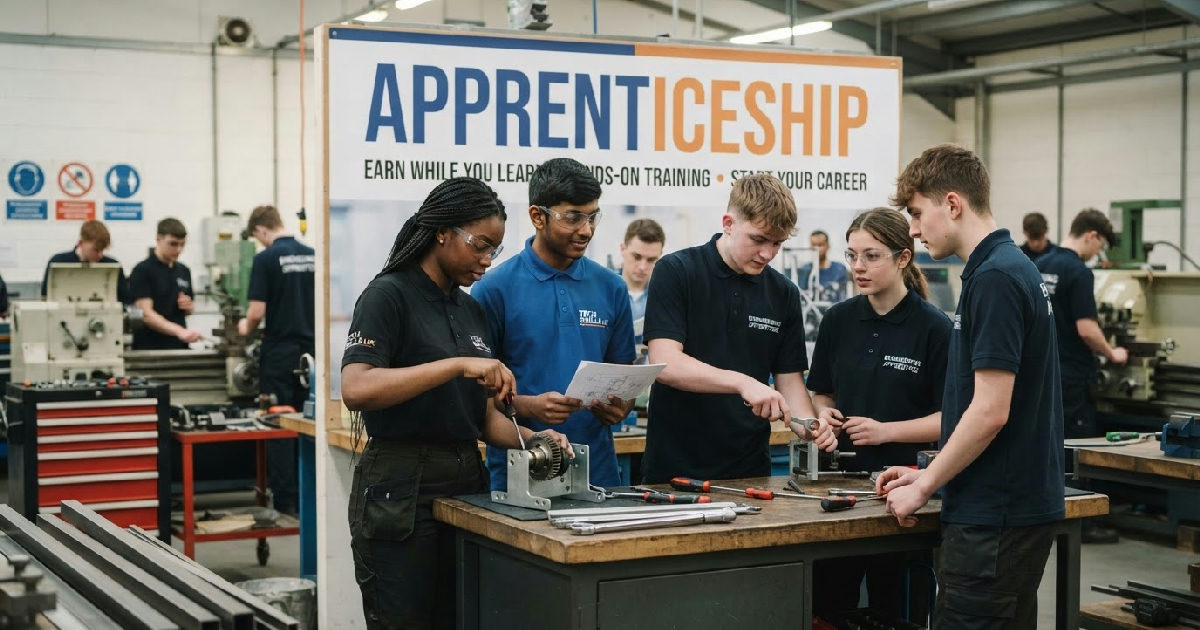
A survey has revealed a significant shift in educational aspirations, with 90% of young people considering an apprenticeship over a traditional university degree.
The report, based on interviews with 1,000 parents and their children aged 11-18, shows a notable change in attitudes across the United Kingdom. It indicates a clear divergence from the long-standing emphasis on university education, reflecting a broader societal re-evaluation of career preparation. This trend has particular relevance for the engineering and manufacturing sectors, which rely heavily on a steady supply of skilled technical talent.
Young people consider apprenticeships over degrees
The Enginuity survey paints a compelling picture of evolving perspectives, with 90% of young people expressing a willingness to choose an apprenticeship over a degree. This interest isn’t confined to students; 71% of parents now say they would encourage their children to pursue an apprenticeship, marking an increase from 67% in 2025.
Such figures underscore a substantial and sustained change in parental guidance and ambition for their children’s futures.
Further research reinforces this trajectory. A separate survey by the Association of Chartered Certified Accountants (ACCA) found that 80% of young people aged 14-18 are likely to begin a degree apprenticeship after school.
Additionally, the 2026 Apprenticeship Barometer from BAE Systems and Censuswide reported that nearly two-thirds (62%) of 16-24-year-olds would consider an apprenticeship, demonstrating increased awareness compared to the previous year. These numbers collectively signal a robust and expanding appeal for vocational training.
This growing preference also extends to financial considerations among parents. An impressive 95% of parents in 2026 expressed interest in apprenticeships that offer the chance to “earn while they learn,” a sentiment echoed by 91% of young people.
Almost two-thirds (63%) of parents actively prefer an apprenticeship over university for their child, indicating a fundamental shift in perceived value and career potential. Engineering pathways offer clear opportunities for early career development.
Financial Pragmatism Drives Choice
The financial advantages of apprenticeships are a primary catalyst for this shift. “Earning while learning” emerged as a critical factor for young people, with 79% ranking it among the most important aspects when considering future careers. This figure represents a sharp rise from 54% in the prior year, indicating that immediate income and financial independence are increasingly paramount.
Avoiding the mounting costs of university tuition and living expenses also plays a significant role. Apprenticeships allow individuals to gain practical experience and professional qualifications without incurring substantial debt. In contrast, traditional bachelor’s degrees often require 8–12 years to offset educational costs and delayed income, a stark reality in the current economic climate.
Modeled 2026 estimates highlight the financial disparity: average apprenticeship costs range from $0 to $3,000, often covered by employers, while a four-year public bachelor’s degree averages $98,000. Apprentices can achieve positive net earnings within their first year, and workers completing an apprenticeship can expect lifetime earnings $300,000 higher than their non-apprentice peers. This economic rationale makes efficiency improvements in career progression highly attractive.
Bridging the Information Gap
Despite the growing enthusiasm for apprenticeships, a significant information gap persists, particularly regarding newer technical qualifications like T Levels. Enginuity’s report found that 30% of young people and 33% of parents had never heard of T Levels, a government initiative launched in 2020 to improve technical education.
An additional 42% of young people and 45% of parents had heard of them but required further information to understand their value.
Ann Watson MBE, CEO of Enginuity, acknowledged this challenge, stating that while demand for vocational routes is evident, there remains “a lag with how schools are disseminating advice and guidance to those that need it most.” This highlights a critical disconnect between student interest and the support available within the educational system. The issue isn’t just about awareness; it’s about the perception of value.
Skills campaigner Steph McGovern echoed this sentiment, remarking, “I have been banging on for years about the need for parity of esteem – I think the penny is at last beginning to drop with young people and their parents.”
Her experience as an apprentice at Black & Decker before her broadcasting career underscores the potential of vocational pathways. The anecdotal evidence also points to outdated perceptions.
Olivia Lane, an Amazon Mechatronics Engineering Apprentice and recipient of the Best of British Engineering Award at the Enginuity Skills Awards, shared a troubling personal account. Her school headmaster had advised her “not to waste her life” on an apprenticeship, suggesting she was “better than that.”
Such incidents reveal how entrenched, and often misguided, traditional academic biases remain within some educational institutions. For manufacturing excellence, awards like the Manufacturer MX Awards celebrate the very skills apprenticeships foster.
Regional Disparities in Engagement
The geographical landscape of apprenticeship uptake and awareness reveals varied progress across the UK. Some regions are demonstrating strong momentum in parental encouragement and school guidance, while others struggle to match high demand with adequate career advice.
The South West, for instance, recorded the largest uplift in parental encouragement for apprenticeships, rising from 60% in 2025 to 77% in 2026. Greater London also saw a significant increase, reaching 75%. The West Midlands reported a sharp rise in young people engaging in balanced discussions about university and vocational options, alongside higher parental support, indicating targeted efforts are paying off.
However, other areas show untapped potential. In both the North East and East Midlands, strong interest in apprenticeships coexists with weaker reported exposure to vocational pathways in schools. This suggests that while young people and parents in these regions are open to apprenticeships, the local careers guidance infrastructure isn’t effectively translating that interest into action, leaving a critical gap for industry to address.
UK Policy and the Future Workforce
Government policy adjustments also reflect the evolving apprenticeship landscape. Effective January 2026, funding for Level 7 degree apprenticeships has been largely withdrawn for most adults aged 22 and above. Only apprentices aged 21 and under, care leavers, or those with an Education, Health and Care Plan remain eligible for public funding for these higher-level programmes.
This policy shift aims to re-direct investment towards earlier-career learners and lower-level provision, signalling a strategic focus on building foundational skills. For the engineering and manufacturing sectors, this means a renewed emphasis on developing talent from a younger age, ensuring a robust pipeline of skilled individuals prepared for industrial demands. It underscores the importance of foundational training.
The long-term health of the UK’s industrial base hinges on its ability to attract and retain skilled engineers and technicians. As such, these apprenticeship pathways are not just alternative educational routes; they are critical components of a national strategy to address skill shortages and maintain competitiveness on a global scale. Industries must adapt their recruitment and training models to align with these changing dynamics.
A Broader Shift in Global Industrial Skills
The UK’s experience with growing apprenticeship interest is not isolated. Globally, there is an increasing recognition of the value of vocational training and hands-on experience, particularly in sectors like advanced manufacturing and engineering. In the United States, for instance, the number of active participants in registered apprenticeships has more than doubled in recent years, indicating a wider international trend.
This global pivot towards vocational skills presents both challenges and opportunities for industrial players. For businesses operating in Africa, for example, understanding and adapting to this trend can be crucial for building local capacity and fostering sustainable industrial growth.
Investing in structured apprenticeship programmes can provide a direct route to developing a highly skilled workforce, tailored to specific local needs. African industries can look to these shifts as models for their own physical AI robotics and automation talent development.
Ultimately, the increasing appeal of apprenticeships represents a maturing understanding of how best to prepare individuals for productive careers. It acknowledges that academic routes, while valuable, are not the only path to success, particularly in technical fields. The focus now turns to strengthening guidance, improving access, and ensuring these pathways are genuinely accessible and respected across all regions and communities.
Re-evaluating Traditional Pathways
The data from Enginuity and other sources makes it clear that the conversation around post-secondary education has shifted fundamentally. Young people and their parents are now weighing the tangible benefits of immediate earnings, practical experience, and reduced debt against the traditional university model. This isn’t a rejection of higher education entirely, but rather a more discerning approach to career preparation.
For industries like engineering, which constantly require new talent with specific, hands-on capabilities, this trend is a powerful positive. It signifies a growing pool of individuals ready to enter the workforce with valuable skills, often directly applicable to industry needs. The challenge remains to ensure that these evolving aspirations are met with robust, well-supported, and widely recognised apprenticeship programmes.
As the cost of living continues to influence financial decisions, the attractiveness of “earn while you learn” pathways will likely grow further. The engineering sector has a unique opportunity to collaborate with educational institutions and government bodies to ensure these vocational routes are not only accessible but also lead to long-term, rewarding careers, cementing their status as a respected alternative to traditional degrees.
