


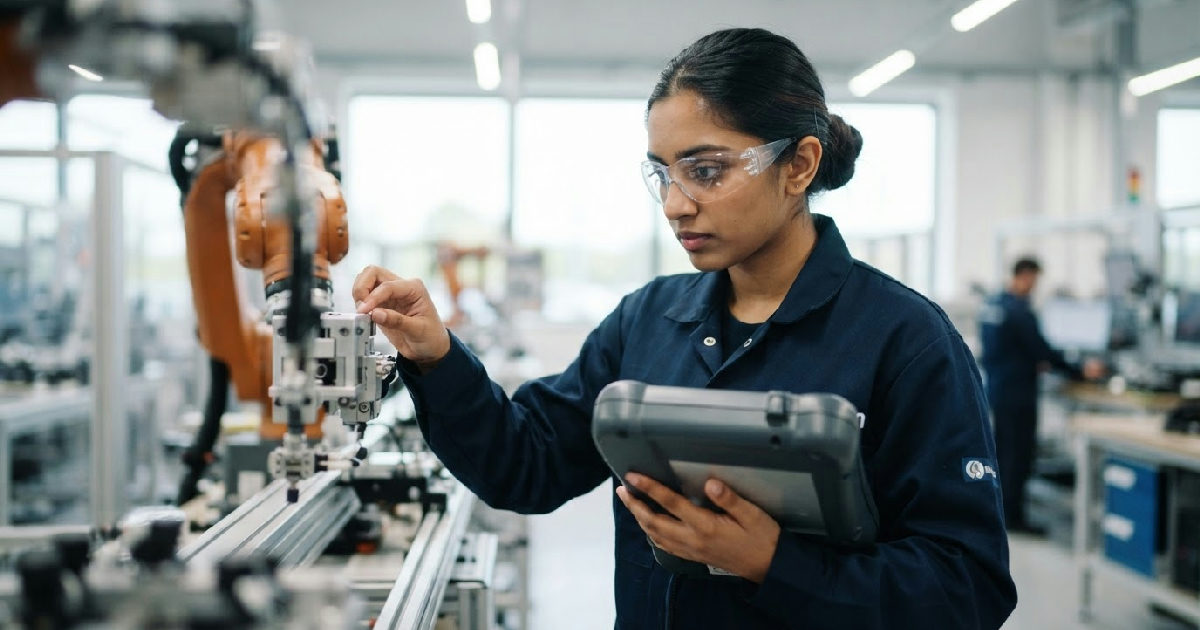
Make UK is relaunching its national photography competition after a hiatus of nearly a decade.
With a £5,000 prize fund, the 2026 Make UK Photography Competition invites professionals, amateurs, and young people to capture the reality of a field that has been radically reshaped by technology. Entries open on 26 August, with a deadline of 24 October 2026.
A visual campaign to fix manufacturing’s perception problem
The initiative is more than an arts contest; it’s a direct response to a persistent image problem. According to Make UK, public perception of manufacturing remains stuck in a bygone era of smoke-belching Victorian factories, hard hats, and heavy manual labour.
A recent survey by the organisation found that many people outside the industry view it as dwindling or dying. This image, says Make UK Chief Executive Stephen Phipson CBE, could not be further from the truth. He argues that this misperception has tangible consequences for attracting new talent.
“The truth is that manufacturing in the modern world is a lot different to how most people perceive it to be,” Phipson stated. “Walk around a modern manufacturing facility; it won’t be a dark factory with people sat at benches; it’ll look more like a lab or a hospital.” The competition is a strategic effort to replace old stereotypes with powerful, accurate imagery.
More than a contest: a strategic push for talent
This battle for hearts and minds has a clear economic driver: a critical skills shortage. The UK manufacturing sector currently has around 50,000 vacancies, and apprenticeship starts have been declining year on year. The competition is an attempt to start building a pipeline of future engineers, technicians, and digital specialists.
The nature of manufacturing work has transformed, demanding skills in data analytics, coding, and robotics that are also in high demand in other sectors. This puts industry in direct competition for talent. Many businesses are undergoing digital overhauls, embracing AI, coding, and data analytics as core elements of modern facilities.
“We need to help young people make that link and really showcase what’s going on in our sector because they are the lifeblood of our industry’s future,” Phipson explained. He contrasted the UK’s view of engineering with that in Germany, where an engineer holds a status comparable to a doctor.
The photography initiative is one part of a broader push to cultivate that same cultural respect in Britain.
Deconstructing the categories: what Make UK wants to see
To guide this visual narrative, the competition is structured around four distinct themes.Each category is open to professional, amateur, and young photographers (those under 20 on 24 October 2026), inviting diverse perspectives on the sector. The goal is to capture images that make people think, “I didn’t realise that was part of UK manufacturing.”
Manufacturing reimagined
This category directly tackles outdated perceptions. It calls for images of automation, robotics, AI, and the cutting-edge facilities that define contemporary industry. “It’s about automation, robotics, AI, coding and data analytics — technologies that weren’t part of the industry’s everyday language a decade ago,” Phipson noted, emphasising the need to show this high-tech reality.
The people who make it possible
Beyond the machinery, this theme focuses on the human element. It seeks to celebrate the diverse workforce, from apprentices to R&D leaders. The brief asks for images capturing collaboration, craftsmanship, and problem-solving, telling the story of the skilled individuals who drive the industry forward. This reflects the reality that even automated processes require immense human expertise.
Manufacturing makes things possible
Here, the focus is on the products and components themselves. Phipson highlights that many people are unaware of the scale and variety of goods made in the UK, noting that the wings for all Airbus planes are 100% manufactured in Britain. This category aims to make the invisible visible, connecting everyday life back to the factories where it begins.
The beauty of industry
This final category acknowledges the artistic side of the competition. It encourages photographers to find the aesthetic qualities in industrial environments—the scale, colour, precision, and intricate details. “Fundamentally, this is an artistic competition,” Phipson said. It looks for beauty in car design centres, sweeping factory landscapes, or the fine detail of a machined component.
Lessons from a past winner: how to capture modern industry
For photographers looking for an edge, the advice from previous winners is invaluable. Adrian Waine, who won in 2018, urges entrants to seek unconventional angles to make their subjects stand out. His winning shot, taken at steel specialist Severfield in Yorkshire, transformed a worker painting a large pipe into a dramatic, almost otherworldly figure.
“I aim to transform the ordinary and turn it into the dramatic,” Waine said. His technique involved using lighting to isolate the subject and hide the distracting background, creating a powerful, focused image. It’s this kind of creative interpretation of industrial processes that judges will be looking for.
Waine’s advice is to explore different perspectives, from high above to ground level, to find a view that the ordinary person never sees.
He also highlighted that the most interesting subjects aren’t always the final products. The complex machinery, logistics, and processes behind the scenes offer endless photographic potential. These complex operations, like those involving digital product passports for remanufacturing, present a creative challenge to visualise.
Waine advises entrants to take risks and “work with the toughest shot possible. A judge ought to recognise the effort put into it.”
Reshaping perceptions for UK industrial growth
The UK also grapples with the challenge of aligning public perception with the reality of modern manufacturing. This is a common issue for industries battling an outdated image that can hinder recruitment and investment.
The competition directly addresses key challenges for the UK sector, including 50,000 current vacancies and a year-on-year decline in apprenticeship starts. Make UK’s Stephen Phipson CBE has consistently highlighted how engineering in Britain often suffers from a “second-class” perception compared with other qualifications, especially when contrasted with the status engineers hold in countries such as Germany..
Showcasing British innovation, such as the UK’s lead in the renewables sector, is crucial for changing these views. The sector created nearly 40,000 new manufacturing jobs last year in areas like wind farms, carbon capture, and hydrogen technology.
This competition helps demonstrate that industry is a dynamic, future-focused field, not a relic of the past, even while it navigates issues like cyber attacks impacting businesses. Ultimately, the goal remains to inspire the next generation to build the future by making things.
