


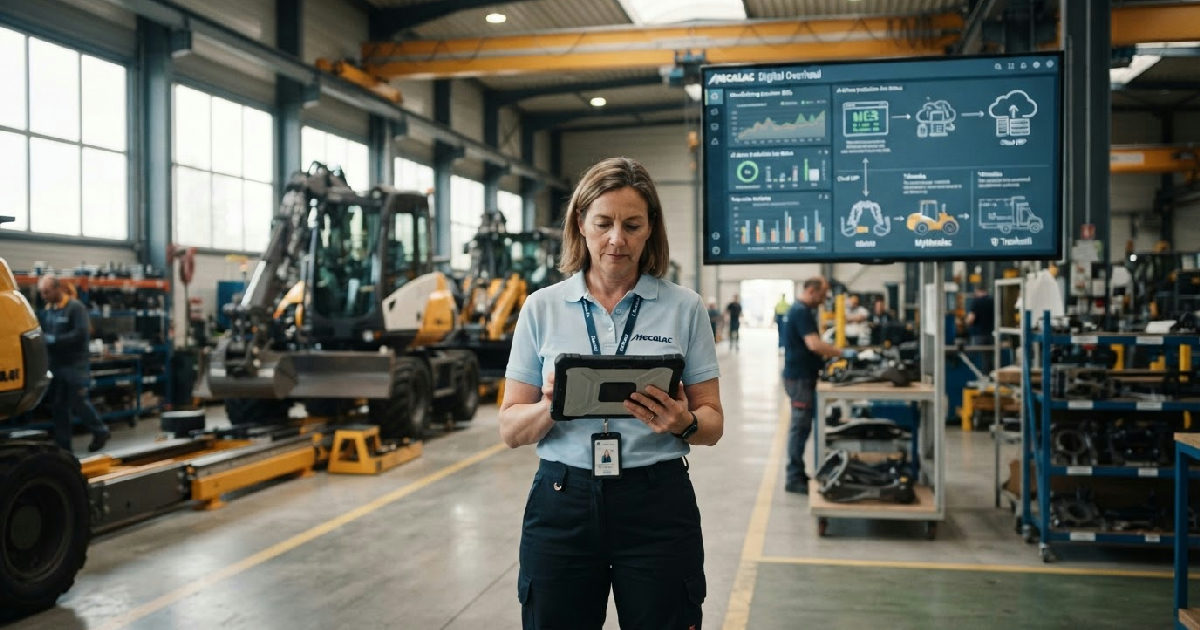
French construction equipment manufacturer Mecalac is undertaking a root-and-branch digital transformation, moving its global operations to a cloud-based ERP system and simultaneously rolling out a new connected machinery platform. The strategy is designed to unify its business processes, enhance operational visibility, and, crucially, build the data architecture required for a future with artificial intelligence.
This dual-pronged investment, spearheaded by the company’s head of IT, Kaye Darke, will see Mecalac adopt Oracle Fusion Cloud for its core business functions. It is a move that showcases a deliberate shift from fragmented, legacy systems towards a single, scalable platform capable of delivering real-time insights across its entire supply chain and manufacturing footprint.
Unifying global operations with Mecalac’s digital overhaul
The core of Mecalac’s internal transformation is the global migration to Oracle’s cloud enterprise resource planning (ERP) suite. This ambitious project, with its UK IT function playing a leading role, aims to replace disparate systems with a unified source of truth for the entire business, from finance and procurement to production and logistics.
By centralising its operational data, the company expects to see a significant uplift in productivity and collaboration. The system provides the kind of granular traceability and control that modern manufacturing demands. This is particularly important for a company like Mecalac, which prides itself on innovative and complex product designs across its various international production sites.
This transition isn’t just about replacing old software; it’s about re-engineering processes to be more efficient and data-driven. A cloud-native ERP provides the flexibility and scalability that on-premises solutions often lack, allowing for automatic updates and easier integration with other digital tools.
The move is foundational, creating a platform on which other services can be built, similar to how trials for digital product passports rely on a solid data backbone.
Connecting the fleet with MyMecalac and Trackunit
While the ERP focuses on internal processes, the second pillar of Mecalac’s strategy extends out to the field. The company has launched MyMecalac Connected Services, a comprehensive telematics solution developed in partnership with Danish tech firm Trackunit. This service equips Mecalac machines with the hardware to transmit real-time operational data.
Accessible via a web portal and mobile app, the platform is designed to directly support customer efficiency and profitability. Fleet managers can monitor machine locations, fuel consumption, and utilisation rates, helping them to optimise deployment and reduce downtime. The system also provides smart notifications for maintenance schedules and flags potential issues before they cause breakdowns.
According to Baptiste Ligot, Mecalac Group after-sales manager, the choice of partner was critical. “We have done a comprehensive review of global telematics companies… and we have chosen Trackunit as our partner,” he stated, highlighting the need to meet complex customer requirements. He emphasised that “machine connectivity is paramount for this digital journey to gain momentum in the industry.”
This sentiment was echoed by Soeren Brogaard, CCO at Trackunit, who noted that the partnership allows Mecalac to tap into a network of over 500,000 connected machines on its cloud platform. This scale creates a powerful ecosystem, not unlike how tech firms in other sectors expand their digital reach through strategic partnerships and acquisitions to deliver more value to the end user.
Standard on new models
Mecalac is making the MyMecalac solution a standard feature on its latest Stage V excavators, including the 12MTX, 15MWR, and 15MC models, as well as the AS1600 and AS210e loaders. It is also available as an option across all other Stage V machines, signalling the company’s firm commitment to a connected future.
The engineering of a digital-first product line
This digital infrastructure directly feeds back into Mecalac’s core strength: engineering and product development. Having access to real-world usage data from thousands of machines provides invaluable insight for future design improvements. But the digital toolkit is also transforming the development process itself, long before any metal is cut.
A prime example is the development of Mecalac’s e12, its fully electric wheeled excavator. To tackle the complex challenge of optimising battery life and performance, Mecalac’s engineers utilised Simcenter Amesim software from Siemens Digital Industries Software. This allowed them to create a complete digital twin of the excavator.
This model simulated the interplay between the machine’s mechanical, hydraulic, thermal, and electrical systems. Engineers could virtually test different configurations and analyse performance under various loads, dramatically accelerating the development cycle. According to Mecalac, the entire modelling phase for the electric excavator prototype was completed in approximately three months, a testament to the power of simulation.
This approach aligns perfectly with the company’s long-held philosophy. “Anticipating technological developments and changes to working practices is part of our DNA,” noted Henri Marchetta, the chairman and founder of Mecalac Group. This focus on practical innovation is what drives the company to improve job site safety, versatility, and efficiency through its product designs.
Laying the groundwork for an AI-driven future
While the immediate benefits of the new ERP and telematics systems are clear, the long-term prize is readiness for artificial intelligence. By unifying and structuring its data, Mecalac is building the essential foundation needed to train and deploy AI models that could further optimise its operations and products.
The vast amounts of data generated by the MyMecalac fleet are particularly valuable. This information can be used to develop predictive maintenance algorithms, which could forecast component failures with high accuracy, allowing for pre-emptive service and maximising machine uptime for customers. It could also inform more intelligent machine designs that adapt to operator behaviour.
Internally, AI could be applied to the data within the Oracle ERP system to improve demand forecasting, optimise inventory levels across its factories, and even automate routine administrative processes.
This is not a theoretical exercise. The manufacturing sector is increasingly seeing the convergence of cloud ERP and AI, turning business systems into intelligent platforms. Mecalac’s digital transformation is a practical and necessary step to ensure it remains at the forefront of this shift, turning data from a byproduct of operations into a core strategic asset.
Strategic context and the path ahead
Mecalac’s digital journey is unfolding against a backdrop of significant corporate change. In June 2025, the FAYAT Group acquired a 100% stake in the Mecalac Group. While Mecalac will operate as an autonomous entity within FAYAT’s Road Equipment Division, a unified and transparent data platform will be invaluable for integration and strategic alignment.
The company’s focus on digitalisation also supports its leadership in sustainable equipment. Mecalac has been a prominent player in the “Green Cities” movement, launching its e-Series of fully electric machines, including an 11-ton excavator and a 6-ton dumper. The data from connected electric machines is critical for optimising battery technology and demonstrating the benefits of electric equipment to customers.
For industrial sectors across Africa, these advancements are particularly relevant. As infrastructure and construction projects grow in scale and complexity, the demand for efficient, reliable, and safe machinery increases. Connected machines that offer predictive maintenance and optimised performance can provide a competitive edge, reducing costly downtime on remote sites.
Ultimately, Mecalac’s journey shows that digital transformation in manufacturing is not a single project but a continuous process. By investing in a modern cloud ERP and a powerful telematics platform, the French innovator has not only optimised its current business but also built a robust launchpad for the next generation of intelligent construction equipment.
