


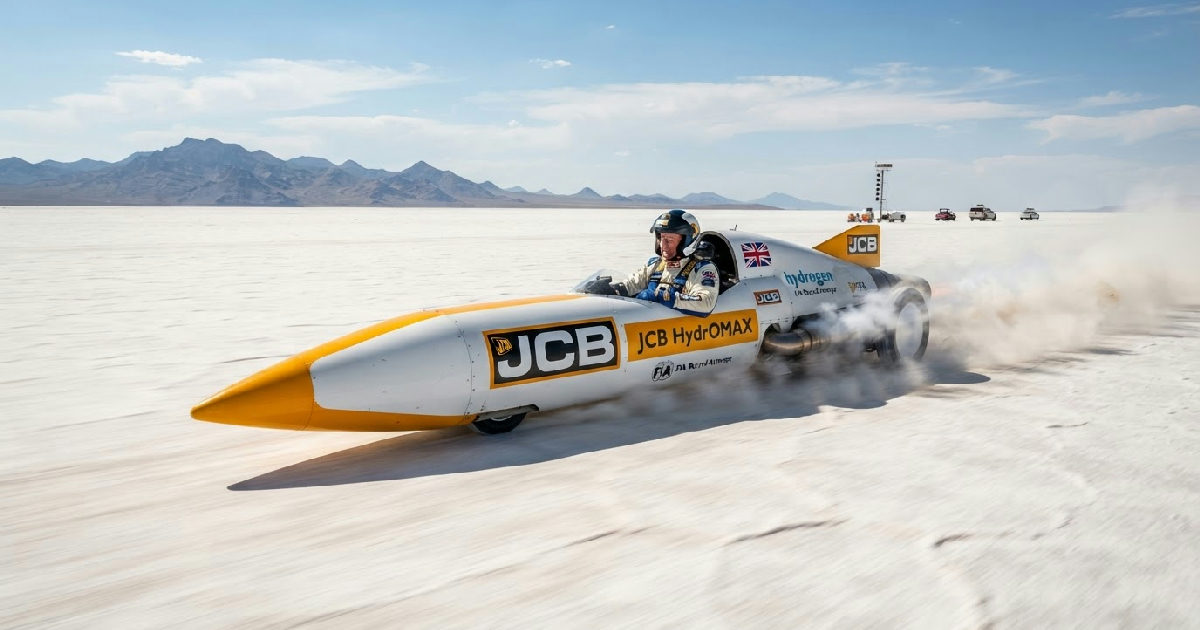
A hydrogen internal combustion-powered vehicle, the JCB Hydromax, has set a new FIA world land speed record with an average speed of 406.320 mph (653.909 kph).
Driven by Wing Commander Andy Green OBE, the JCB Hydromax racer reached this milestone on August 11, 2026, at the iconic Bonneville Salt Flats in Utah, USA. This achievement also positions the Hydromax as the fastest hydrogen-powered vehicle of any kind in history.
Engineering the hydrogen speed record
The record-breaking run saw the JCB Hydromax complete two required passes under Fédération Internationale de l’Automobile (FIA) rules, one in each direction within an hour. The first pass clocked 400.623 mph (644.740 kph), followed by a second at 412.135 mph (663.267 kph), resulting in an official average speed.
This performance comfortably eclipses the previous FIA-officiated hydrogen internal combustion benchmark of 185.5 mph, which the BMW H2R set in 2004. It also surpasses the 303 mph hydrogen fuel cell record.
Power from production engines
At the heart of the 32-foot (9.8 m) Hydromax are two production-based hydrogen internal combustion engines. These units are the same type of engines that power JCB machines rolling off production lines today, manufactured at the company’s Foston, Derbyshire factory.
Each engine delivers 800 hp, giving the vehicle a combined output of 1,600 hp. This direct lineage from industrial equipment to a world-record vehicle underscores JCB’s commitment to applying its hydrogen technology in real-world scenarios.
Bespoke design for extreme speeds
Building the Hydromax was a collaborative engineering effort, bringing together several specialist firms. Prodrive handled the car’s construction, Ricardo tuned the engines for peak performance, and Xtrac provided the transmission system.
The vehicle, weighing approximately 2.6 tonnes, features a twin-transmission and clutch system to drive all four wheels. Extensive aerodynamic development and rigorous stress and simulation testing ensured every component could withstand the immense forces encountered at these velocities. Custom-made tyres were also fitted to handle the extreme speeds.
A legacy of speed and innovation
For JCB, this isn’t its first foray into land speed records. Twenty years ago, in August 2006, the JCB Dieselmax, also driven by Wing Commander Andy Green OBE, set the world diesel land speed record of 350.092 mph (563.418 kph) on the same Bonneville Salt Flats. That record still stands.
This latest achievement marks a significant evolution for JCB, from diesel power to hydrogen with zero tailpipe emissions, as Chairman Lord Bamford noted. The company consistently uses speed records as a platform to demonstrate its engineering prowess and validate new technologies.
Driver with a unique pedigree
Wing Commander Andy Green OBE is no stranger to breaking speed barriers. He holds the outright World Land Speed Record at 763.035 mph, making him the only person to have broken the sound barrier on land with the jet-powered ThrustSSC in 1997. His extensive experience and calm demeanour behind the wheel have been crucial for these high-stakes attempts.
Green’s involvement highlights a continuity of expertise, bridging JCB’s previous diesel record with this new hydrogen milestone. “Bonneville is the spiritual home of the world land speed record, and the JCB Hydromax has just written itself into that history,” Green stated, underscoring the significance of the location and the achievement.
Building on past success
The Hydromax’s success builds directly on engineering lessons from the Dieselmax. “Twenty years ago we came to Bonneville with JCB Dieselmax and showed what British engineering could do with diesel power,” Lord Bamford reflected. “Today we have done it again — this time with engines powered by hydrogen.”
JCB Engineering Director Ryan Ballard, who leads the Hydromax project, praised the team: “This record belongs to the engineering team that took a hydrogen digger engine and made it the fastest of its kind on Earth.” This continuity of talent and focus on practical engineering solutions is a hallmark of JCB’s approach.
Driving hydrogen technology forward
The JCB Hydromax land speed record is more than just a feat of speed; it is a potent validation of hydrogen internal combustion engine (HICE) technology. It demonstrates that these production-based engines can deliver extreme power and performance with zero carbon emissions at the point of use.
This record comes as part of JCB’s ambitious £100 million hydrogen programme, which represents a substantial investment in developing highly efficient hydrogen engines. The company believes HICE technology offers a compelling alternative to electrification for heavy machinery, particularly given the challenges of battery size, charging times, and power density required for large industrial equipment.
JCB’s £100 million hydrogen initiative
The hydrogen programme involves a team of over 100 engineers and plans for further recruitment, focusing on delivering hydrogen-powered machines to market. Prototypes, including hydrogen-powered backhoe loaders and Loadall telescopic handlers, are already undergoing testing, with initial sales targeted for the end of 2026.
This initiative represents a strategic bet on hydrogen as a viable and scalable fuel for the construction and agricultural sectors. The record acts as a high-profile demonstration of the technology’s immediate capabilities.
Practical applications for heavy machinery
The ability of HICE technology to power a vehicle to over 400 mph suggests its potential for demanding industrial applications. Unlike battery-electric solutions, hydrogen internal combustion engines can be refuelled quickly, mirroring the operational patterns of traditional diesel machinery, a critical factor for heavy equipment that operates for long shifts.
As advanced manufacturing capabilities expand globally, the drive for decarbonisation across all industrial sectors becomes paramount. Hydrogen offers a pathway to maintain operational efficiency while drastically reducing environmental impact.
The proving ground: Bonneville Salt Flats
The Bonneville Salt Flats in Utah have long been the spiritual home for land speed record attempts, hosting such endeavours since 1914. The vast, flat, and hard surface provides an ideal environment for pushing the limits of automotive engineering. The rigorous conditions at Bonneville, including varying surface grip and challenging aerodynamics, make any record set there particularly credible.
The record now awaits official ratification by the FIA Land Speed Records Commission, which oversees the relevant land speed records.This formal process ensures adherence to strict FIA rules and, once ratified, would formally place the Hydromax in the Category A, Group XIV, Class 7 FIA World Flying Start Land Speed Record category.
Broader implications for industrial engineering
This record has implications beyond raw speed. It demonstrates how engineering can push the boundaries of sustainability in heavy industries. By proving hydrogen internal combustion engines can deliver extreme power, JCB demonstrates a credible path for decarbonising off-highway vehicles and industrial plant.
The demand for hydrogen engines is projected to grow significantly, driven by mandates for decarbonisation in heavy-duty transportation and industrial sectors. Companies such as Cummins are also developing hydrogen internal combustion engines for applications ranging from buses to long-haul trucks, highlighting a wider industry shift.
This focus on real-world engineering solutions for industrial challenges aligns with broader trends across the manufacturing sector. Investment in new industrial facilities is increasingly prioritising advanced technologies and sustainable practices. The Hydromax record provides a tangible example of what can be achieved when engineering innovation is applied to sustainability goals.
