


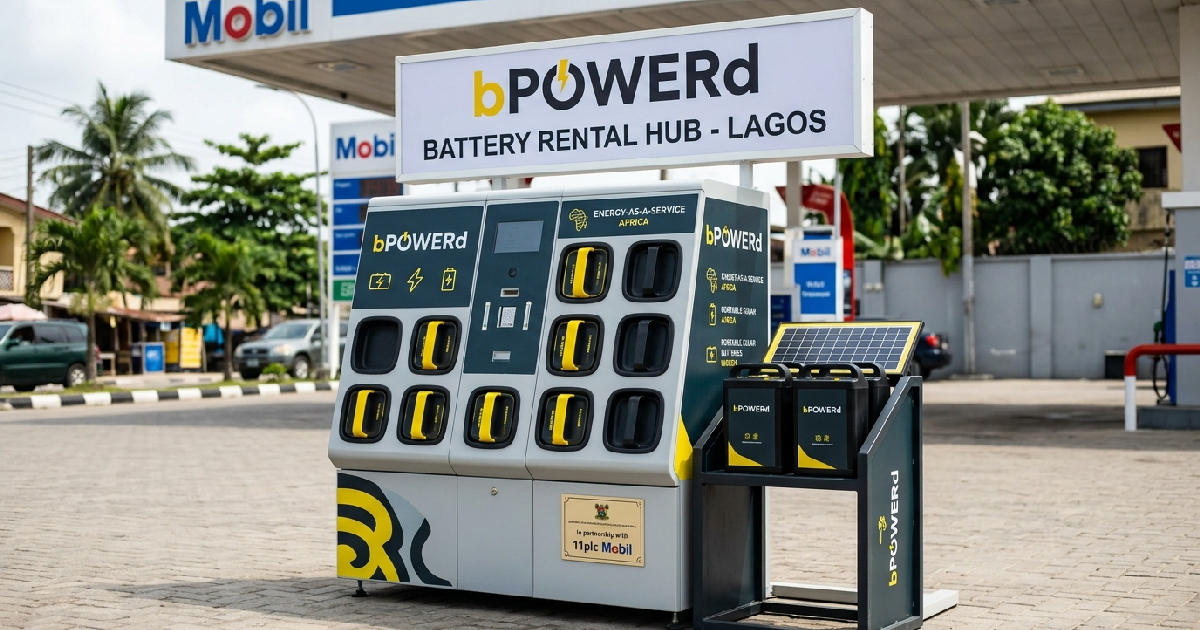
bPOWERd, a bp-backed energy startup, has established seven battery rental hubs in Lagos to provide on-demand electricity to households and small businesses struggling with rising fuel costs. The expansion into Nigeria follows a successful first year in South Africa, where the company facilitated over 125,000 rentals through its subscription-based power model.
Head of Country Operations for South Africa at bPOWERd, Thandekile Madikane, confirmed that the Nigerian rollout reached 60% of its six-month target within just seven weeks of going live.
Battery rental hubs bridge the energy gap in Lagos
The move represents a significant pivot in how energy infrastructure is delivered across the continent. Instead of requiring users to invest in permanent solar installations or expensive inverter systems, bPOWERd provides portable, solar-charged batteries for a daily fee. This “energy-as-a-service” model aims to eliminate the financial barriers that have historically prevented low-income households and micro-entrepreneurs from accessing clean, reliable power.
The arrival of bPOWERd in Nigeria’s commercial capital addresses a chronic reliance on petrol and diesel generators. Grid instability continues to affect four out of ten Nigerian households, forcing many to spend a large portion of their income on fuel and maintenance. By offering a rental alternative, the company provides a way to bypass these costs without the heavy debt associated with asset ownership.
Madikane noted that the demand for reliable power has always existed, but the entry price was the primary obstacle. In South Africa, households often spend between R8,000 ($488) and R150,000 ($9,154) on backup power hardware. For small business owners in Lagos, similar upfront costs for lithium-ion systems are often impossible to meet given current inflationary pressures.
The rental hubs allow users to pick up a fully charged battery, use it to power their essential appliances, and swap it for a fresh unit when depleted. This cycle ensures continuous productivity for businesses like barbershops and food vendors that previously stopped operating during blackouts.
The focus on infrastructure reliability is central to this shift, mirroring how mobile data and digital payments replaced fixed-line services across Africa.
Managing the transition from petrol generators
The economic incentive for switching to battery rentals is clear for many Lagosians. A single bPOWERd battery reportedly offers a 70% cost reduction compared to the daily expense of running a small petrol generator. This margin allows small business owners to reinvest savings into their inventory or staff rather than literally burning their profits as fuel.
Furthermore, the batteries eliminate the noise and exhaust fumes associated with small-scale generation. In densely populated urban areas like Lagos, this engineering shift improves the immediate working environment for vendors and their customers. The transition is not just about cost but also about the quality of the urban commercial space.
Financial flexibility through pay-per-use models
Madikane emphasized that even customers who can afford to buy equipment are increasingly choosing to rent. This preference stems from a desire to preserve financial liquidity. In a volatile economy, tying up capital in a depreciating asset on a wall is less attractive than paying for energy only when it is needed.
This flexibility is particularly useful for seasonal businesses or residents in rented accommodation who cannot install permanent rooftop solar. The rental model treats electricity as a consumable utility rather than a capital investment. It follows the precedent set by M-Pesa in Kenya, where access to financial services was decoupled from the requirement of a physical bank branch.
Engineering a portable alternative for urban small businesses
The hardware provided at these hubs is designed for durability and ease of transport. bPOWERd offers two primary battery sizes to cater to different energy needs. The small 300Wh unit is priced from ₦1,500 per day, while a larger 1,000Wh battery starts at ₦3,000 per day. Both units require a refundable ₦15,000 deposit to ensure the hardware is returned safely.
From an engineering perspective, these batteries are built to survive the rigours of daily transport in busy urban settings. They provide up to 12 hours of power, depending on the load, making them ideal for a full workday. Users can power essential devices including lighting, fans, televisions, and refrigerators without the complexity of wiring a full-house system.
The use of solar power at the hubs to charge these units adds a layer of sustainability to the operation. By centralising the charging process, bPOWERd can achieve higher efficiency than individual small-scale solar setups. This centralised approach also simplifies maintenance, as the company handles all technical upkeep of the cells, removing that burden from the end-user.
Technical specifications of the bPOWERd hardware
The 1,000Wh battery is capable of supporting more intensive industrial tasks, such as powering salon equipment or small shop machinery. This capacity is critical for the “spaza” shop operators and food vendors Madikane identified as core customers in South Africa. The ability to keep a refrigerator running during a grid failure prevents stock spoilage, directly protecting the owner’s capital.
For operations managers, this model functions similarly to a Manufacturing Execution System by providing a predictable, controlled input for their business processes. When energy becomes a reliable variable rather than an unpredictable one, business planning becomes more accurate. This predictability is the foundation of industrial growth in the informal sector.
Safety and compliance through KYC verification
To protect the high-value hardware and maintain a secure network, bPOWERd requires all users to complete Know-Your-Customer (KYC) checks. In Nigeria, this process involves providing a National Identification Number (NIN). This requirement ensures that every battery in circulation is tied to a verified identity, reducing the risk of theft and loss.
This data-driven approach allows the company to track the lifecycle and health of each battery. By monitoring discharge patterns and charge cycles, bPOWERd can predict when a battery needs servicing or replacement. This proactive maintenance ensures that the user always receives a unit that performs to its specified capacity, maintaining trust in the service.
Operational efficiency via retail partnership networks
A key factor in the rapid expansion into Lagos is the partnership between bPOWERd and 11plc, the company that operates Mobil service stations in Nigeria. By using existing service stations as swapping and charging hubs, bPOWERd avoids the high costs of land acquisition and building new storefronts. This strategy allows for a faster rollout across the city’s seven initial sites.
Mobil stations are already established as reliable points for fuel and maintenance, making them natural locations for energy services. This integration into existing retail flows makes it convenient for customers to swap their batteries during their normal daily commutes. The logistical engineering of this “hub-and-spoke” model is what enables the service to scale quickly in a congested environment like Lagos.
The company also benefits from the industrial connectivity offered by modern tracking technologies. Each hub can monitor inventory levels in real-time, ensuring that fully charged batteries are always available for arriving customers. This level of operational visibility is necessary for managing a fleet of portable assets across a massive metropolitan area.
The role of Mobil service stations in urban logistics
The partnership with 11plc represents a logical evolution for traditional fuel retailers. As the global energy market shifts toward renewables and electricity, service stations must adapt to remain relevant. Hosting battery rental hubs allows these stations to capture a new segment of the energy market that was previously served by independent petrol vendors.
For the consumer, the familiar environment of a petrol station provides a sense of security and reliability. The stations are typically located on major transport routes, reducing the “last-mile” effort required to transport a 1,000Wh battery. This logistical convenience is often the deciding factor for small business owners who cannot afford to spend hours travelling to a remote charging point.
Strategic shift from hardware ownership to utility access
The success of bPOWERd highlights a broader movement in African industrial policy toward decentralised energy solutions. National grids in many countries have struggled to keep pace with rapid urbanisation and industrial demand. By decentralising the storage and distribution of power, battery rental models provide a “leapfrog” technology that bypasses the need for immediate grid upgrades.
Madikane believes energy is following the same path as other digital services. Users are no longer interested in the “cinema” (the infrastructure); they want the “film” (the experience or utility). This shift in consumer psychology is forcing energy companies to rethink their business models. Providing access to power is becoming more profitable and scalable than selling the equipment itself.
This model also democratises access to modern energy. When the barrier to entry is a daily fee rather than a five-figure investment, a much larger portion of the population can participate in the formal economy. This inclusion is vital for the growth of small-scale manufacturing and processing in urban townships, where electricity is the primary constraint on productivity.
Lessons from South African township economies
The South African pilot, which began at select bp Southern Africa (bpSA) forecourts in August 2024, provided the data necessary to refine the model. In townships, the batteries became “genuine infrastructure” for residents. They weren’t just used for convenience; they were used to charge neighbours’ phones for a fee or to replace noisy, expensive diesel machinery.
This organic growth of new income streams shows how flexible energy access can stimulate local economies. In Lagos, the early data suggests a similar trend. The fact that the company hit 60% of its target in seven weeks proves that the Nigerian market was primed for this specific engineering solution. People were not resistant to clean energy; they were simply priced out of it.
Scaling decentralised power across West African markets
The rapid adoption in Nigeria suggests that the bPOWERd model could soon spread to other West African nations facing similar energy challenges. Countries like Ghana and Ivory Coast, which are also seeing rising electricity tariffs, present logical next steps for expansion. The modular nature of the battery hubs means they can be deployed quickly in any city with an established retail fuel network.
As battery technology continues to improve, the capacity of these rental units will likely increase while costs fall. Future iterations of the hardware may include integrated IoT sensors that provide even more granular data on energy usage, helping small businesses optimise their operations. For now, the focus remains on the core mission: providing reliable, affordable power to those who need it most.
By removing the “lock” of high upfront costs, bPOWERd has unlocked a massive latent market. The transition from ownership to access is not just a trend; it is a fundamental shift in the engineering of African energy distribution.
As more hubs go live across Lagos and beyond, the sound of petrol generators may finally begin to fade, replaced by the quiet efficiency of rented lithium-ion power.
