


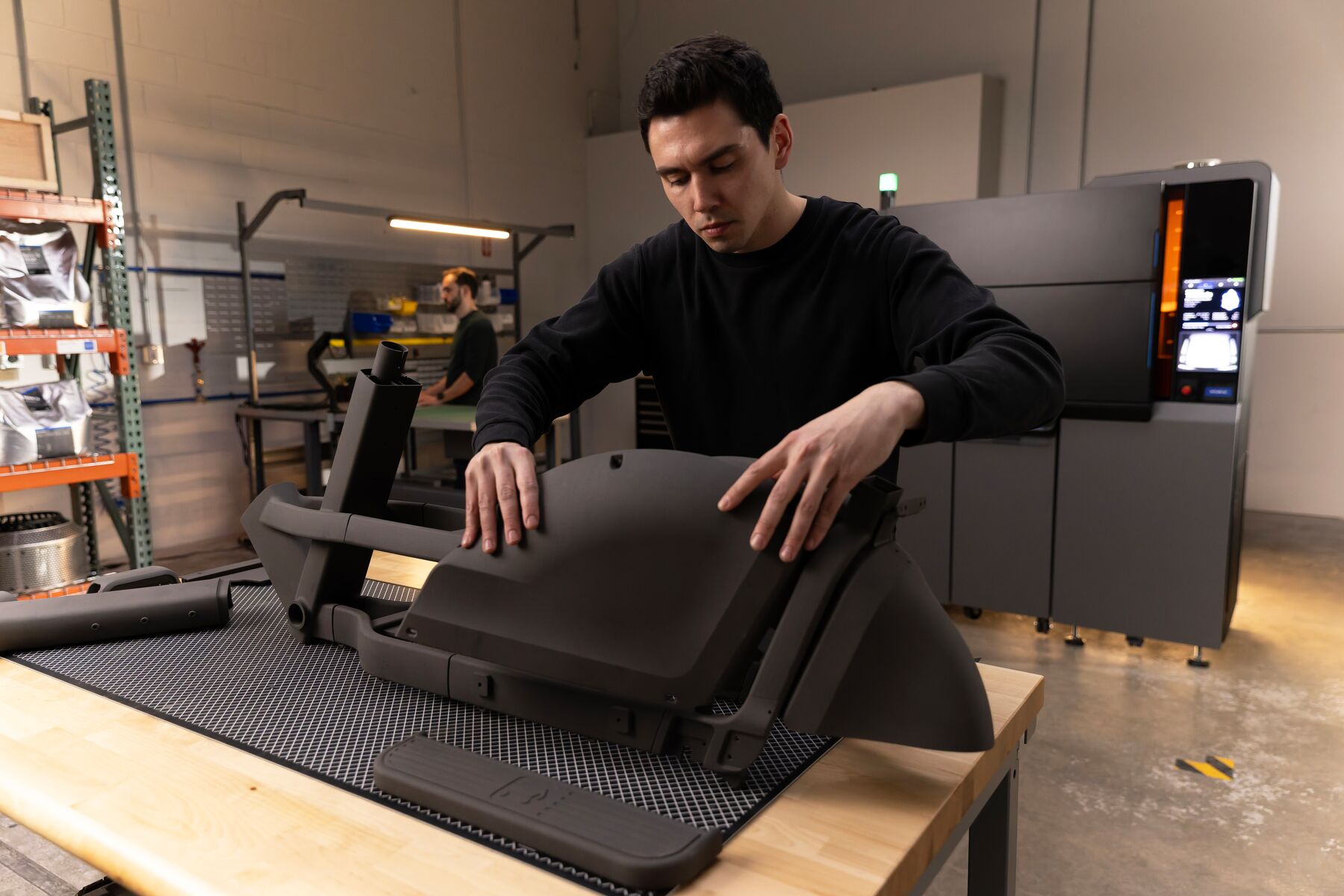
Formlabs co-founder and CEO Max Lobovsky officially launched the Fuse X1 on June 9, 2026, introducing a large-format industrial selective laser sintering (SLS) 3D printer designed to bridge the gap between prototyping and mass manufacturing. The new system, which starts at $84,999, features a 61.5-litre build volume and aims to reduce the cost-per-part of traditional industrial powder bed fusion systems by up to 50%. It enters the market as a direct competitor to injection moulding for medium-volume production runs.
The Fuse X1 isn’t just a larger version of previous hardware; it represents a shift toward more autonomous factory floors. Formlabs has paired the printer with an integrated ecosystem, including the Fuse Sift X1 for powder recovery and the Fuse X1 Vacuum Conveyor for automated material transport. By streamlining these post-processing steps, the company claims the system can achieve up to three times the throughput of comparable industrial systems, sintering at a rate of 0.330 kg per hour.
For operations managers and engineers, the most practical development is the machine’s footprint and utility requirements. Despite its industrial capacity, the Fuse X1 is designed to fit through a standard doorway and runs on single-phase power. It eliminates the need for the specialised HVAC systems or dedicated facilities typically required for high-end SLS machinery, allowing it to be integrated into existing high-output environments.
com/peopoly-giga-800-pellet-3d-printer-launch-details/”>Peopoly Giga 800 pellet 3D printer slashed material costs for large-scale builds.
Advanced thermal monitoring and AI failure prevention
The technical core of the Fuse X1 is a new thermal architecture known as Adaptive Thermal Control. This system uses 13 independent thermal zones to maintain stable conditions throughout the build chamber, which is critical for preventing warping in large nylon parts. According to Formlabs, this architecture processes 700 times more thermal data per second than the Fuse 1+ 30W, ensuring consistency across every layer of the 330 x 330 x 565 mm build area.
Complementing the hardware is a suite of AI-powered “Print Intelligence” tools. These tools utilise computer vision and real-time thermal imaging to monitor the print bed constantly. If the system detects a thermal anomaly or a potential part failure, the AI can selectively stop sintering the affected component in subsequent layers. This prevents a single error from ruining an entire 61.5-litre batch.
This level of automated oversight is becoming a standard requirement as the African IoT sector expands and demands deeper connectivity in manufacturing. By reducing human intervention, the Fuse X1 allows a single operator to manage multiple units. Evan LaBelle, CEO of beta tester Autotiv Manufacturing, suggests this could lead to a return on investment five times faster than legacy SLS systems.
Cost-effectiveness and industrial material roadmap
Matthew Ewertowski, Head of Product for SLS at Formlabs, emphasised that the goal was to create a system that was not only cheaper to buy but cheaper to run. The Fuse X1 achieves this through high packing densities—reaching over 30% by volume—and a reduced material refresh rate. For Nylon 12, the refresh rate can be as low as 20%, meaning 80% of the unsintered powder can be reclaimed and reused in the next cycle.
The printer utilises a 120W Ytterbium Fiber laser with a 330 µm spot size, providing the energy density required for high-speed sintering. While the initial launch focuses on Nylon 12, the company has released a clear timeline for further material support. Nylon 11 is scheduled for release by the end of 2026, followed by Nylon 12 glass fibre and TPU by June 2027. An open material mode will also be available for researchers developing proprietary powders.
Strategic early adopters including Tesla and Radio Flyer have already been beta-testing the hardware. Evan LaBelle noted that his facility can accommodate several X1 units in the same footprint as a single legacy industrial SLS machine. This spatial efficiency, combined with a one-hour installation time, suggests Formlabs is targeting rapid scaling for contract manufacturers who need to adapt quickly to shifting demand.
com/cobot-market-growth-manufacturing-automation-trends-2026/”>collaborative automation goes mainstream globally.
Future outlook for industrial-scale 3D printing
The Fuse X1 will make its first major public appearance at the Reindustrialize Summit on June 16, 2026, in Detroit, MI. For those not ready to invest in hardware, Formlabs has also launched Form Now, an online service that allows U.S. customers to order Fuse X1 parts on demand. This hybrid model—selling both the tools and the service—reflects a broader trend where industrial scale is becoming accessible to mid-tier firms.
As deliveries begin in Q4 2026, the success of the Fuse X1 will likely be measured by how many manufacturers move away from traditional tooling for small-to-medium parts. If the promised 50% reduction in part cost holds true in real-world production cycles, it could justify bringing SLS production in-house for companies that previously found the half-million-dollar price tag of older systems prohibitive. This is particularly relevant for regional hubs seeking to shorten supply chains and reduce reliance on overseas injection moulding.
