


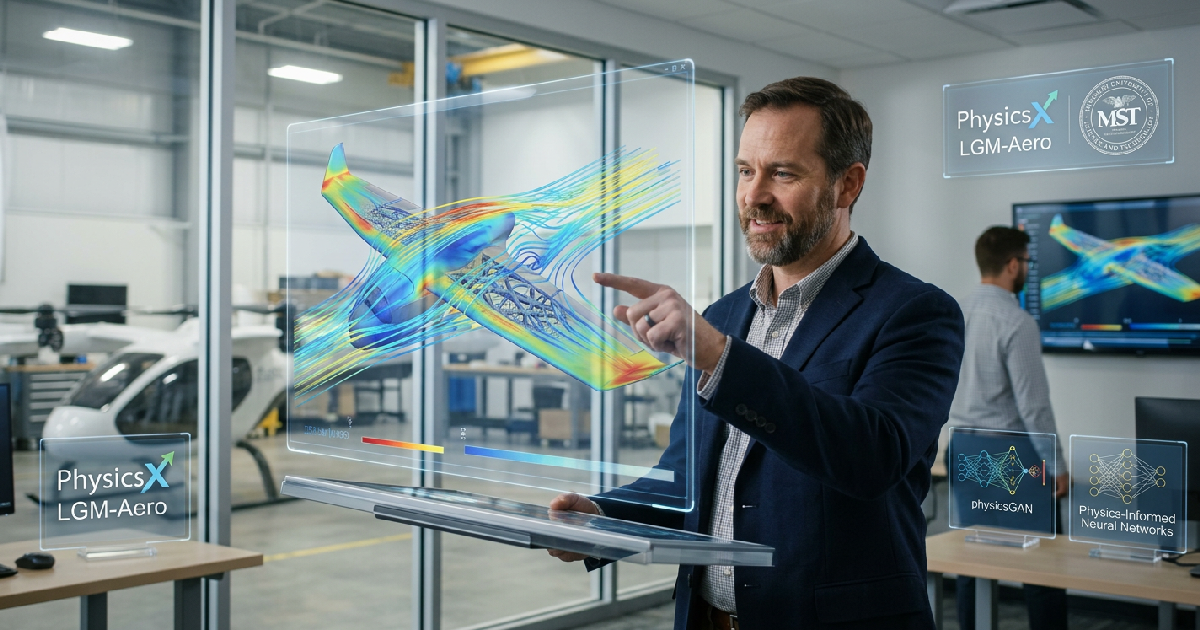
Aerospace engineers are moving beyond traditional statistical machine learning, adopting Physical AI to address the structural and aerodynamic complexities of electric Vertical Takeoff and Landing (eVTOL) aircraft. In a shift toward physics-constrained modeling, the London-based startup PhysicsX launched its Large Geometry Model (LGM-Aero) on 8 January 2025, offering simulation speed-ups of up to a million times compared to traditional numerical methods.
This technology embeds the fundamental laws of thermodynamics and fluid dynamics directly into neural networks, ensuring that generated designs are physically viable from the outset.
The aerospace sector is under constant pressure to maximise structural efficiency to compensate for the weight of current battery technology. Traditional tools like Computational Fluid Dynamics (CFD) provide high accuracy but create bottlenecks, with complex rotor simulations often taking days on supercomputing clusters. By constraining models with partial differential equation (PDE) residuals, engineers can achieve rapid approximations of aerodynamic behaviour.
com/crainsten-partners-aircraft-sale-warning-caveat-emptor/”>Joby Aviation, which uses physics-constrained generative AI to explore multi-objective design spaces that simultaneously account for structural rigidity, thermal dissipation, and manufacturing limits.
Standard generative AI often produces airframe components that appear sleek but fail under real-world aerodynamic loads due to a lack of conceptual awareness regarding shear forces or fatigue. Physics-constrained models eliminate this risk by strictly bounding the AI within the conservation of mass, momentum, and energy. This transition provides a technical foundation for AI systems designed for complex engineering environments where accuracy is non-negotiable.
PhysicsGAN and takeoff trajectory optimization
The dynamic transition from vertical hover to fixed-wing flight presents a high-stakes engineering challenge. Researchers Samuel Sisk and Xiaosong Du at the Missouri University of Science and Technology first detailed a Physics-Constrained Generative Adversarial Network (physicsGAN) for rapid takeoff trajectory design on 7 January 2025. They followed this with an extended work published on 1 January 2026, which integrated more constraints and investigated dimensionality reduction for feasible space exploration.
Tested on the Airbus A3 Vahana eVTOL model, the physicsGAN framework achieved 99.6% accuracy compared to simulation-based optimal designs while reducing computational time by approximately 200 times. The system generated feasible control profiles for power and wing angles in just 2.2 seconds. Furthermore, the researchers reduced the input dimension from 41 variables down to just three, maintaining over 95% accuracy on total takeoff duration.
Machine learning for safety-critical systems
Recent data from early 2026 underscores the reliability of Physics-Informed Neural Networks (PINNs) in Urban Air Mobility (UAM). A study published on 26 March 2026 suggests that PINN frameworks outperform conventional neural networks in trajectory prediction using NASA’s UAM simulation dataset. com/ijeoma-eti-ai-infrastructure-trust-security-compliance/”>infrastructure trust and security concerns essential for aviation certification.
This efficiency extends to the lithium-ion battery packs powering electric flight. Research published on 9 February 2026 found that physics-informed voltage prediction models achieve comparable accuracy to data-heavy models while using up to 75% fewer trainable parameters. A minimal single-layer PINN reduced peak transient errors by roughly 50%, achieving a root mean square error (RMSE) of 20.1 mV. This allows for precise monitoring of energy reserves without requiring excessive onboard processing power.
Digital twins and predictive health monitoring
The integration of Physical AI is also changing how aircraft are maintained through the use of real-time digital twins. Unlike retrospective data dashboards, these models use reduced-order physics-informed models to estimate structural and aerodynamic behaviour alongside live operational data. This allows operators to move away from conservative, generalized maintenance schedules toward predictive health monitoring.
If an aircraft encounters unexpected wind shear or microbursts, the onboard Physical AI can estimate structural loading and accumulated fatigue exposure in real-time. This approach maximizes fleet availability and safety without requiring vehicles to be over-engineered and structurally overweight. By assessing remaining fatigue life based on the exact physics of the stress encountered, engineers can maintain safety margins while trimming every unnecessary microgram of weight.
The drive for weight reduction has pushed innovators like Archer Aviation and Joby Aviation toward AI-driven topology optimization. Generative models can produce organic, lattice-like structures where structural load paths also serve as integrated cooling pathways for power electronics. These biomimetic geometries often achieve weight reductions of 30% to 50% compared to conventionally machined components. As these complex parts are nearly impossible to produce through manual milling, manufacturers are increasingly closing the design loop with physics-based additive manufacturing.
