


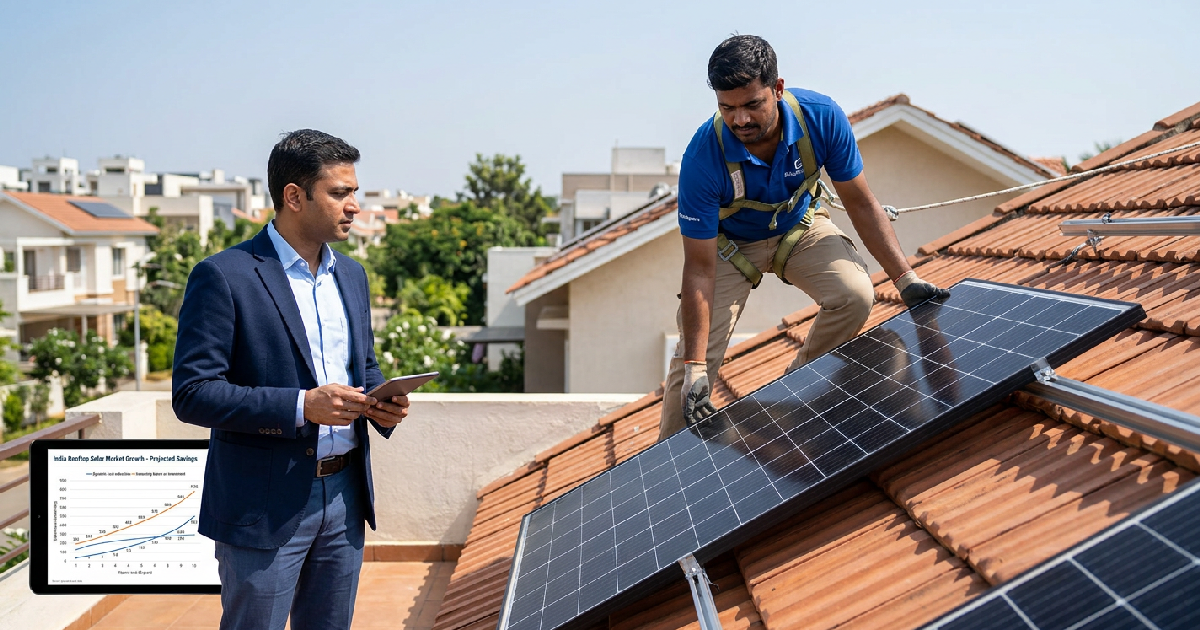
SolarSquare Energy Pvt Ltd is reportedly in advanced discussions to secure between $55 million and $60 million in a Series C funding round as investment appetite for India’s residential solar sector intensifies. B Capital and Lightspeed Venture Partners are expected to co-lead the deal, which could value the Mumbai-based startup at approximately $450 million to $500 million, according to reports from TechCrunch. Existing investor Elevation Capital is also slated to participate in the financing, which is anticipated to close as early as June 2026.
\n\n
The deal represents a significant jump in valuation for the company, more than doubling its $200 million post-money valuation from December 2024. This rapid appreciation reflects a broader shift in the market where venture capital is moving beyond utility-scale projects to target the fragmented rooftop segment. By positioning itself as a “full-stack” platform, SolarSquare handles everything from design and installation to long-term maintenance, a model that has helped it navigate the complexities of individual household and housing society requirements.
\n\n
India is currently the world’s third-largest solar power producer, a position bolstered by aggressive national targets of 500 gigawatts of renewable capacity by 2030. For industrial and infrastructure professionals, the rise of companies like SolarSquare indicates a maturing of the supply chain. While the market has long been dominated by small, local installers, the entry of major growth funds suggests that the infrastructure required to scale residential solar has finally reached a point of bankability.
com/african-iot-sector-growth-industrial-impact/”>industrial connectivity through improved asset management technology and remote diagnostics.
\n\n
Consolidating a fragmented residential solar market
\n\n
Since its founding in 2015 by Shreya Mishra, Neeraj Subhash Jain, and Nikhil Satejlal Nahar, SolarSquare has shifted its focus from B2B industrial projects to the higher-margin residential sector. This strategic pivot appears to be paying off, as the company has now powered nearly 50,000 homes and 400 housing societies. By focusing on urban apartment complexes and gated communities, the firm addresses a specific engineering challenge: providing reliable, interconnected energy solutions in densely populated environments.
\n\n
The company has already installed over 150 megawatts (MW) of solar capacity across 29 cities in nine Indian states. This operational footprint puts it in direct competition with heritage brands and component manufacturers like Tata Power and Waaree Energies. However, SolarSquare’s advantage lies in its service-first approach, treating solar not just as a hardware purchase but as an ongoing energy management service. This distinction is critical as India aims to increase its installed solar capacity, which has grown from 3 GW in 2014 to over 150 GW in 2026.
\n\n
Financially, the startup is hitting significant milestones, reportedly crossing an annualized revenue run rate of $104 million (₹10 billion). This scale is vital for a sector that relies on high-volume installations to offset the logistical costs of operating across diverse geographies. The company aims to expand its residential portfolio to 200 MW within the current calendar year, a goal that requires both capital and a sophisticated logistics network.
\n\n
Strategic shift from industrial to residential rooftop projects
\n\n
SolarSquare’s decision to scale back on lower-margin industrial projects highlights a trend where specialized service providers are finding better returns in the consumer and housing society space. While industrial projects offer large-scale capacity, the residential market—though fragmented—offers better margins and a more stable long-term revenue stream through maintenance and financing. This shift mirrors developments in other emerging markets where energy infrastructure reliability is becoming a priority for urban residents.
\n\n
Large enterprises have also utilized SolarSquare’s services, including delivery giants Swiggy and Zepto. These partnerships demonstrate that even corporate entities are looking for efficient rooftop solutions to power their local hubs and warehouses. The mix of residential and lightweight commercial projects allows for a diversified risk profile, making the company an attractive target for growth funds like Lightspeed, which is reportedly investing through its growth fund for this Series C iteration.
\n\n
As the company prepares for its next phase, the focus will likely turn toward enhancing its technical stack. SolarSquare plans to invest in asset management technology for remote monitoring. For the operations professional, this move toward data-driven maintenance is essential. It ensures that the thousands of decentralized solar arrays provide consistent power output, reducing the reliance on India’s often-congested national grid.
\n\n
Future outlook for Indias decentralized energy sector
\n\n
The success of this funding round would set a new benchmark for climate-tech investment in the region. If the deal closes at the projected $60 million, it will provide SolarSquare with the liquidity needed to expand into new cities and potentially explore horizontal integration in energy storage or electric vehicle charging. The momentum in India provides a clear parallel to other regions where industrial and engineering stocks are finding new life through green energy transitions.
\n\n
While the terms of the deal could still change, the involvement of B Capital and Lightspeed signals a high degree of confidence in the scalability of rooftop solar. As government incentives and subsidy schemes continue to make solar more affordable for the average Indian household, the primary bottleneck will be installation capacity and service reliability. SolarSquare’s growth suggests that the “full-stack” model—controlling the process from the warehouse to the roof—is the most effective way to address these hurdles at scale.
