


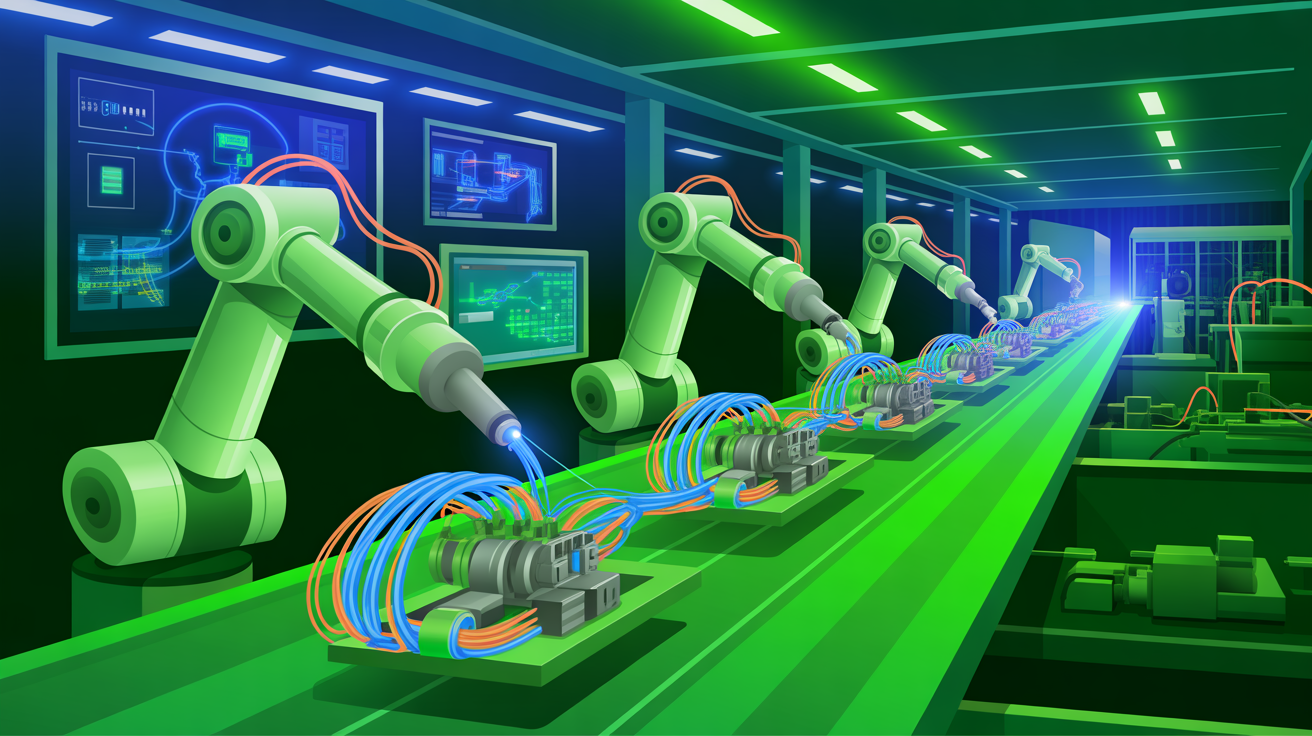
Senra Systems, a Cypress, California-based firm, has secured $65 million in Series B funding to significantly expand its aerospace manufacturing capacity. Announced on Wednesday, 15 July 2026, this investment will establish a third factory.
It directly addresses the escalating demand for critical wire harnesses within the aerospace and defence industries.
This latest capital injection brings the company’s total funding to over $112 million. The move underpins its software-driven platform for wire harness production, a sector vital for modern flight and defence systems.
The substantial funding round was co-led by Lowercarbon Capital and Interlagos, signalling investor confidence in Senra’s approach to a critical, often-overlooked manufacturing sector. Chief Executive Officer and co-founder Jordan Black, a former SpaceX engineer, calls wire harnesses a major bottleneck in aerospace and defence production.
These components are integral to advanced aircraft, satellites, and defence systems.
Senra Systems secures $65 million for manufacturing expansion
This $65 million Series B funding will underpin Senra Systems’ growth plans, prominently featuring the construction of a third manufacturing facility. This expansion is crucial as the company strives to keep pace with the “skyrocketing demand” for wire harnesses, as noted by CEO Jordan Black.
Prominent investors participated in the round. These include General Catalyst, Sequoia Capital, Andreessen Horowitz, Founders Fund, 8VC, CIV, Dylan Field, The Friedkin Group, Jaws Estates Capital, Sozo Ventures, and Alumni Ventures. Their collective backing underscores a belief in Senra’s model and its potential to alleviate critical supply chain pressures.
Software platform modernises wire harness production
Senra Systems manufactures complex wire harness systems, often called the ‘nervous system’ of aerospace and defence platforms. These systems distribute power, communications, and data. The company’s proprietary software platform, Amp, orchestrates its manufacturing operations.
Amp integrates engineering, quoting, supply chain management, production planning, and manufacturing workflows into a unified digital system. This intelligent integration drastically reduces manual processes. It also streamlines onboarding for new personnel and ensures greater consistency in manufacturing outcomes, moving beyond traditional reliance on PDFs and spreadsheets.
Scaling output fivefold for critical aerospace components
Earlier this year, Senra had already demonstrated its scaling capabilities. It opened a second manufacturing facility in Cypress, California, an 80,000-square-foot site. This dramatically increased its production footprint by five times.
The impact of this expansion is considerable. The company is now set to boost its monthly production capacity from approximately 1,000 wire harnesses to a projected 10,000 units by 2027. This tenfold increase reflects the urgent industry need for such components.
Tackling workforce and defence supply chain challenges
The surging demand for wire harnesses comes as aerospace and defence industries grapple with persistent workforce shortages and manufacturing constraints. Senra’s model directly confronts these issues. It marries software automation with structured workforce training programmes.
The firm believes its integrated manufacturing solution offers a blueprint for supporting not only aerospace and defence but also the energy and computing sectors. Caie Kelley, General Partner at Lowercarbon Capital, said wire harnesses form the foundation of virtually every advanced electronic platform. This makes manufacturing automation essential for expanding industrial capacity.
Accelerating skilled workforce development
Mastering wire harness assembly has traditionally demanded years of hands-on experience. Senra’s approach, however, aims to compress this timeline significantly. By pairing software-enabled workflows with structured training, the company states technicians can achieve proficiency in weeks rather than years.
This strategy not only helps to mitigate the broader industry’s labour challenges but also contributes to building a more resilient and adaptable domestic manufacturing base. It’s a pragmatic response to the shortage of highly specialised skills. Engineering initiatives like these are key to broader industrial self-sufficiency.
Former SpaceX CIO joins leadership team
To further solidify its growth trajectory, Senra Systems has strengthened its executive team. They appointed Ken Venner as Chief Technology and Product Officer. Venner brings a wealth of experience, having previously served as Chief Information Officer at SpaceX.
During his tenure at SpaceX, Venner was instrumental in overseeing enterprise systems and manufacturing infrastructure development. He led the technology that supported production operations and launch infrastructure across multiple advanced aerospace programmes. At Senra, Venner will now steer the company’s manufacturing platform, operational systems, and long-term technology roadmap, leveraging his deep understanding of high-stakes industrial environments.
This leadership addition underscores Senra’s commitment to refining its technological edge and operational excellence. Venner’s expertise will be crucial as the company navigates its next phase of rapid expansion. It ensures its software and automation strategies remain aligned with the evolving demands of critical industries.
Wider industrial impact for global supply chains
Senra Systems’ success in securing substantial investment and scaling its operations carries significant implications. Its focus on digital transformation within a historically manual manufacturing process offers a compelling model for other industrial sectors facing similar challenges.
The emphasis on strengthening domestic production capacity for crucial components like wire harnesses speaks directly to ongoing global efforts to enhance supply chain resilience. This becomes particularly vital in defence and aerospace, where geopolitical factors can heavily influence procurement and security of supply.
For regions like Africa, which are actively pursuing industrialisation and infrastructure development, the lessons from Senra’s approach are pertinent. While not directly operating on the continent, the principle of using integrated software platforms to streamline complex manufacturing, reduce training times, and scale production could inform strategies for building local industrial capabilities.
Ensuring reliable supply chains for advanced components is as critical for emerging industrial powers as it is for established ones.
com/ngx-market-capitalization-increase-industrial-engineering-rally/”>Industrial and engineering stocks often rally behind such transformative ventures, indicating market confidence in these modernised approaches.
